


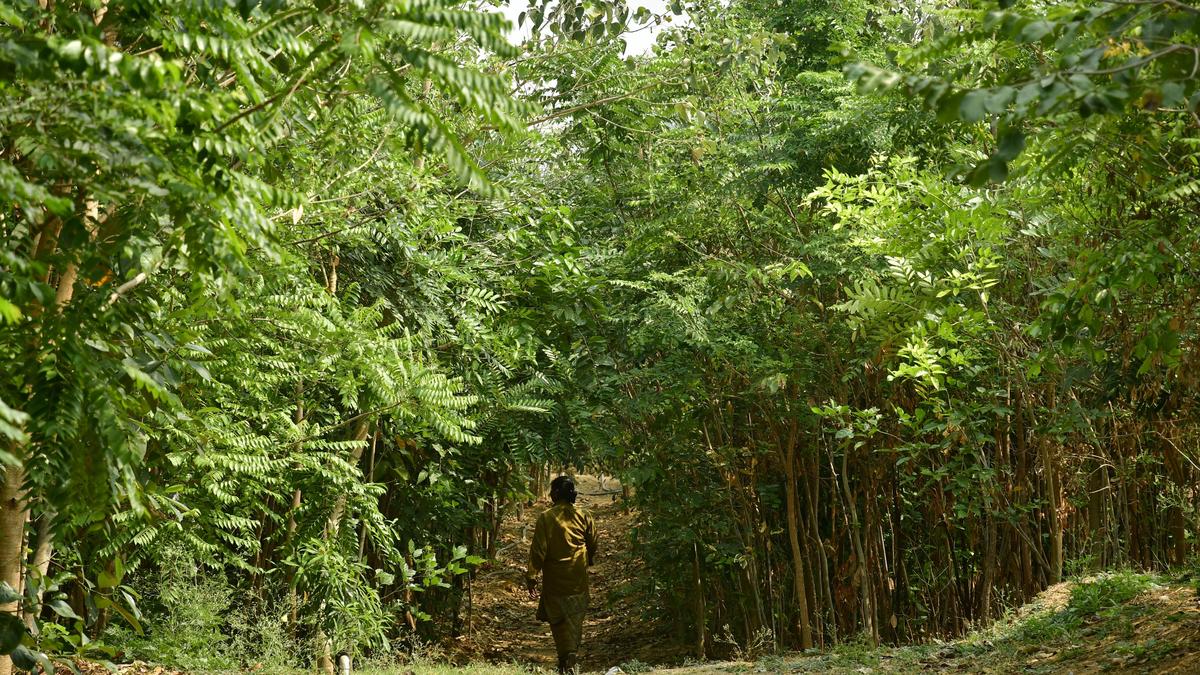
On the environmental front, MCC plans to develop three Miyawaki forests (the Japanese-inspired technique of planting native-species densely).
| Photo Credit: File photo
The Mysuru City Corporation (MCC) has unveiled an array of development and infrastructure projects in its 2026-27 budget, but questions remain over its ability to execute them, given its past struggles in realising proposals into action.
Presenting the budget on Wednesday, Regional Commissioner and MCC administrator Nitesh Patil announced ₹5 crore for a new stadium at Kumbarkoppal in Chamaraja constituency and ₹3 crore for the restoration of the century-old Town Hall. The civic body has also proposed swimming pools in Krishnaraja, Chamaraja and Narasimharaja constituencies under public-private partnership (PPP) or hybrid models.
To improve construction standards, MCC has earmarked ₹1 crore to establish a dedicated quality control sub-division and laboratory to monitor roads, buildings and other civil works. Another ₹10 crore has been allocated to develop pedestrian-friendly footpaths, despite persistent encroachment issues across the city.
The budget emphasises strengthening civic infrastructure, with ₹11 crore set aside for Kannada Bhavan and indoor stadium works at Puttaraja Gawai Stadium, and ₹50 crore reserved for development works across three Assembly segments.
A major share of the spending is directed towards core infrastructure, with ₹30 crore each earmarked for road and drainage works, and for water distribution and underground drainage (UGD) systems. However, MCC has not detailed the specific projects under these allocations.
In line with digital transformation goals, ₹5 crore has been proposed to digitise over 12.87 lakh pages of records and implement systematised indexing to improve governance.
On the environmental front, MCC plans to develop three Miyawaki forests within existing parks under CSR support and introduce a ‘Green Property’ tag to encourage eco-friendly practices such as rainwater harvesting and solar energy use among residents. A ‘Waste to Wonder Park’ is also proposed to convert scrap into art and functional installations, besides serving as an awareness hub.
As part of its clean city initiatives, MCC has proposed launching a ‘Clean City App’ — similar to Bengaluru and other city corporations in the State — a 24-hour complaint redressal system and a dedicated mechanism to keep the Central Business District (CBD) clean. Additionally, GPS tracking will be introduced for 579 vehicles involved in solid waste transportation.
In a major green initiative, MCC will partner with Bharat Petroleum Corporation Limited (BPCL) to set up a 150-tonne-per-day compressed biogas (CBG) unit under a PPP model, converting wet waste into fuel. The corporation has proposed ‘LIDAR’ and drone-based 3D mapping surveys of buildings, roads and other properties, aimed at improving property mapping, traffic management, and identifying flood-prone areas as part of its efforts to improve urban planning.
Published – March 25, 2026 06:47 pm IST



