


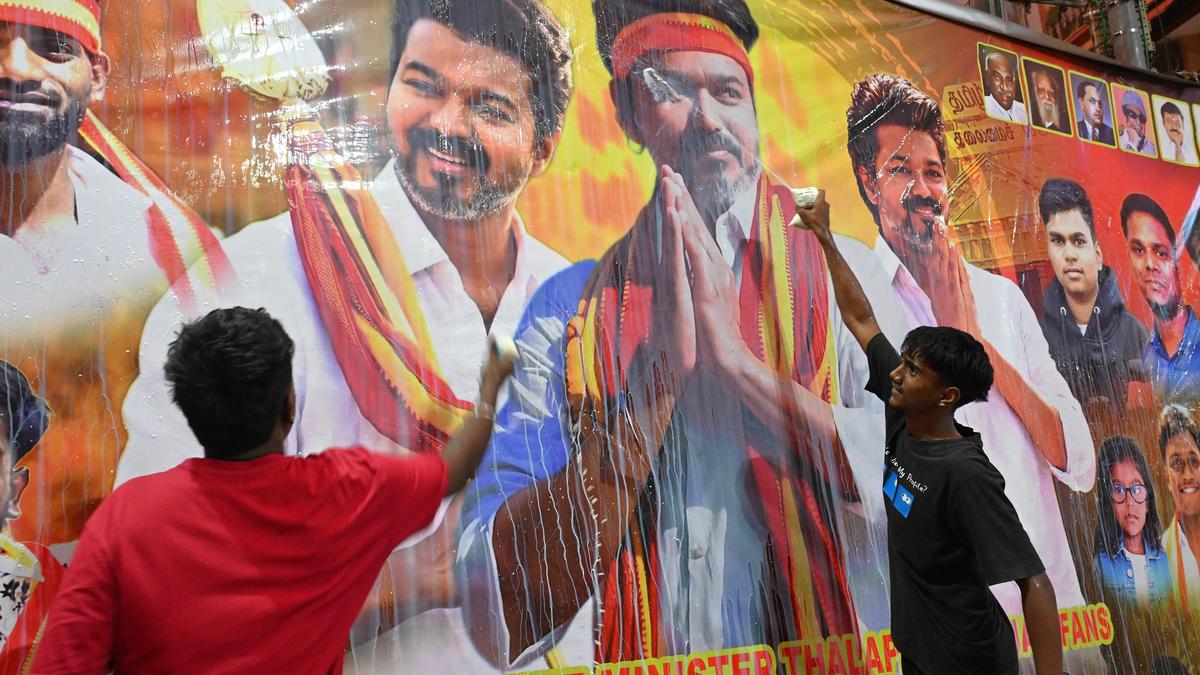
‘Throughout the election season, a large chunk of TVK followers were repeatedly criticised as “tharkuri,” meaning ‘imbecile’, for their alleged lack of political insight or their inability to articulate why they wanted to vote for Vijay.’
| Photo Credit: The Hindu
Throughout the recent election season in Tamil Nadu, there was an unmissable air of restlessness and frenzy among youth voters. Most youth — the largest share of the vote bank that led to actor-turned-politician Joseph Vijay’s Tamilaga Vettri Kazhagam (TVK) winning over 100 seats — seem to have looked at the elections as one that would lead to “a change.”
Tamil Nadu, of course, has seen its share of youth revolution in politics. The very Dravidian government that Mr. Vijay defeated was built by a student political movement more than six decades ago. But unlike the 1960s, this new “change” wasn’t built up through protests against an oppressive force; it largely transpired on social media, in the minds of youth, amid a pandemic of political indifference.
A narrative of change
During the election campaign, two statements largely captured the opposing viewpoints netizens had about Mr. Vijay’s TVK; one was that “Vijay doesn’t understand that politics isn’t cinema” and two, “we need Vijay because we need a change.” There’s more to these statements than what meets the eye. The question is not whether politics is cinema but about how politics needs to become cinema, which Mr. Vijay understands. And change? The youth don’t necessarily crave for a change — what they crave for is a narrative; some purpose that empowers them with direction.
Sociologically speaking, life in 2026 cannot get any more routine for a youth of the State. They work a nine-to-five job, and endlessly scroll through various social media platforms. Beyond personal goals, life hardly allows one a purpose, let alone a larger-than-life vision for a revolution. But cinema does. Cinema offers an augmented reality where purpose is celebrated. This is why we live in a time when escapist cinema is so frenzied, and political news consumption has declined.
Throughout the election season, a large chunk of TVK followers were repeatedly criticised as “tharkuri,” meaning ‘imbecile’, for their alleged lack of political insight or their inability to articulate why they wanted to vote for Mr. Vijay. “Anna [older brother] will do us good,” they said. How or from what? They never bothered, as was evident from the many videos that went viral. However, it would be unfair to blame these youths, as what we are seeing is political indifference and political illiteracy that came from the State’s inability to educate the youth in their language. Depoliticised campuses have long been the cause of this aversion to politics.
This lack of purpose is why propaganda on social media and movies work — audiences need to feel a win, and cinema offers a narrative. And a narrative is what the politician in Mr. Vijay — a face they have seen so often serving them with a purpose — offered them when he took to the stage and tagged the government of the Dravida Munnetra Kazhagam (DMK) as “theeya sakthi” (evil force). The narrative was clear. Mr. Vijay had to win, and it didn’t matter why the DMK had to lose.
Need for dramatic change
This need for a purpose through a narrative has now reshaped politics as we know it. Mr. Vijay, to his credit, seems to have learnt this from his decades in the film industry — for an actor to win, politics must become his playground; politics must become cinema. Which is why Mr. Vijay’s election campaign, which ranged from urging children to ask their parents to vote for the TVK to repeatedly symbolising the DMK as a villain, seemed straight out of the climax of a summer blockbuster. If anything, the DMK did not lose to an actor who sold dreams, but to a strategist who offered the satisfaction of a social media campaign win. This is also why Mr. Vijay’s victory feels so personal to most of his voters. What they have done is essentially beat the force that was unofficially declared unbeatable.
For the interest of these youth ‘audiences’ in politics to sustain, politics needs to become more. They need to see variety in politics, and stability can seem boring. Development shouldn’t just improve upon something; it should demolish something pre-existing, for the lack of dramatic flair would simply be akin to death.
There must be development, but through a steady supply of ‘something different’. Because “we need a change.” In fact, if anything, this statement from supporters of the TVK says enough about the crisis of ‘purposelessness’. For example, many TVK supporters wished for a government change due to the many crimes against women in the last five years. This is one definition of ‘change’ they have attested to. Now, all one must do to check if this was a genuine concern is to see if similar social media campaigns hold the TVK accountable should there be crimes against women during their reign. If not, perhaps, like most election manifestos these days, ‘change’ is just a pre-election commodity. Crimes against women do not need a mere change in government — it needs a government that acknowledges the deep-seated patriarchy in society and takes steps towards abolishing the socio-political factors that lead to sexual assaults. Until then, a change in this regard wouldn’t be concrete.
How Mr. Vijay and the TVK define this victory and govern in the years to come remains to be seen. For the social media warriors who voted for them, this victory is a respite under the punishing sun. Who cares if there’s a happily ever after? We don’t bother about what happens to the hero after the climax.
Published – May 14, 2026 01:23 am IST



