


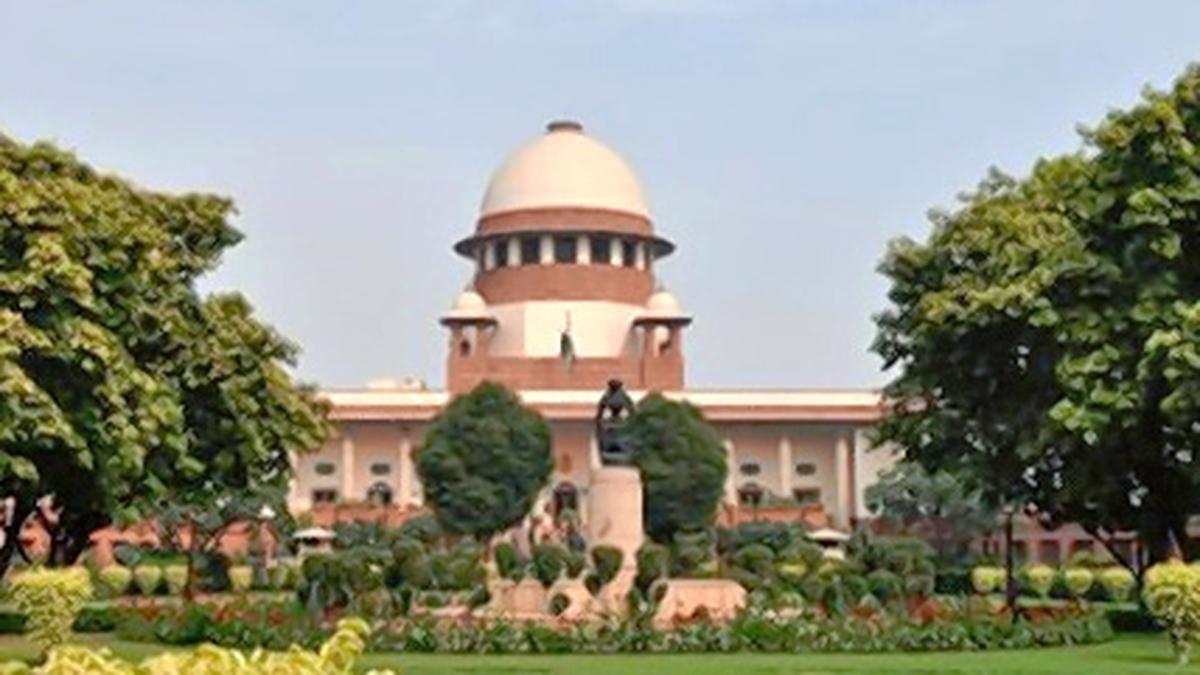
A view of the Supreme Court of India in New Delhi.
| Photo Credit: Sushil Kumar Verma
Petitioners criticise that the University Grants Commission (Promotion of Equity in Higher Education Institutions) Regulations, 2026 is based on an “unfounded presumption” that caste discrimination is “uni-directional”.
They argue that the 2026 Regulations wrongly imagine that only members of Scheduled Caste (SC), Scheduled Tribe (ST) and Other Backward Classes (OBC) are affected by caste bigotry.
The stimulus behind the 2026 Regulations was a petition filed jointly by the mothers of Rohith Vemula and Payal Tadvi in the Supreme Court against “rampant” caste discrimination in higher education institutions. Vemula, a PhD scholar at Hyderabad Central University, and Tadvi, a tribal student of the TN Topiwala National Medical College, died by suicide in January 2016 and May 2019, respectively, after being subject to caste biases on campus.
Senior advocate Indira Jaising and advocate Prasanna S., the lawyers for the two women, had submitted that 115 students took their own lives between 2004-2024, many of them belonging to the Dalit communities.

A UGC affidavit filed in October 2023 in the case revealed that caste discrimination against Dalit students was not just an “unfounded presumption”, but a reality. A June 26, 2019 letter placed on record by the UGC in court had specifically declared that “officials and faculty members should desist from any act of discrimination against SC/ST students on grounds of their social origin”.
The oral arguments raised in the apex court, which led to the stay of the 2026 Regulations on January 29, did not cover situations in which Dalit students face discrimination, non-cooperation or ostracisation from people who have overwhelming authority over them — faculty and college administration — within the four walls of the campus. Lawyers for the petitioners only delved on upper caste freshers being “ragged” by Scheduled Caste college seniors.
The scenario of institutional discrimination faced by SC/ST students is best illustrated in the 2007 Thorat Committee report on caste prejudice at the All India Institute of Medical Sciences (AIIMS), Delhi: “A very large majority of SC/ST students reported biases and unfairness in the evaluation of theory paper, practical. A large portion of them attribute this to their caste background. It may be mentioned that internal evaluation constitutes half of the marks. The internal evaluation gives enough power to the faculty members to intimidate the students. A majority of the SC/ST students reported that discrimination takes the form of avoidance, non-cooperation and discouragement.”

The petitioners have accused the 2026 Regulations of championing reverse discrimination. They argued that the definition of ‘caste-based discrimination’ in clause 3(c) of the Regulations was “restrictive and exclusionary”, leaving upper caste or general category individuals completely remediless under the statutory framework, even if they were subjected to caste-based discrimination or institutional bias within higher education institutions. They have argued that SC/ST/OBC students could use the Regulations to register false complaints. The court prima facie seemed to have accepted the arguments, noting that the “possibility of misuse of the Regulations cannot be ruled out”.
The court has framed questions, including whether the definition of caste-based discrimination in Clause 3(c) bore a reasonable and rational nexus to the Regulations’ objective to promote “full equity and inclusion” in higher education institutions.
However, the 2026 Regulations draw their strength from Article 15 (non-discrimination) of the Constitution. The inclusion of the provision is testimony to the historical oppression faced by marginalised communities for centuries. Article 15(1) imposes an enforceable obligation on the State to not discriminate against citizens on any of several grounds, including caste. Article 15(2) was adopted to specifically prohibit the discrimination faced by marginalised communities in accessing public services and resources.

In its judgment in the Sukanya Shantha case, the apex court, while dealing with caste discrimination within prisons, upheld the principle of substantive equality, that is, the law must endeavour to correct historical injustices. The court had pointed out how the Constitution itself was the greatest testament against historical injustices done against the marginalised castes.
The judgment noted that the manifestations of caste were too numerous to exhaustively enumerate. They manifested in various forms and across different sectors of society, from education and employment to social interactions and access to resources.
The court had pointed out that the commitment to move towards an egalitarian social order was not limited to preventing discriminatory actions by the state alone.
“It extends to the actions of citizens and private entities as well. It empowers the state to enact appropriate legislation or take executive measures to tackle caste-based discrimination. At the same time, it mandates the decision-makers to take every step to end discrimination in Indian society. The pervasive influence of caste necessitates continuous efforts to ensure equality and justice for all citizens,” the Supreme Court had observed.
Published – January 30, 2026 04:39 pm IST



