


V. Nataraj, a native of Kuppam mandal of Andhra Pradesh’s Chittoor district, is up early due to the constant buzz of an alarm. He peeps outside the window to confirm if it is still dark. The 27-year-old, who works as an electrician at a firm in Bengaluru, hurriedly gets ready and reaches the Chittoor-Bengaluru National Highway to board the first bus at 5 a.m. to Bengaluru, which is at least 120 kms from his village.
There has been a constant whirring and low-to-high metallic thudding sound since Nataraj woke up until the moment he boarded the bus.
The streets of the rural areas in Bangarupalem, Palamaner and Kuppam mandals, located at the tri-State junction of Chittoor district, paint a similar picture, with the granite mining at the centre of the ordeal that residents of the villages have been facing.
Year-round mining activities
The non-stop, year-round mining activity ravages mineral wealth that was undisturbed for centuries. In the early hours, sparks flash and disappear as mechanical drills begin cutting into rock. Dust rises slowly, settling like a thin veil over everything. Workers move along the edges of deep pits and ridges, while their shouts are drowned out by the constant hum of compressors. A huge crane groans as it lifts a massive block of black granite from the earth. Within minutes, the rugged boulder is lowered onto a truck waiting below.
By noon, the truck will be on the highway. In a day or two, the load could reach Chennai or Krishnapatnam Port. Weeks later, it may arrive at a sprawling processing yard in China. By the time it reappears in the global market, it will have been polished and refined into part of a building or monument. Its origins become almost invisible.
So goes the journey of Chittoor granite.
It is also the saga of a region where stone has slowly come to dictate the terms of life. Till five decades ago, life in Chittoor district followed a different rhythm. Agriculture remained its backbone, and the seasons determined its pace. Though stones existed in abundance, they were largely used for tools, homes, and temples. Even during the British Raj, when mining expanded in other parts of the country, this region remained largely untouched.
A paradigm shift dawned in Chittoor in the 1980s, when the demand for polished granite grew in international markets. Chittoor’s mineral wealth and geological diversity became the cynosure of the industry. Beneath its parched fields lay high-quality stone in shades of deep black, muted grey, green, white, galaxy, and richly patterned varieties that appealed to international traders. Small-scale clandestine quarrying after dusk gradually transformed into an open and thriving network of extraction, transport, and export.
Mandals in the erstwhile Chittoor district, including Kuppam, Shantipuram, Palamaner, Bangarupalem, Yadamarri, Gudipala, Gangadhara Nellore, Chittoor, Nagari, Vijayapuram, Piler, Punganur, and Madanapalle, witnessed hectic activity with the arrival of heavy machinery.
Farmlands soon turned into quarry pits, and heavy vehicles began plying rural roads. The nondescript countryside of Chittoor, once on the margins, gradually found its way into global markets.
Today, the granite belt in the region runs along a hazy line between regulation and evasion. While a few licensed quarries operate within defined limits and produce export-grade stone, a couple of hundred quarries, reportedly illegal, operate from Kuppam to Nagari with round-the-clock extraction and transportation activities. At the same time, repeated enforcement drives by the Mines and Geology Department struggle to establish violations, while most cases go under-reported.
‘Tight vigil on illegal mining’
Deputy Director (Mines and Geology) S.K.V. Satyanarayana admits that despite maintaining a hawk eye on illegal mining activities, perpetrators continue clandestine operations in some parts of the region. “During our raids, we seize vehicles, machinery, granite blocks, and tools used in excavation works. Ironically, by the time we reach, no one is present at the sites. Thanks to constant surveillance, we have managed to render many such units inoperative,” he said.
The official added that since the Mines and Geology Department lacks the power to arrest offenders, it must depend on the police to carry out such tasks. Across the vast terrain along the borders of Tamil Nadu and Karnataka, there are barely two or three officials, including the Deputy Director and his driver, to monitor an area that cuts through hills, valleys, and forests.
Cases are booked under the Mines and Minerals (Development and Regulation) Act, 1957, leading to the seizure of granite blocks, machinery, and vehicles, with penalties running into several lakhs of rupees. Though the system appears stringent on paper, in practice, it draws public criticism for being far more flexible.
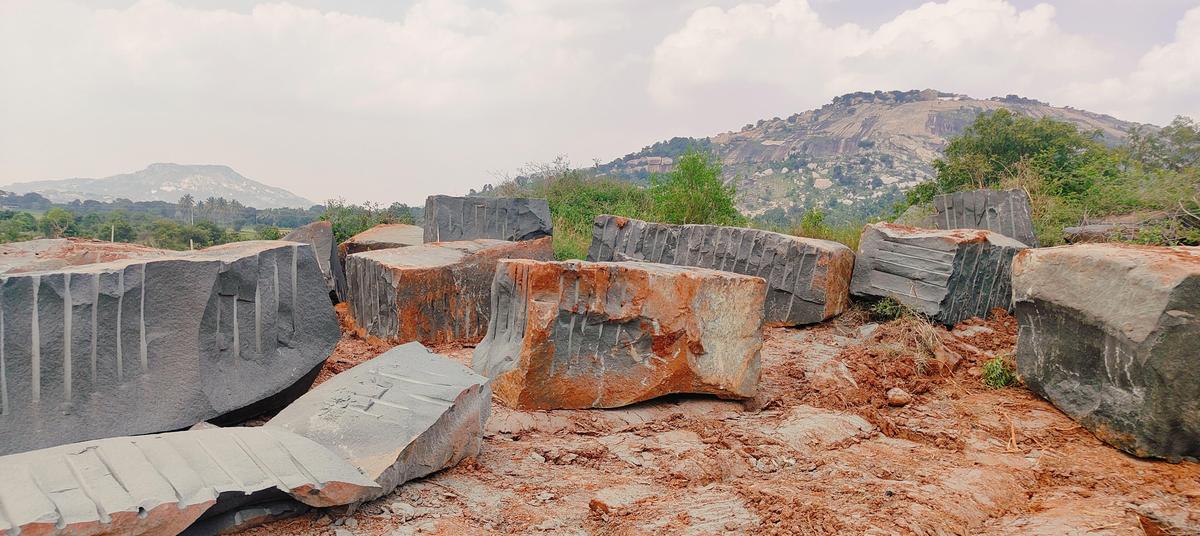
A panoramic view of granite rich hillocks in Bangarupalem mandal of Chittoor district.
| Photo Credit:
K. UMASHANKER
Lapses in mining practices
In the granite heartland of Kuppam, concerns over illegal quarrying have repeatedly come under the scrutiny of the National Green Tribunal, which has flagged serious lapses in mining practices. The issue also attracted political attention when TDP chief N. Chandrababu Naidu personally inspected quarries in and around Kuppam in recent years, both as Opposition Leader and now as Chief Minister. He expressed concern over unchecked mining, pointing to environmental damage and revenue loss, while calling for stricter oversight. In recent weeks, Kuppam Police registered cases after seizing a couple of quarries and machinery.
Granite blocks constantly move out of the district towards Chennai and Krishnapatnam ports. With the rise in illegal mining, several members of the syndicate prefer shifting blocks to Chennai, where polishing and sizing are completed before export. Some importers in countries such as China readily accept raw blocks, as they possess advanced polishing facilities. “Each consignment should carry proper documentation, including transit permits, invoices, and weighbridge slips. But in a majority of cases, these records are duplicated, altered, or manipulated,” a police officer in Chittoor district said.
A transporter near Palamaner, who claims to have spent “30 years in the industry”, was candid: “If your papers are weak, you pay. If your backing is strong, you move. This is no drama; it’s how things work.”
Chittoor Collector Sumit Kumar, responding to the concerns, said illegal mining is not absent. “Within a short span, the granite industry has expanded rapidly. Chittoor is home to some of the finest granite varieties. Despite staff shortages, inspections are continuing. Our priority is to protect government revenue. An action plan will be prepared to streamline the system,” he said.
Ramanujam Chalapathi, a senior Telugu Desam Party leader in Nagari Assembly constituency, fumes that quarrying activities pose a grave threat to the lives and health of over 400 families living on the outskirts of Nagari town across half a dozen localities. “Whenever a blast is triggered in the stone quarry at Kanavapalle village, the deafening sound reverberates across six hamlets. The livelihood of people in this area is at high risk. Most residents complain of serious respiratory problems caused by quarry dust. Medical tests should be conducted on all of them. They appeal to officials to address their plight, but no one responds. It has been continuing for years,” he said.
‘Ravaged by excavation works’
The Nagari Nose, the peak of the Nagari Hills nestled between Tirupati and Tiruttani in Tamil Nadu, is widely acclaimed by nature lovers as a geological wonder. “Now the foothills are being ravaged by excavation works. The Puttur-Chennai National Highway, which once offered a beautiful roadside landscape, is now denuded by blasting activities. The environmental destruction is glaring and an open secret, yet no one stops it,” said Kodandam, a B.Tech student from Puttur.
Villagers in the granite belt of G.D. Nellore and Yadamarri mandals voiced similar concerns, particularly over constant dust settling on crops and increasing respiratory ailments. Quarries operating round-the-clock generate clouds of fine dust.
“As per government rules, the application fee collected for quarry leases should go to local panchayats for developmental activities. In reality, no panchayat in our Assembly constituency has received funds through this route in recent years. There is no difference between illegal and legal mining. It is a huge business. No one is even allowed near the boundaries of quarry sites,” said Girisha, a techie from Yadamarri mandal.
No recognition for labourers
At the centre of all this is a workforce that rarely gets noticed. Quarry sites across Chittoor rely heavily on migrant labour from the north-western districts of Tamil Nadu. They arrive in groups, bringing with them the “rich and extraordinary” expertise needed to cut and handle granite.
“There is absolutely no shortage of labour. At any point in the year, around 3,000 workers are employed across Chittoor. A worker entering a quarry will not return home with less than ₹3,000 a day if he works from dawn to dusk. Work is available round the clock. Whether legal or illegal, we are not bothered. Even if one quarry shuts down, we move to another. Compared to previous years, safety measures have improved, though accidents still occur and many go unrecorded. Compensation is assured in case of casualties,” said Vel Muruga, a senior mason from Vellore.
Altaf Kouser, 47, of Chittoor, who has 25 years of experience in granite mining, said the present system of directly submitting applications for mining leases is a welcome change. “This procedure moves away from tendering, which benefits only the rich and corporates. The application-based approach makes entry into the mining sector affordable even for middle-class families. Though the sector is highly risky, it also offers substantial profits. If you invest ₹5 crore in a year, it could become ₹15 crore,” she said.
Khan Bhai, 65, of Chittoor, a former mining lessee, summed up the evolution of mining in Rayalaseema: “In the 1980s, the application fee was ₹150 per hectare of granite field; now it is ₹1.8 lakh. Those whom I once saw as workers are now self-styled dons, wearing gold and diamond rings on eight fingers, sporting hefty gold chains, travelling in costly SUVs, investing heavily in real estate, and frequently flying abroad. Some are directly involved in politics, while their children are aspiring politicians.”
Losses to the govt.
On losses to the government due to illegal mining, a former revenue official observed: “Even a small discrepancy per truck becomes enormous when multiplied by hundreds of trips a day. You are looking at crores slipping away.”
A police officer in Chittoor, speaking on condition of anonymity, admitted that the perception of low risk also encourages illegal operations. “Those booked in illegal mining cases are rarely arrested. Even if arrested, they secure bail quickly. Legal proceedings stretch for years. Penalties, which are insignificant compared to the wealth amassed, are often realised much later. This delay drastically reduces the impact of enforcement.”
Another officer remarked, “You know why China is the largest importer of granite from this region. The government there acts against illegal mining with the speed of a bullet. Clandestine operations are shut down immediately, assets are seized, and offenders are blacklisted. The guilty can face jail terms of up to seven years and eventually become paupers in society.”
Chittoor’s proximity to Tamil Nadu is an added advantage for the industry. Granite businesses on both sides remain closely linked, sharing labour, transport routes, and markets. Trucks cross State borders with ease.
umashanker.kk@thehindu.co.in



