


When Uma took her autorickshaw out on the streets of Mysuru for the first time, she spent the entire day driving around without approaching a single customer. Too hesitant to call out to passengers and unsure of herself, she returned home that evening with zero earnings. The next day, a customer approached her and she earned ₹60 from her first trip — a start that marked a turning point in her life.
Today, nine months later, the Mysuru native is among several women who have found a source of livelihood through the “Swavalambi Stree Auto-Rickshaw Driving” initiative run by Bengaluru-based NGO Thaliru Foundation. Many of the women associated with the programme are single mothers or survivors of abusive marriages who are using the training to rebuild their lives after years of financial hardship and personal loss.
Riding over misfortunes
Uma turned to autorickshaw driving after losing her husband, a lorry driver, to tuberculosis and alcoholism. She was working as a security guard at a hospital and had applied for insurance benefits when her husband fell ill. However, he passed away before any support could come through, forcing her to borrow money.
Soon, her hardships worsened. Speaking to The Hindu, Uma recalled receiving calls from her daughter’s school informing her that the child had suffered fits. Since hospital rules required employees to surrender their phones during duty hours, she said she only learnt of the incident after returning home. Her 17-year-old daughter was later diagnosed with Acute Disseminated Encephalomyelitis (ADEM), while her 18-year-old son has a speech disorder.
Unable to balance work while also caring for her children, she said she moved back to her mother’s house and began selling clothes and homemade fryums to support the family. She later learnt about Thaliru Foundation through WhatsApp and enrolled in their driving programme.
She said driving an autorickshaw has helped her gradually repay her loans, but what she likes the most is being able to drop her children to school every day and spend more time with them.
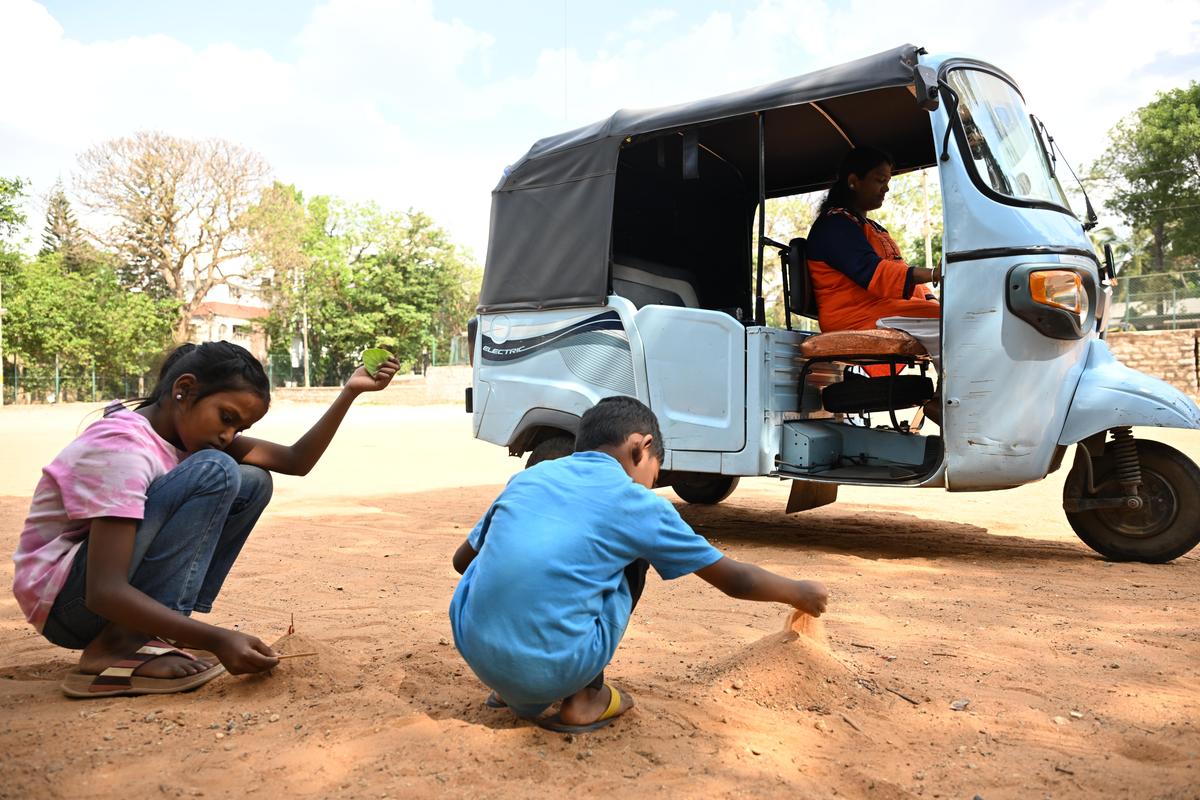
Sandhya decided to take up autorickshaw driving to care for her two children, after she lost her husband to alcoholism and her brother to a bike accident, in a span of 11 days.
| Photo Credit:
ALLEN EGENUSE J
Rebuilding from scratch
For Sandhya, a Bengaluru resident, the decision to take up autorickshaw driving came after two deaths in the family, in a span of 11 days, left her being the sole provider for her children.
Five months after losing her husband and her brother, Sandhya now spends her days learning to drive an autorickshaw, hoping it will help her rebuild life for herself and her two children.
Sandhya’s husband died five months ago due to complications arising from alcoholism. During the final stages of his kidney failure, the family learnt that he was also suffering from diabetes. She said her husband had been a severe alcoholic for the past four years.
With financial support from her brother, she managed the expenses for her husband’s treatment, but he died after 11 days of being admitted to hospital. Before the family could recover from the loss, tragedy struck again. Within 11 days of her husband’s death, her brother, the sole breadwinner of the family, died in a bike accident.
To support the family and her children – a son, who is currently in SSLC, and a daughter in Class 8 — Sandhya initially ran a small toy stall on the footpath at V.V. Puram Food Street and also took up tailoring work. She said she came to know about the NGO through her friends and started learning auto driving as she had been unable bring in sufficient income.
Sandya, who is awaiting her license now, said, “I want to stand on my own feet and take care of my family independently. More women should learn skills that could help them become financially independent.”
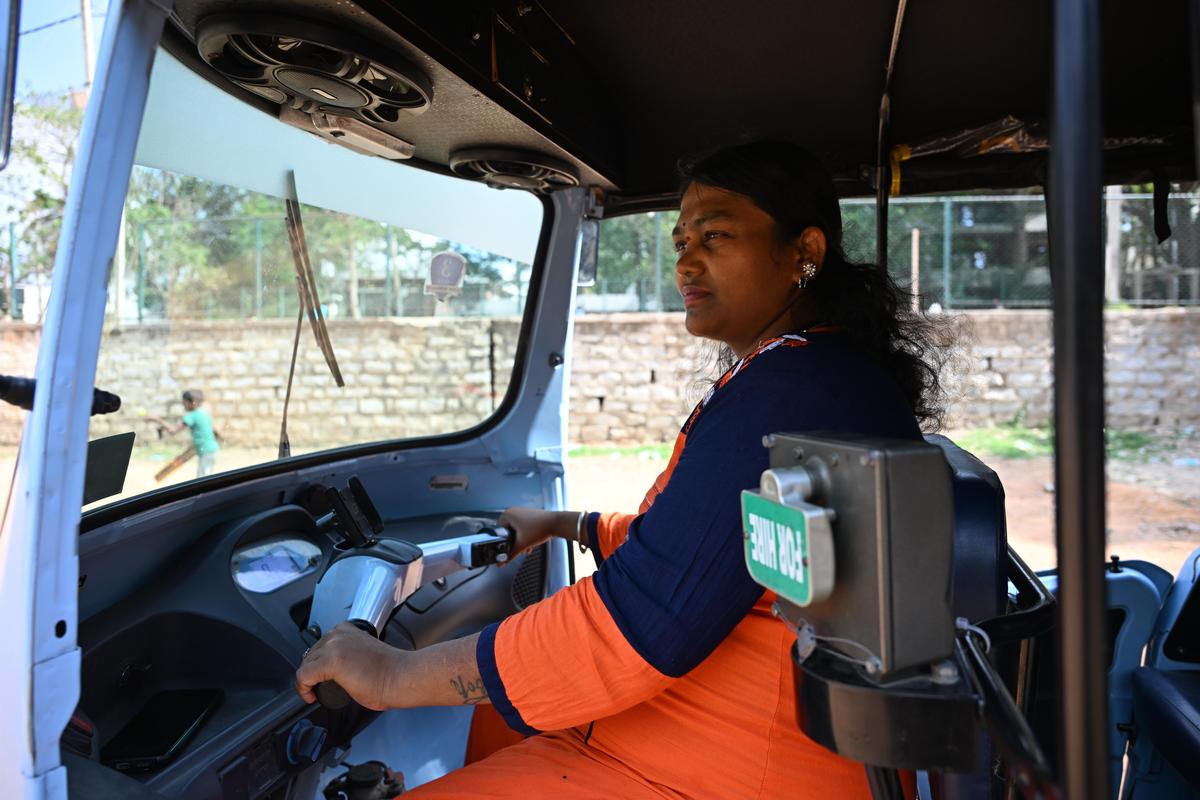
The “Swavalambi Stree Auto-Rickshaw Driving” initiative run by the Bengaluru-based NGO Thaliru Foundation provides free driving training through CSR funding at centres in Jambu Savari Dinne, Hebbal, Rajajinagar, and Jayamahal.
| Photo Credit:
ALLEN EGENUSE J
Eyes on the road ahead
For Nagaratna, the programme became a means to step out of an abusive marriage while raising her two sons.
Speaking to The Hindu, she said her husband used to assault her regularly and rarely allow her to step out of the house. She recalled that he would even check his food fearing she had mixed poison in it.
Once, he stabbed her in the hand with a knife. Even after the attack, she continued to live with him for some time. However, when the violence continued during her second pregnancy, she decided to walk away. Nagaratna has two sons, aged nine and five.
Through the foundation, she underwent driving training and more recently, with assistance from yet another organisation, she was able to buy her own vehicle at a reduced cost.
She said the initial days were difficult as she struggled to identify routes and had to depend on passengers for directions. She added that male autorickshaw drivers in the area guided her during the learning phase. It has now been four months since she began driving independently.
“My children, mother and brother are proud of me,” she said, adding that women should not remain confined to their homes out of fear and should work towards becoming self-reliant.
Sakhi: Bengaluru gets its first women-only auto service
| Video Credit:
The Hindu
Funding remains a challenge
Speaking to The Hindu, Chitra A.R., founder of Thaliru Foundation, said she left her corporate career to start the organisation in 2024. “Around 230 women benefited from the foundation in its first year, and the number has risen to 250 this year. Around 80 women in Mysuru have also undergone training,” she said.
According to her, nearly 70% of the women associated with the foundation are single mothers, while many others are separated from abusive or alcoholic spouses. The programme provides free driving training through CSR funding at centres in Jambu Savari Dinne, Hebbal, Rajajinagar, and Jayamahal. Ms. Chitra said helping women secure finances to purchase autorickshaws remains one of the biggest challenges, as many banks still require male guarantors, forcing some women to take high-EMI loans.
Published – May 09, 2026 05:45 pm IST



