

By using this site, you agree to the Privacy Policy and Terms of Use.
Accept
India Times NowIndia Times NowIndia Times Now
Notification Show More
Font ResizerAa
  • India News
    India News
    Politics is the art of looking for trouble, finding it everywhere, diagnosing it incorrectly and applying the wrong remedies.
    Show More
    Top News
    The States Braces for Protests Over New COVID Rules
    August 29, 2021
    Noida techie death: The road that ended in a tragedy
    January 26, 2026
    Tamil Nadu election: Vijay, TVK cadre booked for conducting roadshow in violation of poll code
    March 31, 2026
    Latest News
    TVK gained people’s trust in a short period of time: J.C.D. Prabhakar
    April 11, 2026
    Home Secretary appoints Durai Kumar as DVAC in-charge following Election Commission reshuffle
    April 11, 2026
    No move yet to reinstate one-way traffic norms on service roads in Kozhikode city
    April 11, 2026
    ‘Filling choice of colleges is crucial while attending TNEA online counselling’
    April 11, 2026
  • Technology
    TechnologyShow More
    Strengthening the Team: Thryve PR Onboards Pranjal Patil as PR Executive & Project Manager
    October 1, 2025
    How to Take the Perfect Instagram Selfie: Dos & Don’ts
    October 1, 2021
    Apple iMac M1 Review: the All-In-One for Almost Everyone
    Hands-On With the iPhone 13, Pro, Max, and Mini
    September 4, 2021
    Apple VS Samsung– Can a Good Smartwatch Save Your Life?
    August 30, 2021
  • Posts
    • Post Layouts
      • Standard 1
      • Standard 2
      • Standard 3
      • Standard 4
      • Standard 5
      • Standard 6
      • Standard 7
      • Standard 8
      • No Featured
    • Gallery Layouts
      • Layout 1
      • Layout 2
      • layout 3
    • Video Layouts
      • Layout 1
      • Layout 2
      • Layout 3
      • Layout 4
    • Audio Layouts
      • Layout 1
      • Layout 2
      • Layout 3
      • Layout 4
    • Post Sidebar
      • Right Sidebar
      • Left Sidebar
      • No Sidebar
    • Review
      • Stars
      • Scores
      • User Rating
    • Content Features
      • Inline Mailchimp
      • Highlight Shares
      • Print Post
      • Inline Related
      • Source/Via Tag
      • Reading Indicator
      • Content Size Resizer
    • Break Page Selection
    • Table of Contents
      • Full Width
      • Left Side
    • Reaction Post
  • Pages
    • Blog Index
    • Contact US
    • Search Page
    • 404 Page
    • Customize Interests
    • My Bookmarks
  • Join Us
Reading: Social ill cannot be branded as ‘religious practice’, says Supreme Court on maiden day of Sabarimala reference hearing
Share
Font ResizerAa
India Times NowIndia Times Now
  • Finance ₹
  • India News
  • The Escapist
  • Entertainment
  • Science
  • Technology
  • Insider
Search
  • Home
    • India Times Now
    • Home 2
    • Home 3
    • Home 4
    • Home 5
  • Categories
    • Technology
    • Entertainment
    • The Escapist
    • Insider
    • Finance ₹
    • India News
    • Science
    • Health
  • Bookmarks
    • Customize Interests
    • My Bookmarks
  • More Foxiz
    • Blog Index
    • Sitemap
Have an existing account? Sign In
Follow US
Home » Blog » Social ill cannot be branded as ‘religious practice’, says Supreme Court on maiden day of Sabarimala reference hearing
India News

Social ill cannot be branded as ‘religious practice’, says Supreme Court on maiden day of Sabarimala reference hearing

Times Desk
Last updated: April 7, 2026 6:07 pm
Times Desk
Published: April 7, 2026
Share
SHARE


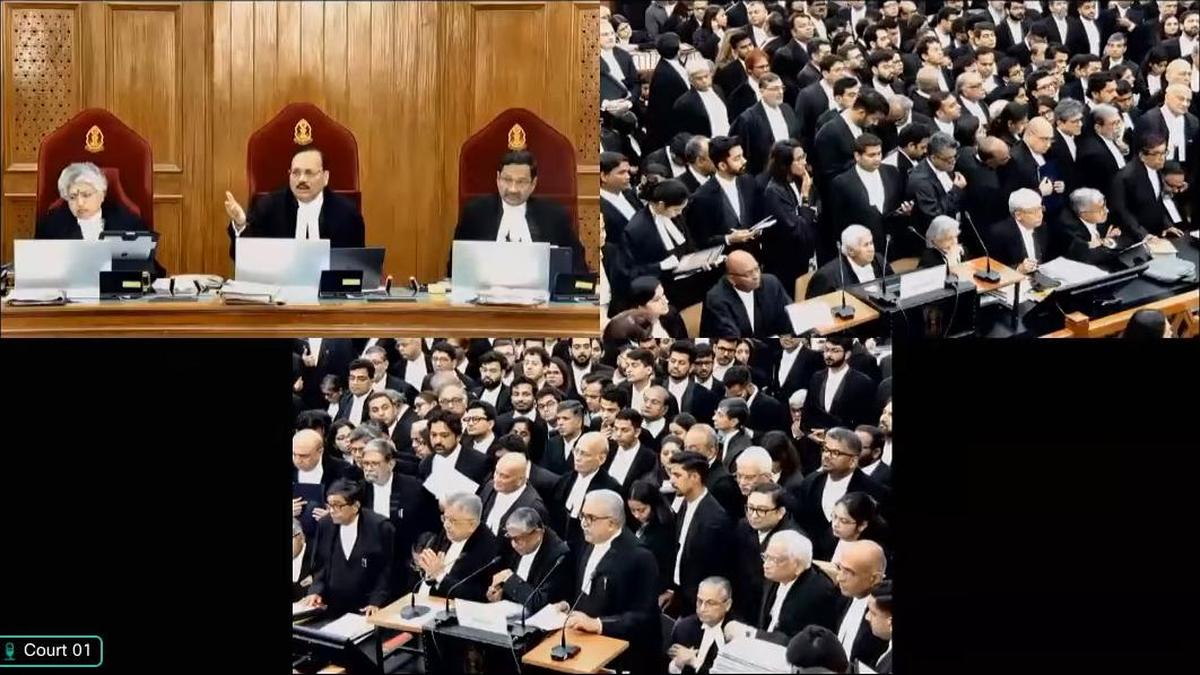
Supreme Court nine-judge Bench hearing led by Chief Justice of India (CJI) Surya Kant underway in the long-pending Sabarimala temple entry judgment review case, along with a batch of connected matters, in New Delhi on Tuesday, April 7, 2026. Photo credit: Supreme Court YT

Supreme Court nine-judge Bench hearing led by Chief Justice of India (CJI) Surya Kant underway in the long-pending Sabarimala temple entry judgment review case, along with a batch of connected matters, in New Delhi on Tuesday, April 7, 2026. Photo credit: Supreme Court YT

Justice B.V. Nagarathna, the sole woman judge in the Supreme Court and part of the nine-member Bench hearing a reference spurred by a 2018 judgment upholding the right of women of menstruating age to worship at the Sabarimala shrine in Kerala, said on Tuesday (April 7, 2026) that social ills cannot be branded and passed off as ‘essential religious practices’.

The Centre, which holds the position that the Sabarimala judgment was an intrusion into free exercise of religious freedoms and denominational rights, said the legislature, not courts, drives reform in religion, if need be.

“If social evils are given a religious colour, then the courts can intervene to distinguish [between] the two,” Justice Nagarathna said.

Solicitor General Tushar Mehta, who opened the arguments before the nine-member Bench headed by Chief Justice of India Surya Kant, said the Preamble to the Constitution champions liberty of thought, expression, belief, faith, and worship.

“How can the courts then examine the essentiality of religious practices of a denomination which does not otherwise offend public order, morality and health?” Mr. Mehta asked.

The exchange marked the first day of hearing of a reference to evolve a ‘judicial policy’ for constitutional courts while dealing with questions of right to religious freedom enshrined in Article 25 and a denomination’s privilege to manage its own religious affairs under Article 26 of the Constitution.

The focal point of the reference is how far the courts can use their plenary powers to judicially review religious practices considered “essential or core” in the name of ushering in social reform.

“The reasons for empowering legislature to introduce social welfare and reform are obvious — If a religion or religious practice requires any social welfare measure or even reform, it must emanate from within the religion or from within the society and cannot be imposed by a judicial dictum,” Mr. Mehta submitted.

He said the apex court’s decision in the current reference would influence the trajectory of the nation for decades to come.

The Union government argued whether the judges had the expertise to decide if a ritual or a manner of devotion was merely superstition or an essential religious practice.

“The courts would first have to decide if it is a religious practice by interpreting the religious texts concerned. These texts require examination by religious scholars to understand what actually was meant at the time it was written. That is impossible for a court to do,” Mr. Mehta submitted.

The 2018 judgment had upheld the right of women to enter the Sabarimala temple while rejecting the argument that not allowing women of menstruating age inside was an ancient custom essential to the nature of the deity, Lord Ayyappa in the Naishtika Brahmachari form, presiding at the shrine.

“Can the attribute of a deity [Naishtika Brahmachari] be judicially reviewed?” the top law officer queried.

Justice Ahsanuddin Amanullah, one of the nine judges on the Bench, asked if the Solicitor was trying to point out that courts must not get into the examination of the essentiality of a religious practice at all.

“I am saying that this – the essentiality of a religious practice – may not fall within the domain of judicial review,” Mr. Mehta responded.

Justice Joymalya Bagchi referred to the fact that courts do entertain civil suits on ecclesiastical matters. “Judges are not experts in science. Yet, courts are empowered by the Evidence Act to examine the opinions of scientific experts and become an expert of experts,” Justice Bagchi observed.

Justice M.M. Sundresh intervened to note that “the difference here is science is based on logic and religion is based on belief”.

Mr. Mehta said the courts cannot embark on a theological journey to decipher the essentiality or morality of a faith-based practice.

“The courts need not hesitate to intervene if somebody claims cannibalism is a part of his religion. It is plainly immoral. Courts need not undertake a theological exercise to come to that conclusion,” he said.

Unlike Pakistan, which has ecclesiastical courts, India does not, he pointed out.

Published – April 07, 2026 11:37 pm IST


Source link

Tamil Nadu government announces police honours for poet Erode Tamilanban’s funeral
Hyderabad: Restaurateurs face concerns over commercial LPG gas supply
Governor, CM condole death of Tamil scholar D. Gnanasundaram
Government to fill up 8,000 vacant posts in police department this year: Siddaramaiah
Sonam Wangchuk detention hearing rescheduled by Supreme Court to February 9
TAGGED:sabarimala caseSabarimala women entry casesupreme court on religious practice sabarimalasupreme court on Sabarimala case
Share This Article
Facebook Email Print
Leave a Comment

Leave a Reply Cancel reply

Your email address will not be published. Required fields are marked *

Follow US

Find US on Social Medias
FacebookLike
XFollow
YoutubeSubscribe
TelegramFollow

Weekly Newsletter

Subscribe to our newsletter to get our newest articles instantly!
[mc4wp_form]
Popular News

Paisley to calligraphy: fashion designer rewrites Kashmir’s pashmina story

Times Desk
Times Desk
February 15, 2026
18 of 33 Telangana districts record temperatures above 41°C amid rising heatwave conditions
Fourteen Bills passed by Kerala Assembly awaiting assent, says Speaker A.N. Shamseer
Exclusive | Actor Armaan Khera reacts to defamation case on The Ba***ds of Bollywood: ‘Whoever was at fault…’
PM Modi to visit Somnath Temple on January 11, hold yatra
- Advertisement -
Ad imageAd image
Global Coronavirus Cases

Confirmed

0

Death

0

More Information:Covid-19 Statistics
© INDIA TIMES NOW 2026 . All Rights Reserved.
Welcome Back!

Sign in to your account

Username or Email Address
Password

Lost your password?

