


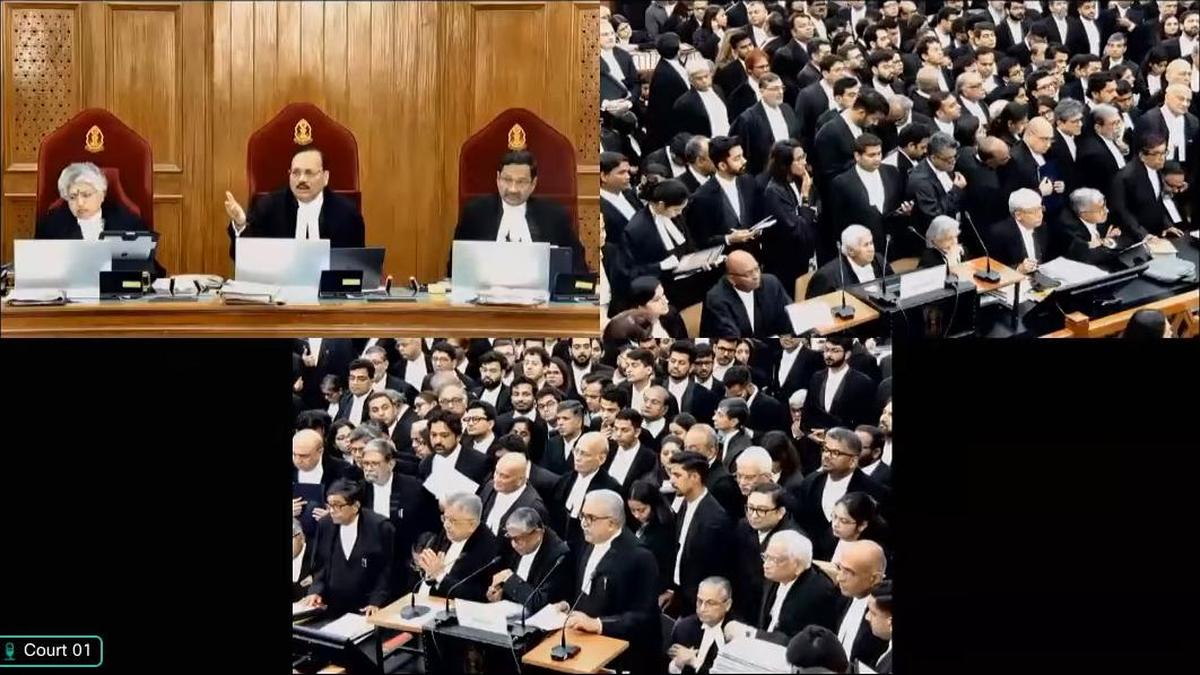
Supreme Court nine-judge Bench hearing led by Chief Justice of India (CJI) Surya Kant underway in the long-pending Sabarimala temple entry judgment review case, along with a batch of connected matters, in New Delhi on Tuesday, April 7, 2026. Photo credit: Supreme Court YT
Justice B.V. Nagarathna, the sole woman judge in the Supreme Court and part of the nine-member Bench hearing a reference spurred by a 2018 judgment upholding the right of women of menstruating age to worship at the Sabarimala shrine in Kerala, said on Tuesday (April 7, 2026) that social ills cannot be branded and passed off as ‘essential religious practices’.
The Centre, which holds the position that the Sabarimala judgment was an intrusion into free exercise of religious freedoms and denominational rights, said the legislature, not courts, drives reform in religion, if need be.

“If social evils are given a religious colour, then the courts can intervene to distinguish [between] the two,” Justice Nagarathna said.
Solicitor General Tushar Mehta, who opened the arguments before the nine-member Bench headed by Chief Justice of India Surya Kant, said the Preamble to the Constitution champions liberty of thought, expression, belief, faith, and worship.
“How can the courts then examine the essentiality of religious practices of a denomination which does not otherwise offend public order, morality and health?” Mr. Mehta asked.
The exchange marked the first day of hearing of a reference to evolve a ‘judicial policy’ for constitutional courts while dealing with questions of right to religious freedom enshrined in Article 25 and a denomination’s privilege to manage its own religious affairs under Article 26 of the Constitution.
The focal point of the reference is how far the courts can use their plenary powers to judicially review religious practices considered “essential or core” in the name of ushering in social reform.
“The reasons for empowering legislature to introduce social welfare and reform are obvious — If a religion or religious practice requires any social welfare measure or even reform, it must emanate from within the religion or from within the society and cannot be imposed by a judicial dictum,” Mr. Mehta submitted.
He said the apex court’s decision in the current reference would influence the trajectory of the nation for decades to come.
The Union government argued whether the judges had the expertise to decide if a ritual or a manner of devotion was merely superstition or an essential religious practice.
“The courts would first have to decide if it is a religious practice by interpreting the religious texts concerned. These texts require examination by religious scholars to understand what actually was meant at the time it was written. That is impossible for a court to do,” Mr. Mehta submitted.
The 2018 judgment had upheld the right of women to enter the Sabarimala temple while rejecting the argument that not allowing women of menstruating age inside was an ancient custom essential to the nature of the deity, Lord Ayyappa in the Naishtika Brahmachari form, presiding at the shrine.
“Can the attribute of a deity [Naishtika Brahmachari] be judicially reviewed?” the top law officer queried.
Justice Ahsanuddin Amanullah, one of the nine judges on the Bench, asked if the Solicitor was trying to point out that courts must not get into the examination of the essentiality of a religious practice at all.
“I am saying that this – the essentiality of a religious practice – may not fall within the domain of judicial review,” Mr. Mehta responded.
Justice Joymalya Bagchi referred to the fact that courts do entertain civil suits on ecclesiastical matters. “Judges are not experts in science. Yet, courts are empowered by the Evidence Act to examine the opinions of scientific experts and become an expert of experts,” Justice Bagchi observed.
Justice M.M. Sundresh intervened to note that “the difference here is science is based on logic and religion is based on belief”.
Mr. Mehta said the courts cannot embark on a theological journey to decipher the essentiality or morality of a faith-based practice.
“The courts need not hesitate to intervene if somebody claims cannibalism is a part of his religion. It is plainly immoral. Courts need not undertake a theological exercise to come to that conclusion,” he said.
Unlike Pakistan, which has ecclesiastical courts, India does not, he pointed out.
Published – April 07, 2026 11:37 pm IST



