


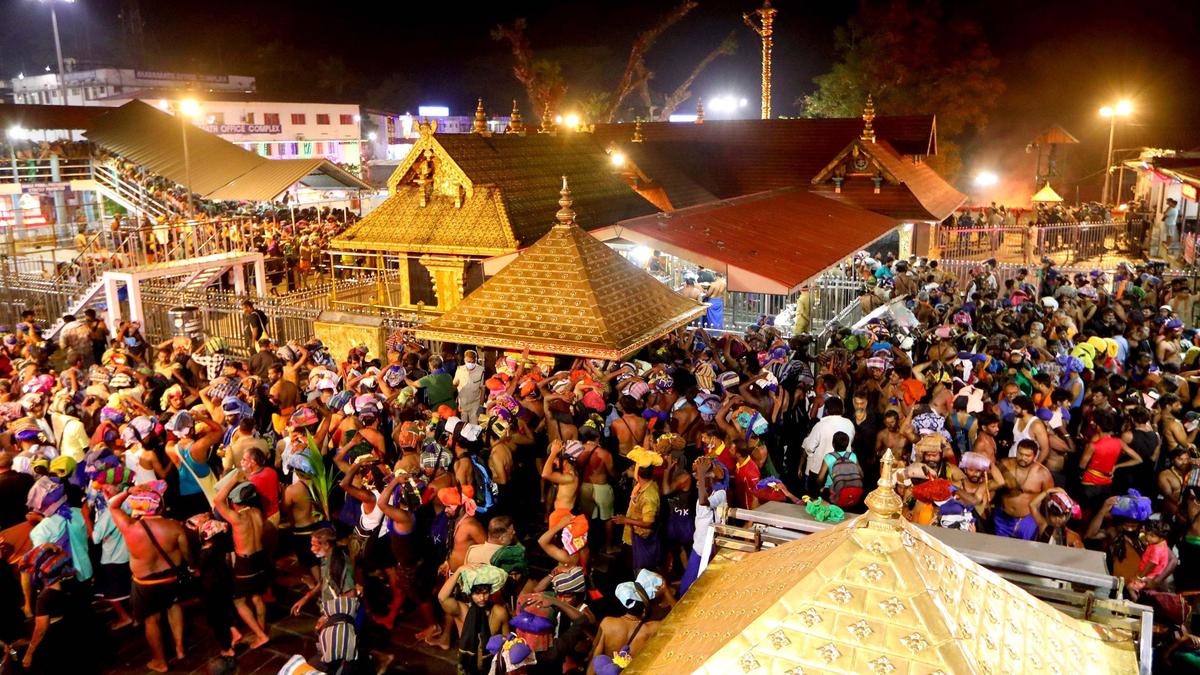
The nine-judge Bench would also look into, in the backdrop of the Sabarimala case, the larger question of the extent to which constitutional courts could engage in core matters of faith. A file picture of devotees at the Sabarimala Ayyappa temple.
| Photo Credit: Leju Kamal
The Union government has told the Supreme Court that a straitjacket definition of what constitutes a ‘religious denomination’ or which religious practices are ‘essential’ would “compress” the inherently plural nature of Hinduism expressed through diverse sects, groups, spiritual lineages, regional traditions, faith, practices, rituals, customs and beliefs.
The Centre has made its position clear ahead of the maiden hearing of a series writ and review petitions linked to the Sabarimala temple case scheduled to be heard by a nine-judge Bench headed by Chief Justice of India Surya Kant from April 7. The nine-judge Bench would also look into, in the backdrop of the Sabarimala case, the larger question of the extent to which constitutional courts could engage in core matters of faith.
The written submissions of the Union government, represented by Solicitor General Tushar Mehta, countered the September 2018 judgment of the Supreme Court which had held that devotees who visit the Sabarimala temple in Kerala were not a separate religious denomination called ‘Ayyappans’ protected under Article 26 of the Constitution.
The five-judge Bench had dismissed the notion that the prohibition of women aged between 10 and 50 from entering the temple was an ‘ancient custom’ of the religious denomination amounting to an ‘essential religious practice’ protected under Article 25.

The 2018 judgment by a majority on the five-judge Bench concluded that there was “no identified group called ‘Ayyappans’”. Every Hindu devotee could visit the Sabarimala temple. There were no exclusive identified followers or religious tenets peculiar to a cult.
The majority verdict in the Sabarimala case had concluded that the exclusion of menstruating women from Sabarimala temple was akin to treating them as the children of a “lesser God”. It had said exclusion of any kind, especially based on a biological attribute, amounted to practice of untouchability, an abolished social evil. Besides, the court had reasoned that women entered other Ayyappa temples and declared the Sabarimala temple a public religious endowment.
The Centre said the restrictive approach of the 2018 judgment invaded intrareligious diversity. Matters of faith, belief, doctrine, practice, observance, symbolism and modes of spiritual life vary from community to community, however minor they may be.
“This is more pronounced in the context of Hinduism, which does not rest upon a single founder or text or scripture or ecclesiastical authority or creed or mandatory set of practices. Hinduism, by its very character, accommodates within its fold a wide plurality of traditions, schools of thought, customs, rituals, philosophies and forms of worship… Any attempt to compress Hinduism into a narrow or singular definition would be doctrinally flawed and constitutionally unsafe,” Mr. Mehta submitted.
Drawing inflexible rules to define religious denominations and establish essential religious practices would lead to confusing results especially in religions like Hinduism which are devoid of any mandatory written codes or canonical texts.
“Denominations, sects and religions with no canonical texts, and which are open to change, would find it very difficult to establish any aspects of their beliefs, practices or culture to be essential,” the Centre submitted.
Published – April 07, 2026 10:04 am IST



