


Shivalik, an Indian-flagged LPG carrier with a cargo-carrying capacity of more than 54,000 tonnes, has crossed the Strait of Hormuz as on Friday night (March 13, 2026), according to marinetraffic.com, an online portal that tracks merchant ships movement.
As per the website, the ship had departed from Ras Laffan, Qatar, on March 7 and was originally destined for the U.S. The Indian Navy has denied reports that the Shivalik is being guided by naval vessels.
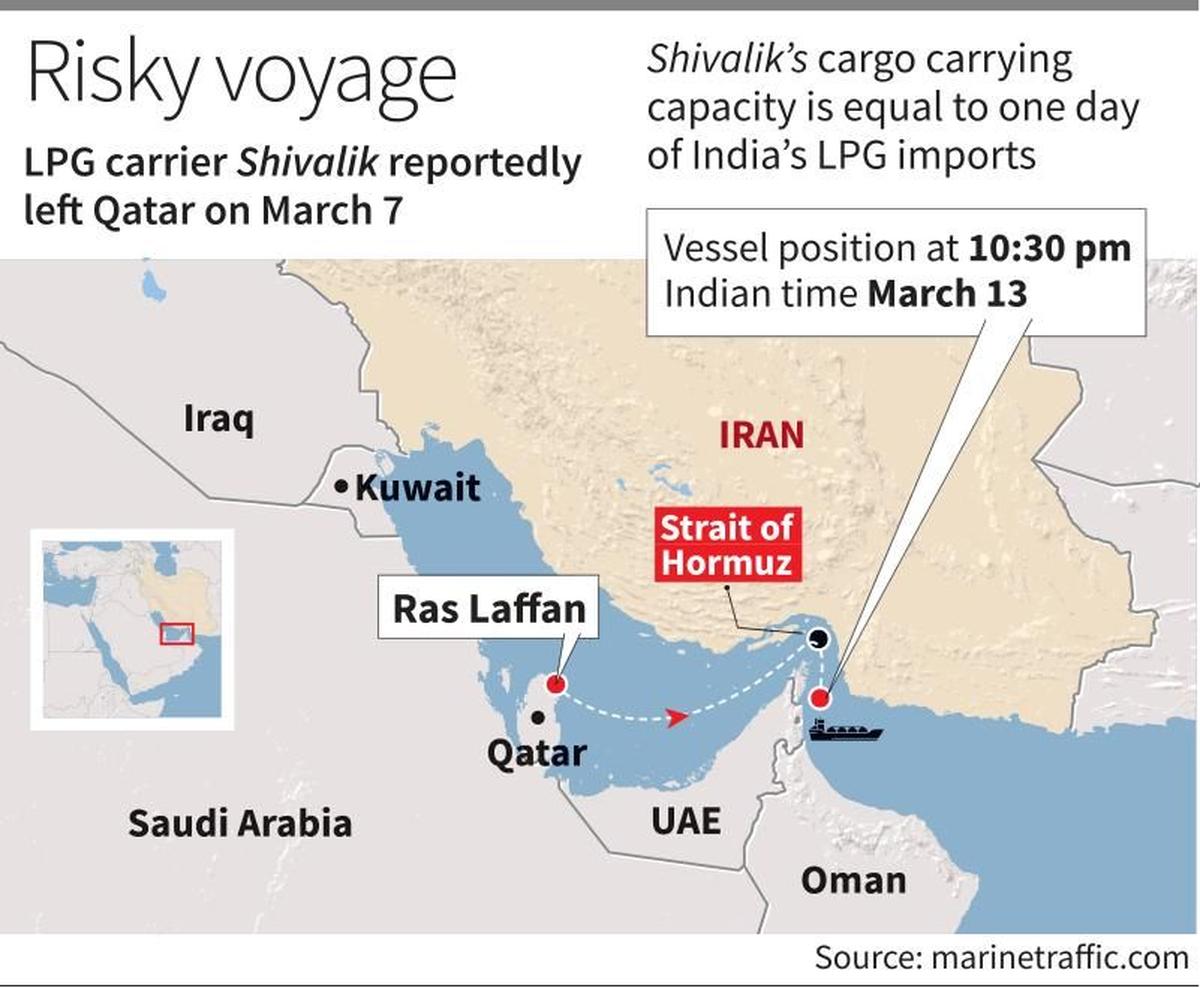
The LPG carrier is owned by the Shipping Corporation of India. Built in 2008, its first owner was Qatar Shipping Co. The SCI is the ship’s fifth owner, as per the shipping database equasis.com.
The Shivalik’s 55,000 tonnes of cargo could amount to nearly one day of India’s LPG imports. The Shivalik and the Sahyadri, another LPG carrier, were inducted into the SCI’s fleet in August-September of 2025. The Shivalik was among the 24 ships that were stranded upstream of Strait of Hormuz since the conflict started on February 28. The Sahyadri is at present located on the west coast of India.
Earlier at a briefing on Friday (March 13, 2026), a senior government official said that of the 28 Indian-flagged ships in the Persian Gulf-Gulf of Oman region that had stopped moving with the start of the West Asia conflict on February 28, one oil tanker bound for Africa, Jag Prakash, had started moving.
The Jag Prakash, an oil products tanker with a carrying capacity of 48,000 tonnes cargo and owned by Great Eastern Shipping Company, was among the four ships stranded east of the Strait of Hormuz. This means that, unlike the Shivalik, it did not have to cross the strait that the newly elected Iranian Supreme Leader Mojtaba Khamenei has said must remain closed. The Jag Prakash loaded at Sohar port in Oman, and its original destination was Tanzania.

Three more Indian-flagged cargo ships with 76 seafarers aboard are still located in the Gulf of Oman, while the 23 ships inside the Persian Gulf west of the Strait of Hormuz continue to remain stranded, according to officials.
Shipping industry leaders have been expecting relief and indications from the government advising ships to move at sea after Prime Minister Narendra Modi spoke to Iranian President Masoud Pezeshkian on March 12. But the government had said the same day that it was premature to expect Iran to allow Indian ships to cross the strait.
At a media briefing on Friday (March 13, 2026), Rajesh Kumar Sinha, Special Secretary, Shipping and Waterways Ministry, said there were 23,000 Indian nationals working in the Persian Gulf region on merchant ships, ports, and offshore vessels. The Directorate General of Shipping was in constant touch with them and all relevant stakeholders, he said.
Four Indian sailors have been killed in attacks since the beginning of the war. On March 11, an Indian seafarer was killed when his ship, Safesea Vishnu, was attacked near Basra, Iraq, in what has been described as a suicide mission. The remaining 15 Indian crew members are reported to be safe. The owners of the vessel are based in New Jersey, U.S., and the ship carries the flag of Marshall Island, but the vessel is managed by Bravo Ship Management based in Chennai, India.
Strait of Hormuz must remain closed, says Iran’s new leader
In the crosshairs
Crossing the volatile strait carries risks that shippers are unwilling to bear. When the conflict started, some 600 ships were reportedly stranded in the region because of fear of attacks.
Shenlong, the crude oil carrier carrying one million barrels of oil that docked in Mumbai on Wednesday (March 11), had crossed the strait on March 8. Reports have described the perilous journey it undertook to cross the strait in a region where GPS spoofing and jamming are commonly deployed as war tools. Such measures can confuse ships by giving false locations. The ship had apparently gone into “digital darkness” and used manual navigation to safely cross the strait.
When equipped with the Automatic Identification System (AIS) that identifies the vessel and can make the ship easy to track, it puts the carriers in danger of attacks, says Richard Meade, editor-in-chief of Lloyd’s List, a maritime information journal. “We have observed 77 transits across the Strait of Hormuz since March 1, half of whom were ‘shadow fleet’. Iranian ships carrying fuels continue to cross the strait. Seventeen were ‘dark transits’, which means the AIS of the ship was switched off, and some of them were mainstream fleet vessels such as Shenlong,” he said.
Though it would be expected that vessels affiliated with the U.S., Israel, and Europe would be targeted by Iran, there has been no pattern in the 16 ships that have been attacked so far, he says. “This is unlike in the Red Sea where the Houthis targeted ships that had certain affiliations,” says Mr. Meade.

Exercise restraint
Meanwhile, the Union government has expressed concern over unverified reports about vessels operating in the Gulf region and the Strait of Hormuz being circulated across social media and messaging platforms.
In an advisory, the Directorate General of Shipping (DGS) said the circulation of unconfirmed and speculative information was causing unnecessary anxiety and distress among seafarers and their family members.
“Responsible communication will help prevent misinformation, reduce panic among seafarers and their families, and maintain confidence within the maritime community during this sensitive period,” the advisory issued a few days ago to maritime stakeholders and seafarers community said.

The DGS urged all maritime stakeholders, shipping companies, employee unions and individuals to exercise restraint and responsibility while sharing information related to maritime incidents or security developments in the region.
It underlined the need to refrain from forwarding or publishing unverified information and ensure that only authenticated updates from official sources and competent authorities were disseminated.
“The Directorate General of Shipping continues to closely monitor the situation in coordination with relevant authorities and working together with stakeholders to ensure that only accurate and verified information reaches the seafarer community,” the advisory said.
With inputs from Vijay Kumar
Published – March 14, 2026 12:51 am IST



