


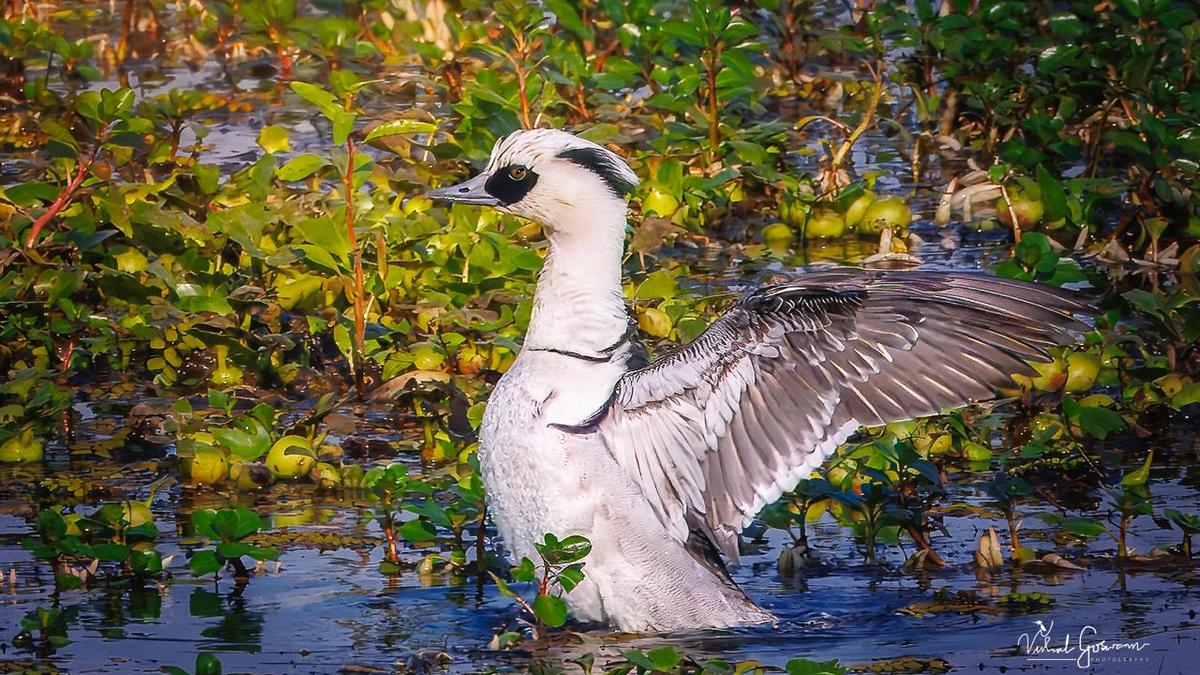
Smew, a Eurasian diving duck, spotted in Kaziranga National Park during the waterbird census in January 2026.
| Photo Credit: SPECIAL ARRANGEMENT
The seventh waterbird count at the Kaziranga National Park and Tiger Reserve in Assam released on Wednesday (February 25, 2026) has spotlighted a new avian guest — a diving duck from the Eurasian taiga breeding grounds.
However, the cheer for ornithologists and wildlife officials has come with some concern related to climate change.
“The smew (Mergellus albellus) signals wetland health in India, but its vagrant status flags climate-driven range shifts and the need to protect refuelling stops amid hunting and oil pollution threats,” said ornithologist Nilutpal Mahanta, a part of the waterbird census held from January 4 to 11.
A striking diving duck, the smew is a rare visitor to India. Male smews have a black-masked white body, while females have a mottled brown body. Sightings are sporadic and localised, mainly in northern or central Indian wetlands, including Haiderpur in Uttar Pradesh.
During the census, the smew was recorded at Rowmari-Donduwa beels in Laokhowa, part of the Kaziranga landscape covering 1,302 sq. km., and in the core areas of the park that are better known for its one-horned rhinoceroses.
The diving duck favours fish-rich, sheltered waters during winter, singly or in a small flock. Globally, there are an estimated 130,000 smews, but their number has been declining due to habitat loss and human activities.
Fewer waterfowls
The enumerators recorded 105,540 individual waterbirds belonging to 107 species. The number was 6,522 individuals and 17 species fewer than what the sixth waterbird count yielded in 2025.

Officials downplayed the numerical dip. They said the arrival of the smew “underscores floodplain resilience for flyway migrants, guiding anti-encroachment efforts in the two Important Bird Areas (IBAs) in the Kaziranga landscape — the Kaziranga National Park and two wildlife sanctuaries, Laokhowa and Burhachapori, together.
‘Record-breaking census’
“The first-ever sighting of the smew has stolen the spotlight in a record-breaking census of 105,540 birds. This spectacular debut reaffirms Assam’s wetlands and vital biodiversity hotspots,” Assam’s Forest, Environment, and Climate Change Minister Chandra Mohan Patowary said.
This year’s survey, conducted by 120 enumerators and 50 volunteers, spanned 166 wetlands across 10 ranges of the tiger reserve. The recorded species included ducks or geese, waders, herons or egrets, and marsh birds.
The top abundant species were the bar-headed goose, northern pintail, and lesser whistling duck. The census report highlighted targeted conservation needs with 18 critically endangered, endangered, vulnerable, and near-vulnerable species on the International Union for Conservation of Nature (IUCN) watchlists.
The top five wetlands by count were Laokhowa’s Rowmari Beel (15,661 birds), Donduwa Beel (14,469), Katakhal (4,979), Sohola (3,612), and Khalihamari (3,463). The top five wetlands by diversity were Rowmari (77 species), Donduwa (71), Sohola (69), Kawoimari-Bhoisamari-Diffulo (57), and Ververy (53).
Published – February 25, 2026 05:49 pm IST



