


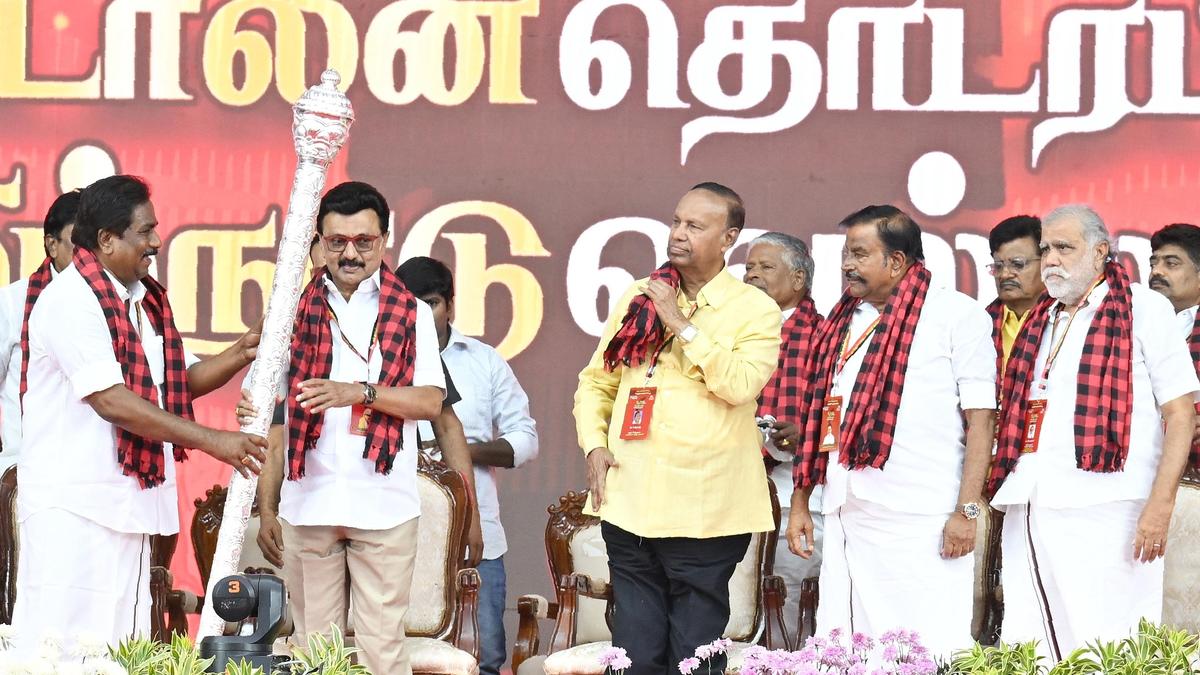
DMK Madurai North District Secretary and Commercial Taxes Minister P. Moorthy handing over a silver sword to party president and Chief Minister M.K. Stalin at the party’s booth agents conference in Madurai on February 21, 2026.
| Photo Credit: The Hindu
Tamil Nadu Chief Minister M.K. Stalin has made a strong case for a recalibration of Union-State relations, pointing out that the objective is not to weaken the Union but to right-size it, allowing it to concentrate on genuinely national responsibilities while restoring to the States the autonomy essential for effective governance.
“India now stands at a constitutional juncture that calls for a recalibration of Union-State relations. Such recalibration would not diminish national unity; it would deepen it by aligning authority with responsibility,” he said in a letter addressed to Chief Ministers, political leaders, constitutional experts, and journalists across the country.
He also enclosed a copy of Part I of the report of the High-Level Committee on Union-State Relations. The report was prepared by a committee headed by Justice Kurian Joseph, with former IAS officer Ashok Vardhan Shetty and economist N. Naganathan as members.
Tilted balance of power
Mr. Stalin argued that through successive constitutional amendments, expansive Union legislation on subjects in the Concurrent List, conditional Finance Commission transfers, and Centrally-sponsored schemes with rigid templates, the balance of power had tilted even further towards the Union.
“Large Ministries exist in New Delhi that duplicate State functions and often attempt to steer State priorities through micromanagement and procedural oversight. In an inversion of democratic hierarchy, plenary State legislation in Concurrent List subjects is at times sought to be diluted through subordinate rule-making at the national level,” he pointed out.
‘Unpersuasive record’
According to Mr. Stalin, such centralisation might have been defensible if it had demonstrably delivered superior outcomes. “But by comparison with decentralised federations, global benchmarks, or India’s own aspirations, the record of India’s centralised governance is unpersuasive,” he said.
Moreover, the Chief Minister observed, the model had struggled to deliver universal access, sustained quality, genuine equity or global competitiveness. “Instead, it has produced regulatory complexity, chronic underfunding as resources are stretched across expanding mandates, blurred accountability, and a gradual erosion of State capacity,” he said.
Mr. Stalin expressed the hope that the report would stimulate informed and constructive dialogue among the States and contribute towards restoring a balanced and cooperative federal order — one in which the Union is strong because it is focused, and the States are strong because they are trusted.
Published – February 21, 2026 10:13 pm IST



