


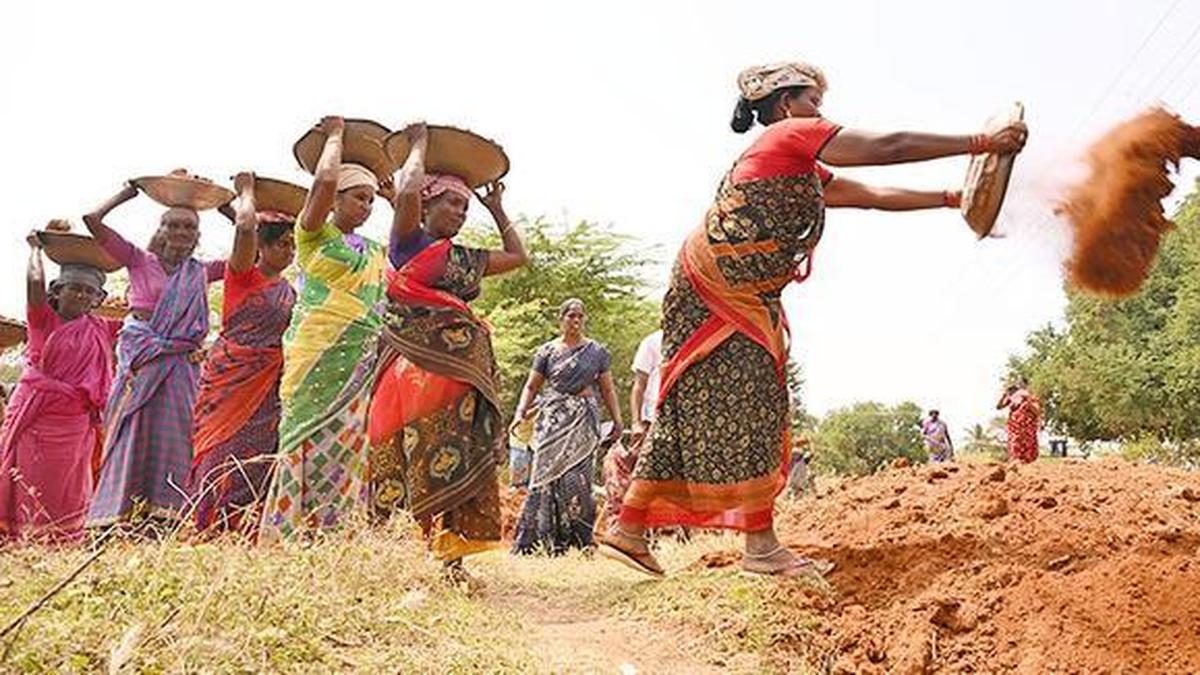
Representative image
| Photo Credit: The Hindu
The Union government is set to introduce the “Viksit Bharat—Guarantee For Rozgar And Ajeevika Mission (Gramin)” bill, which aims to replace the Mahatma Gandhi National Rural Employment Guarantee Act, 2005 (MGNREGA), during the ongoing winter session of Parliament. The new legislation enhances the number of workdays from 100 to 125, while simultaneously increasing the financial burden on states and dismantling the demand-driven structure of the existing law.
The government circulated the bill to Parliamentarians on Monday (December 15, 2025), framing it as legislation to “establish a rural development framework aligned with the national vision of Viksit Bharat @2047.” The bill also specifies its shortened name as “VB-G-Ram-G”.

Under MGNREGA, the wage bill was borne entirely by the Centre, while states shared the cost of materials for infrastructure and other administrative expenses. However, Section 22 of the new bill specifies that, for states other than those in the Northeast, Himalayan states, and three Union Territories, the states will now bear 40% of the total expenditure incurred.
While this increases the financial burden on states, the new bill also gives the Centre greater control over where and how the scheme will be implemented. Section 4(5) states: “The Central government shall determine the state-wise normative allocation for each financial year, based on objective parameters as may be prescribed by the central government.” Unlike MGNREGA, which was demand-based and allowed flexibility to increase the budget based on need, the new bill fixes allocations.
The Centre will not only set the Budget for each state but also decide where it will be spent. Section 5(1) empowers the Union government to “notify rural areas in a state” where the scheme will be implemented.

Another significant departure from MGNREGA is that the new bill allows for pausing the programme during peak agricultural seasons to “facilitate availability of labour.” Technological interventions introduced under MGNREGA—such as mobile app-based attendance, Aadhaar-based payment systems, and geotagging of worksites—are now codified into law.
In its Statement of Objects and Reasons, the government argues that MGNREGA needs to be replaced in view of the “significant socio-economic transformation” in rural India. It cites improved rural connectivity, housing, electrification, financial inclusion, and digital access, along with a diversified workforce and aspirations for “better incomes,” “growth infrastructure,” “sustainable livelihoods,” and greater climate resilience.
Nikhil Dey, a founder member of Mazdoor Kisan Shakti Sangathan (MKSS) and one of the architects of MGNREGA, criticised the move, calling it a retreat from the rights-based framework enjoyed for two decades. “It is the end of the right to work in India, dismantling the basic architecture of MGNREGA and its entitlements. The new legislation takes the country back to allocation-based schemes where the Centre plays a bigger role and the beneficiary has little say. It also places a huge and impractical financial burden on the states,” Mr. Dey told The Hindu.
Published – December 15, 2025 10:58 am IST




