


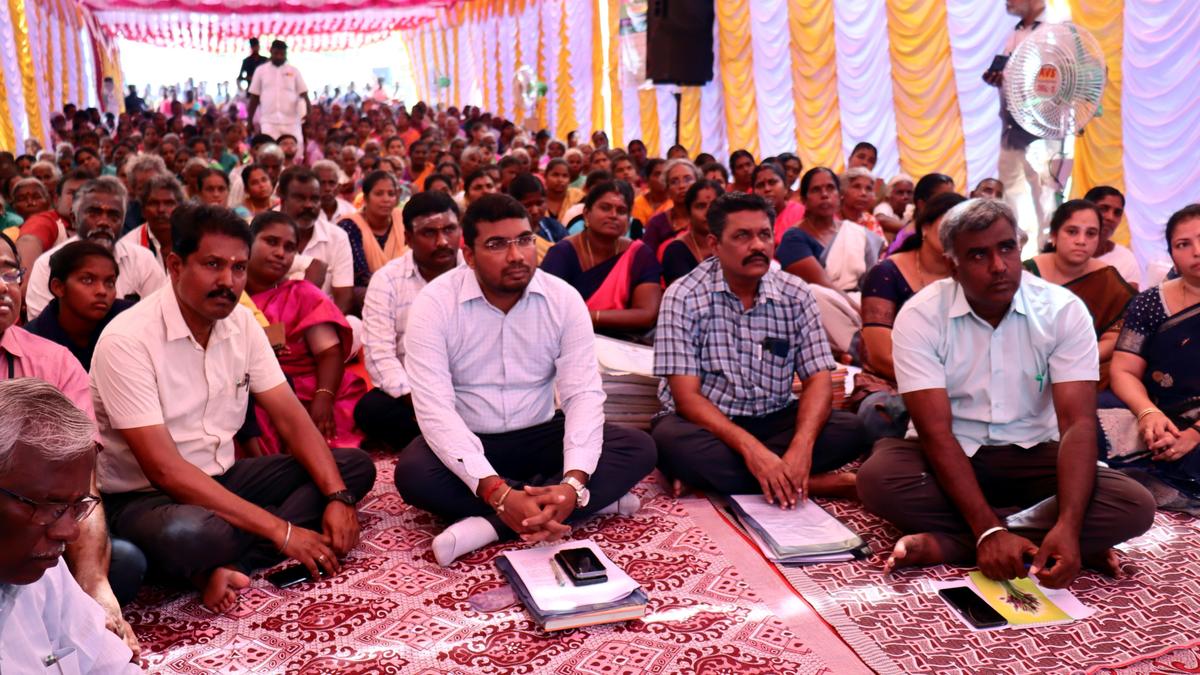
Collector S. Saravanan taking part in a gram sabha meeting held at Adiyanoothu panchayat near Dindigul, Tamil Nadu, on October 11.
| Photo Credit: KARTHIKEYAN. G
The story so far: On November 17, the 16th Finance Commission (FC) submitted its report to the President of India.
What are the expectations?
Main expectations include a percentage share for vertical transfer of resources from the Central revenue pool to the States for the next five years and the formula of its horizontal distribution among States. This is mandated under Article 280 of the Constitution.
What about panchayats, municipalities?
The other expectation is the recommendation to improve the finances of panchayats and municipalities as mandated under Article 280 (3) bb and c.
Like many other federations, local governments are the ones rendering essential public services, including drinking water, sanitation, public health, rural roads, maintenance of community assets etc. For this purpose, panchayats and municipalities are mandated to collect certain taxes like property tax, advertisement tax and non-taxes such as market fee, toll etc. However, a huge gap between revenues and expenditure responsibilities can be seen across States and Union Territories (UTs).
As per the 73rd and 74th constitutional amendments, State governments have the power to assign revenue handles and expenditure responsibilities to various rungs of panchayats and levels of municipalities. Due to this reason, there is a wide variation in fiscal powers of panchayats and municipalities across States.
In an ideal scenario, functional responsibilities should be closely linked to the financial powers delegated to local governments. However, there is no separate list for either functional responsibilities or revenue handles that should be assigned to panchayats and municipalities. While the 11th and 12th Schedules enumerate on 29 broad subjects for panchayats and 18 matters for municipalities respectively, they are merely illustrative and not binding. Moreover, it is the Union and State governments that are expected to design vertical schemes on economic development and social justice, while local governments implement them.
State governments tend to assign responsibilities to local governments without concomitant revenue handles or officials. As a result, panchayats and municipalities bear the financial brunt which not only affects their development but operational efficiency as well.
What is the role of the SFC?
Every five years, States constitute a State Finance Commission (SFC) which can make recommendations to State legislature. The recommended devolutions by SFC could be, inter alia, that panchayats and municipalities should have a share in the revenue pool of the State; be assigned revenue handles; receive both conditional and unconditional grants-in-aid; that local governments be assigned civic functions and functionaries; and various other administrative measures. More than a hundred SFC reports have been submitted across States, but hardly a few have been respected.
In such a situation, the local government must count entirely on fiscal transfers from the Union government. For this purpose, the Constitution mandates the Union Finance Commission (UFC) to suggest measures to augment State finances for local governments.
What did the previous UFCs do?
So far, recommendations of six UFCs have been implemented. However, they weren’t able to quantify the resource requirements of local governments, and made ad hoc arrangements and recommended lump sum grants. The 13th UFC, however, suggested calculating the grant as a percentage share in the union tax divisible pool. The 13th UFC did this consciously after a round of consultations with top legal experts and at the demand of the Union Ministry and several State governments. Neutrality to inflation was the first advantage of the proposal and share of local government in high buoyancy of union tax proceeds was the second major benefit. Sadly, the subsequent UFC took a complete U-turn and recommended lump sum grants. The 15th UFC followed its immediate predecessor in its route of fiscal transfers to local governments. This was not the only discontinuity in the recommendations made by the three successive bodies. The other major anomaly was in the form of conditional grants. In their zeal to reform panchayat and municipal administration, all these UFCs divided the grants into two components — basic and performance-based. While basic grants were unconditional, performance grants were tied to certain conditions identified by these UFCs as reform instruments. However, each UFC ensured to discontinue the line of reform initiated by the previous UFC. To illustrate, the 13th UFC stipulated six conditions for performance grants. None of the conditions could be fulfilled by most States. The 14th UFC refused to acknowledge any merit in the previous reform agenda and recommended fresh conditional performance grants. The conditions put forth by the 15th UFC were again of a different variety.
The 16th UFC, it is expected, must have gone beyond the oft-beaten approach and assessed the resource requirements of 2.7 lakh panchayats and about 5,000 municipalities, which would enable them to act as institutions for economic development and social justice.
V. N. Alok is professor at the Indian Institute of Public Administration.
Published – November 19, 2025 08:30 am IST



