


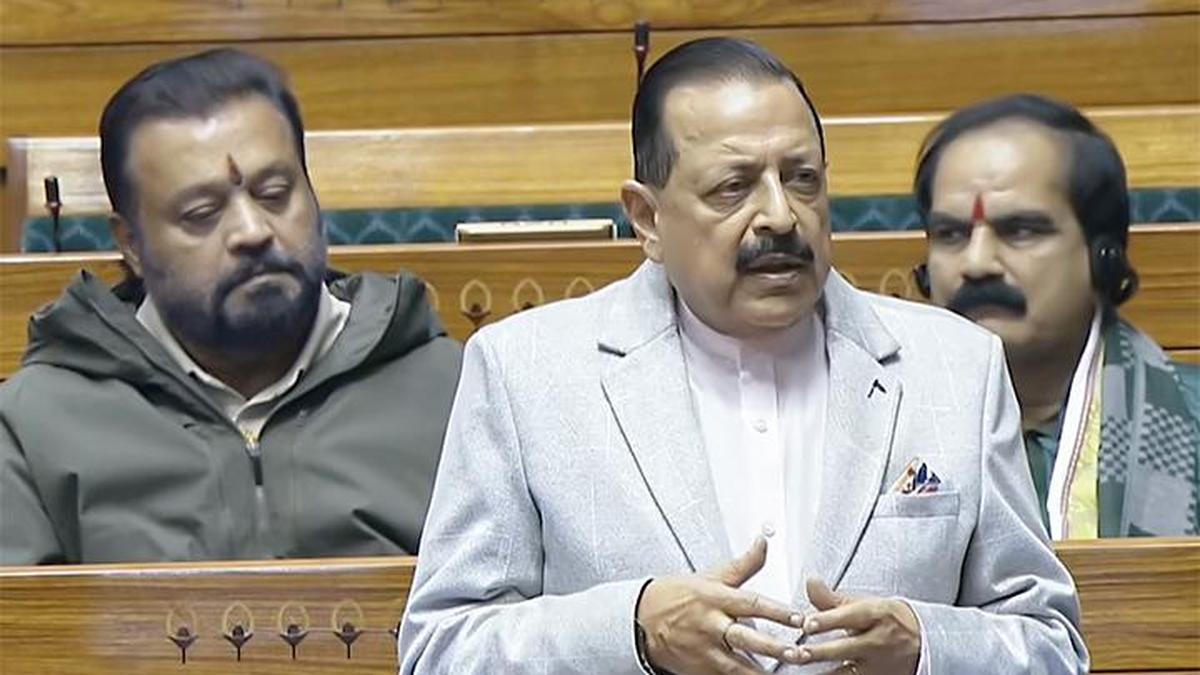
Union MoS Jitendra Singh speaks in the Lok Sabha during the ongoing Winter Session of the Parliament, in New Delhi.
| Photo Credit: ANI
The story so far: Parliament has brought into force the Sustainable Harnessing and Advancement of Nuclear Energy for Transforming India (SHANTI) Act which repeals legislation that governs nuclear activity — the Atomic Energy Act, 1962, and Civil Liability for Nuclear Damage (CLND) Act, 2010.
Why is SHANTI significant?
SHANTI encourages private companies to participate and potentially, allow foreign funding to flow in India’s nuclear sector. Currently, only public sector enterprises can build and operate nuclear power plants in the country. India has plans to increase its current nuclear capacity from 8.8 GW (or about 1.5% of the total installed) to 100 GW by 2047 and thereby increase the contribution of nuclear power to generated electricity from the current 3%. State-owned nuclear power utilities have projected that they will add about 54 GW with the rest, presumably, from private companies.

What are the major differences in SHANTI?
The heart of nuclear power plant operations is safety. Given nuclear energy’s chequered history with atom bombs, there is tight scrutiny of the movement of nuclear fuel (uranium) because of the possibility of it being diverted for producing weapons-grade plutonium. Accidents such as the Three Mile Island disaster in 1979, Chernobyl nuclear meltdown in 1986, and the Fukushima core meltdown following the tsunami in 2011 have contributed to extreme caution and restrictions in all aspects of nuclear plant operations. Currently, the global consensus is that in case of an accident, a plant operator must compensate victims commensurate with the level of damage. Damage can often exceed projections, as has been the case with Fukushima most recently. The agreement is that victims must be compensated immediately without waiting for ascertaining the causes and those responsible for the accident. Following this, however, the plant operator — if it can establish that it was not its management but rather faulty equipment, provided by a supplier, that led to the catastrophe — can claim recourse.
Editorial:On nuclear policy, the SHANTI Bill
The erstwhile CNLD allowed operators to claim recourse from a supplier of equipment under three instances: if a) the supplier and an operator have an explicit agreement (b) the nuclear incident has proved to be due to the suppliers or their equipment’s fault; (c) the nuclear incident has resulted from deliberate intent to cause nuclear damage. In SHANTI, clause (b) has been done away with. Despite the Indo-U.S. nuclear deal of 2008 that allowed India access to uranium and international nuclear technology (restricted, because of its nuclear tests of 1974 and 1998), American, and French makers of reactors were hesitant because as ‘suppliers’ they could in theory be held liable for billions of dollars. With the elimination of clause (b) and even the deletion of the word ‘supplier,’ this ‘problem’ vanishes. Ironically, in 2010, when the Bharatiya Janata Party (BJP) was in the Opposition, it insisted on such a clause and Congress parliamentarians pointed this out during the debate. The BJP-led government’s laconic response to this was that nuclear technology had changed and “changing times” required adapting to new realities.
Does SHANTI load the dice against operators?
The earlier laws enabled those affected by a nuclear accident to claim compensation from a nuclear plant operator for an amount up to ₹1,500 crore. Were nuclear damage to exceed this, the Centre would chip in through an insurance pool up to ₹4,000 crore. SHANTI goes for a graded approach. Only operators of plants above 3,600 MW are liable for a ₹3,000 crore penalty; from 3,600 MW to 1,500 MW, the amount is ₹1,500 crore; from 1,500 MW-750 MW, it is ₹750 crore; from 750 MV-150 MV, it is ₹300 crore; and it is ₹100 crore for plants under 150 MW. All India’s plants are currently 3,000 MW or lower. Science Minister Jitendra Singh, who piloted the legislation in Parliament, said this gradation was meant to “not scare off” potential private sector participants. During the debates, it was pointed out that the costs of reparations often went into billions of dollars, much more than what these caps suggested. The Act also gives a statutory form to the Atomic Energy Regulatory Board, though the Centre still controls functions such as appointing a chairman and providing major licences to an aspirant power plant operator.

Will SHANTI spur India’s nuclear vision?
The original vision of Homi Bhabha, the father of India’s atomic energy programme, was to provide for India’s energy security through nuclear power as well as make up for India’s scarcity of uranium through the use of thorium. This involves, in Stage 1, building and making pressurised heavy water reactors which uses natural uranium (U-238) to produce plutonium and energy. In the second stage, by using ‘fast breeder reactors,’ more plutonium and uranium-233 is made along with energy. In the final stage, U-233 is combined with the plentiful thorium to make electricity and create a self-sustaining U-233-and-thorium power-generating system. India has not yet reached the second stage; it only has a prototype Fast Breeder Reactor. Delayed for 20 years, it was to be active in 2025, but now the commissioning has been further pushed to September 2026. For its nuclear goals, India is looking to rely on Small Modular Reactors (SMRs). They are smaller versions of existing reactors in the U.S. and France that will need enriched uranium-235 (which India lacks), and produces all the radioactive elements — plutonium, strontium etc. — that India’s stage 1 produces. Just as modern airplanes or iPhones are built component by component across the world and assembled centrally, SMRs too will be built in the same way. Though smaller, they also produce less electricity per unit than a large reactor and are costlier unit-wise. They also do not address the problem of nuclear waste better than large reactors though some of them have incorporated better designs that can automatically cause a plant to shut down in case of a threat. While SMRs might help produce electricity, they don’t necessarily help with India’s quest to use thorium as fuel.
Published – December 21, 2025 02:28 am IST



