


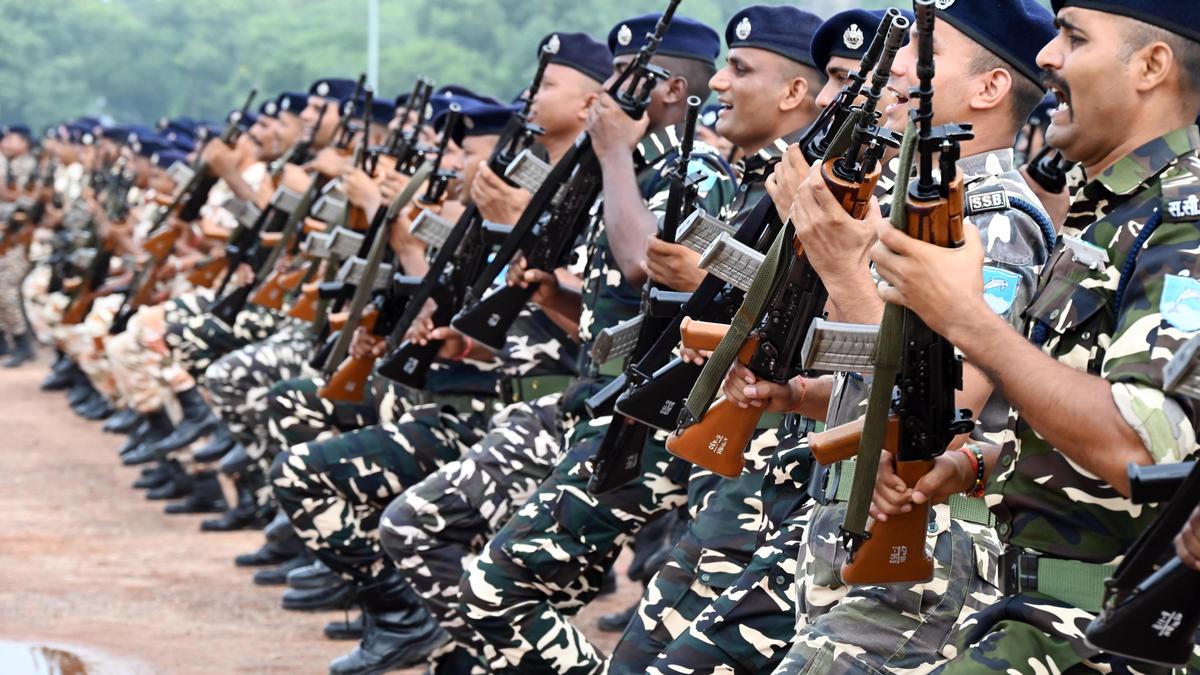
Image used for representational purposes only.
| Photo Credit: ANI
The story so far:
The Central Armed Police Forces (General Administration) Bill, 2026, was introduced in the Rajya Sabha on Wednesday (March 25, 2026). The Bill states that in the Central Armed Police Forces (CAPFs), 50% of the total posts in the rank of Inspector General, at least 67% of the posts in the rank of Additional Director General, and 100% posts in the rank of Special Director General and Director General shall be filled by Indian Police Service (IPS) officers on deputation. The Bill has been criticised by Opposition members and retired CAPF officials.
Why was the Bill introduced?
The Bill is in response to a Supreme Court judgment dated May 23, 2025. A Bench of Justices A.S Oka and Ujjal Bhuyan ruled then that the deputation posts of IPS officers in the Senior Administrative Grade or up to the rank of Inspector General in CAPFs should be “progressively reduced over a period of time, say within an outer limit of two years.”
The Court also ruled that Group A officers of CAPFs are “Organised Services” for “all purposes.” An Organised Group A Service (OGAS) is a structured, cadre-based civil service with defined hierarchy, promotion pathways, and cadre control, as distinct from isolated or general civil posts. The IPS, the Indian Administrative Service, and the Indian Foreign Service are all OGAS.

The Ministry of Home Affairs (MHA) filed a review petition in the Supreme Court, which the Court dismissed on October 28, 2025. Despite the judgment, the MHA continued to appoint IPS officers in CAPFs at the rank of Inspector General and Deputy Inspector General. This prompted retired CAPF officials to file a contempt petition against Union Home Secretary Govind Mohan for not implementing the order. On March 9, the MHA informed the Court that a statutory intervention is proposed. And on March 10, the Union Cabinet gave its nod to the CAPF (General Administration) Bill, 2026.
What are the CAPFs?
The CAPFs comprise the Border Security Force (BSF), which is deployed along the Pakistan and Bangladesh borders; the Central Industrial Security Force (CISF), which protects airports and critical installations; the Central Reserve Police Force (CRPF), which is deployed for internal security, law-and-order duties, and in Left Wing Extremism-affected areas; the Sashastra Seema Bal (SSB), which guards the border along Nepal and Bhutan; and the Indo Tibetan Border Police (ITBP), which is deployed along the border with China.
At present, 20% of the posts in the rank of Deputy Inspector General and 50% of the posts in the rank of Inspector General in CAPFs are reserved for IPS officers through an executive order. There are around 13,000 Group A officers in the CAPFs, and about 10 lakh personnel in total. The MHA is the cadre-controlling authority of the CAPFs and the IPS. Recruitments are done by the Union Public Service Commission.
As on March 9, there were 213 sanctioned IPS posts in the CAPFs, of which 35 are vacant. There are 4,594 total IPS officers in the country and as per norms, 40% senior duty posts are to be reserved for Central deputation and the remaining 60% for the States.
Why is there opposition to the Bill?
Retired CAPF officials say the Bill is being brought to negate the Court’s ruling. They argue that an officer who joins at the rank of an Assistant Commandant in the CRPF does not get a promotion even after 16 years of service, whereas their counterparts in the IPS get three or four promotions during the same period. They argue that the Bill reserves 100% of Special Director General posts for IPS officers replacing the present structure under which some CAPF officers could reach these positions.
What is the government’s argument?
The Bill states that the CAPFs perform national security functions in close coordination with State authorities, and that IPS officers are necessary for their effective functioning in the interest of maintaining Centre–State relations.
What did Opposition members say?
Congress MP Ajay Maken said that the Bill encroaches upon the rights of the judiciary. He said the CAPFs have played an important role in combating Maoists. Still, they were not being promoted, and cases of suicide and voluntary retirement are increasing among the officers. CPI(M) MP John Brittas said Parliament cannot annul operative judicial orders without addressing their legal basis. Earlier, the Leader of Opposition in the Rajya Sabha, Mallikarjun Kharge, wrote to Prime Minister Narendra Modi to implement the Court order. Discussion on the Bill will resume on Monday.
Published – March 29, 2026 02:00 am IST



