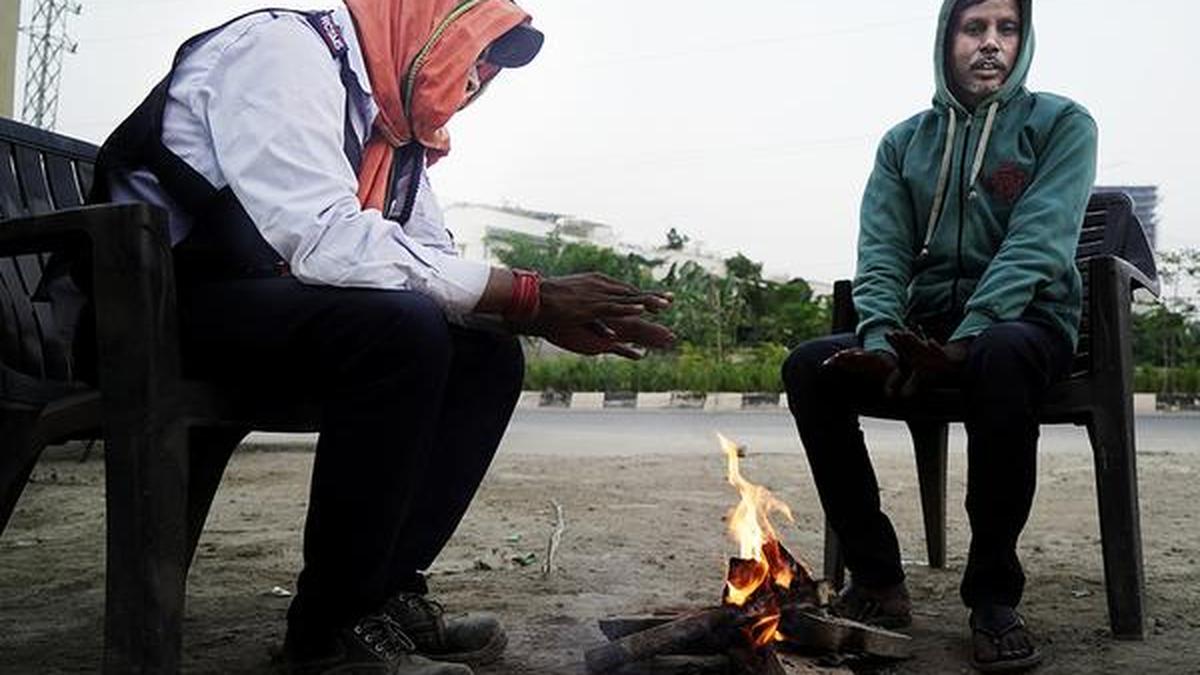
People sit around a fire to keep themselves warm in Hyderabad, December 2025.
| Photo Credit: SIDDHANT THAKUR/The Hindu
Unlike the stormy remnant of Cyclone Ditwah near Chennai earlier this month, cold waves can’t linger. Instead, if they’re happening over and over, it must be because the ingredients required for an unusually low nighttime temperature are also staying in place. And over Telangana right now, the India Meteorological Department (IMD) has pointed to a combination familiar in winter: dry air, clear skies, and continental winds.
The air mass over Telangana State has been unusually dry of late. When humidity is low, the atmosphere holds less water vapour, which is one of the main greenhouse gases near the surface. With less water vapour to trap heat, the ground loses energy more efficiently after sunset. Clear skies strengthen this effect because clouds that might otherwise absorb and re-radiate some of the outgoing heat are absent. Meteorologists have already said the ongoing cold wave is partly linked to dry winds blowing north and northeast and clear skies at night.
Second, the northerly and northeasterly surface winds bring cooler, drier air from inland parts of India rather than air from the Bay of Bengal, which is more moist. This steady cooling keeps the daily minimum temperature down even when the daytime temperature is ‘ordinary’ since each night begins with a cooler starting point. Telangana had a cold wave warning in mid-November but it has seemed to go on because these low-level winds haven’t shifted, thus the local air mass has remained cool and dry.
Third, in a press release issued on December 11, the IMD said cold-wave conditions had occurred at isolated places over Telangana and warned that such conditions were “very likely” over the State, as well as in north interior Karnataka, during December 12-14. The bulletin also said there would be “no significant change” in minimum temperatures over “remaining parts of the country” during the next week. That is, the cold patterns won’t break in a sudden way.
In the plains, The IMD considers cold-wave conditions when the minimum temperature falls to 10°C or below in the plains and is substantially below normal, i.e. a negative departure of 4.5ºC to 6.4ºC. Any temperatures below that lead to a “severe” cold wave. Thus, parts of Telangana are currently in the grip of a cold wave.
A weak western disturbance is expected to influence the western Himalaya from December 13 and the IMD has said there could be a 2-4ºC rise in the minimum temperature between December 13 and 15 as the larger pattern evolves with the lower level easterlies.
Published – December 12, 2025 01:29 pm IST