


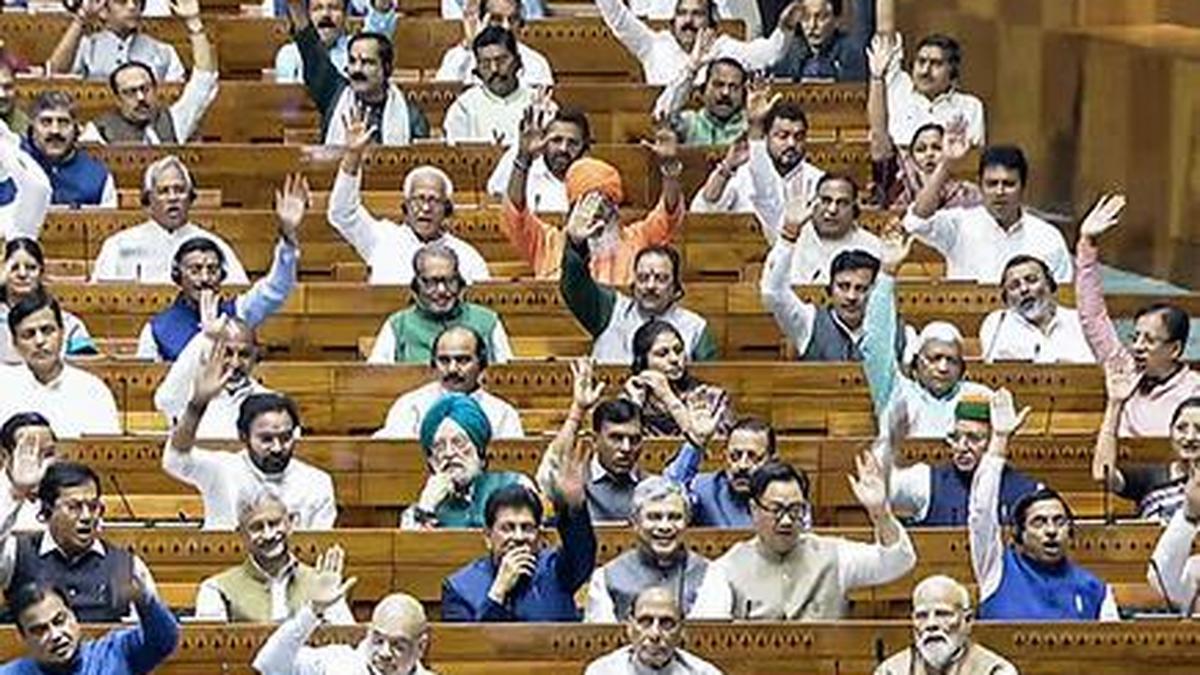
Budget Session of Parliament. File
| Photo Credit: ANI
In India’s parliamentary framework, the term “guillotine” defines an expedited measure undertaken for quick approval of bills. The mechanism, time-bound in nature, is invoked by the Lok Sabha Speaker to ensure ministry-specific proposals are cleared before the financial year deadline. The decision comes into play when the House takes note of the confined time limit, forcing them for approval without debates.

Significantly, the mechanism is specifically undertaken for ‘Demands for Grants’, than any ordinary bills.
Why guillotine is in news?
Recently, the term “guillotine” has raked up interest among general public after the Lok Sabha passed the Demands for Grants of various Ministries for 2026-27 on Wednesday (March 18, 2026). The House approved an expenditure of over ₹53 lakh crore by applying the guillotine, passing the Demands for Grants for various Ministries without a discussion in Parliament. The House had discussed Demands for Grants for two Ministries — Agriculture and Railways.
Read | Where the guillotine falls
How guillotine works?
Following the presentation of the Union Budget, the parliament facilitates debates for “Demands For Grants”, which underlines the expenditure demands of various ministries, such as Railways, Agriculture, Defence, and Education. During the process, these demands are thoroughly scrutinised by Members of Parliament (MPs). Further, the concerned MPs raise questions and doubts about allocations, and also move cut motions to reduce spending.
However, only a limited number of demands are discussed in detail due to large number of ministries and confined discussion hours. Later, the pending list stretches further as the session proceeds, demanding the urgency for a structured closure mechanism.

The Business Advisory Committee (BAC) undertakes an effort to schedule discussion time for “Demands For Grants”. On the final day, the Lok Sabha Speaker invokes the “guillotine”, by which, all pending “Demands For Grants”, whether debated or not, are put to vote simultaneously and passed at once.
How is it different from passing a Bill in din?
Sometimes, the Lok Sabha or Rajya Sabha may pass a bill without discussion due to disruptions from legislators. This is called passing a Bll “in din”. While guillotine is a formal process to fast track voting, the “in din” is a call taken by the Chair when a discussion is not possible due to ruckus. Also, guillotine is specifically used in financial business.
What happens after “guillotine” process?
Following the approval of “Demands For Grants”, the government introduces the ‘Appropriation Bill’, which validates the withdrawal of funds from the Consolidated Fund of India to meet the required expenditures. The Appropriation Bill is then sent to Rajya Sabha, where it is discussed and returned. Money Bills are not passed in Rajya Sabha, but returned to Lok Sabha.
Published – March 19, 2026 12:54 pm IST



