


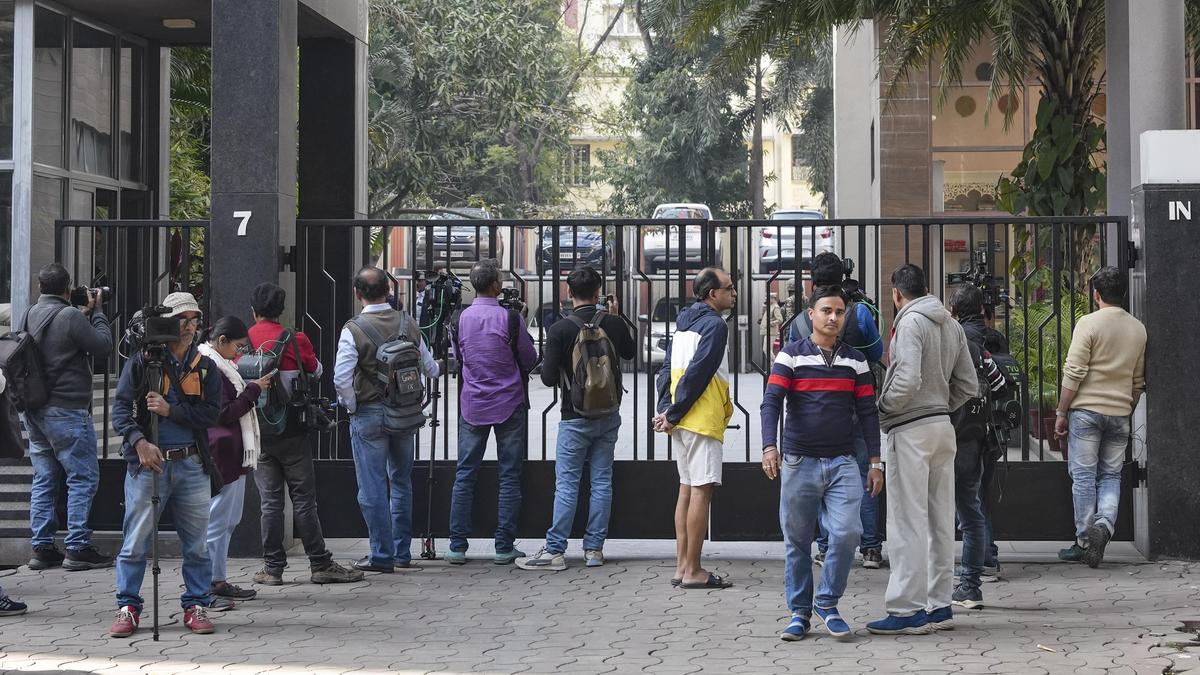
The Directorate of Enforcement conducted searches on the premises of political consultancy firm I-PAC and its director, Pratik Jain, in Kolkata as part of a money laundering investigation, official sources said. File
| Photo Credit: PTI
The West Bengal Government has questioned the Directorate of Enforcement (ED )’s move to approach the Supreme Court seeking a Central Bureau of Investigation (CBI) probe into the alleged obstruction of its raids at the offices of political consultancy firm I-PAC by West Bengal Chief Minister Mamata Banerjee and State officials.
The State asked whether the petition was maintainable when a similar case was pending before the Calcutta High Court urging identical grounds of challenge.

A Bench headed by Justice Prashant Kumar Mishra had, on January 15, stayed the Kolkata Police probe against ED officials who conducted searches at I-PAC office and the residence of its co-founder Pratik Jain on January 8.
The State police investigation had been based on allegations that sensitive election records of the State’s ruling Trinamool Congress, which consults I-PAC on electoral and political strategy, were “stolen” by the Central agency officials during the raids. The complaints were lodged against the ED at Shakespeare Sarani Police Station and Bidhannagar Electronic Complex Police Station.
Filing its response to the ED petition, the State Government said there cannot be “parallel proceedings” before the High Court and the Supreme Court. It said the Central agency did not have the fundamental right to file a writ petition before the top court. The State argued that the ED did not have the power to conduct “omnibus search and seizure” and that the agency had violated privileged communications.

The ED has sought a CBI probe against State and police personnel for obstructing raids, which were part of an investigation into a ₹2,742-crore coal smuggling case. The Bench, in its order, said the case raises “serious” issues relating to the scope of the investigations carried out by Central agencies like the ED and interference by State agencies.
“According to us, for the adherence to the rule of law in the country and to ensure that each organ functions independently, it is necessary to examine this issue so that offenders are not allowed to be protected under the shield of law enforcement agencies of a particular State. There are larger questions involved here. If they are left undecided, the situation may become worse and a situation of lawlessness may prevail in one or the other State, considering that different outfits are governing different States,” the Bench had recorded in the January 15 order.
Published – February 02, 2026 11:02 pm IST



