


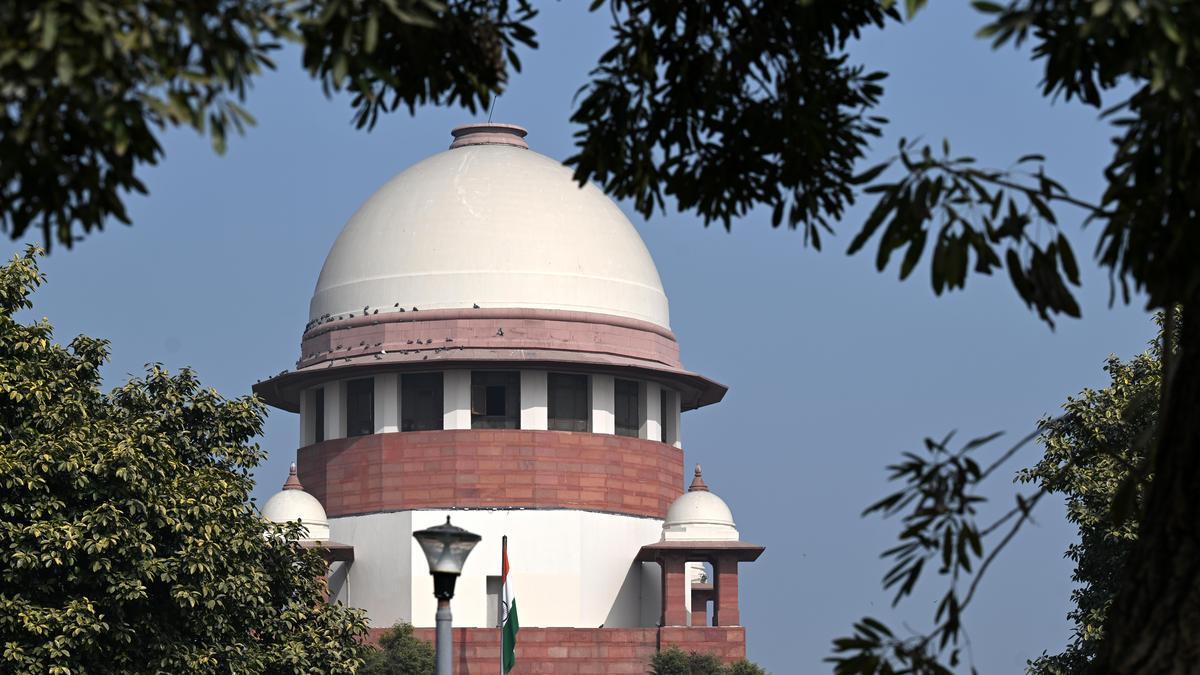
A file image of the Supreme Court of India
| Photo Credit: The Hindu
The safety of the victim and the sanctity of the trial are paramount considerations while adjudicating bail applications in cases involving sexual offences against children, the Supreme Court said in a judgment as it cancelled the bail granted to an accused in a 2024 gangrape case.
Allowing an appeal filed by the victim, a Bench of Justices B.V. Nagarathna and R. Mahadevan held that the April 2025 order of the Allahabad High Court granting bail had resulted in a “miscarriage of justice”, as it failed to account for the threat to the victim’s safety, particularly since she resided in the same locality as the accused.

“In offences involving sexual assault against children, the likelihood of tampering with evidence or influencing witnesses constitutes a grave and legitimate concern. The safety of the victim and the need to preserve the purity of the trial process assume paramount importance,” the Bench observed.
The top court was hearing an appeal filed against the bail granted to one of the accused by the Allahabad High Court on April 9, 2025. The minor victim had contended that the family of the accused was highly influential in the locality and could therefore tamper with evidence in the case.
The victim, who was 16 years old at the time of the incident, was allegedly sexually assaulted by four individuals in Uttar Pradesh’s Shamli district on December 1, 2024. A First Information Report (FIR) in the case was lodged on the following day. Subsequently, charges were framed against the accused under multiple provisions of the Bharatiya Nyaya Sanhita (BNS) and the Protection of Children from Sexual Offences (POCSO) Act, including Sections 5(1) and 6 of the POCSO Act, which deal with aggravated penetrative sexual assault committed repeatedly against a minor, and carry punishment extending to life imprisonment or the death penalty.
‘Manifestly pervese’
Taking into account the heinous nature of the offence and the allegation that the crime was recorded for the purpose of blackmail, the Bench held that the release of the accused gave rise to a “real and imminent apprehension of intimidation” to the victim. The judges also noted that the counselling report of the Child Welfare Committee indicated that the victim was living in fear and suffering psychological distress.

“In the present case, the grant of bail by the High Court is vitiated by material misdirection and nonconsideration of relevant factors rendering the same manifestly perverse,” the ruling, authored by Justice Mahadevan, said.
The judges further pointed out that while the High Court order had relied on earlier decisions concerning prolonged incarceration and delay in trial to grant bail, it had failed to adequately consider the gravity of the alleged offences, as well as the stringent provisions of the POCSO Act.
“The omission to notice that the chargesheet had already been filed, coupled with the prima facie material emerging from the victim’s statements, renders the exercise of discretion by the High Court manifestly erroneous. The High Court failed to apply the settled parameters governing the grant of bail, including the gravity of the offence, the vulnerability of the victim, and the likelihood of witness intimidation,” the Bench said.
Accordingly, the Bench set aside the bail verdict and ordered the accused to surrender within two weeks. It also directed the trial court to conclude proceedings as expeditiously as possible.
“…POCSO Act is a beneficial legislation enacted to protect children from sexual offences, and proceedings under the said Act warrant prompt and sensitive handling,” the court said.
Published – January 12, 2026 09:46 pm IST



