The fight against cancer unfolds in many ways: patients fight with hope, doctors with medical knowledge, health systems by striving to provide equitable access to care. The fundamental requirement is proper information on the cancer burden and survival rates, which cancer registries provide through systematic and continuous surveillance. The purpose is to achieve rational cancer control through meaningful actions: for the individual patients at the hospital level, and for a collection of patients at the population level. This brings hospital-based cancer registry (HBCR) and population-based cancer registry (PBCR) into play.
What do cancer registries do?
Cancer registries are essential tools for cancer services, epidemiology, education and research
They provide critical leads that help devise cancer policy
They provide a framework to evaluate public health interventions such as cancer screening, vaccination
They elicit cancer burdens, incidence patterns and survival trends
They provide a platform to mount high-resolution studies on cancer risk factors and care
Source: Cancer Institute, WIA
The Cancer Institute registry
The first HBCR in India was started in 1954 by the Cancer Institute (WIA), Adyar, Chennai, catering to all patients attending its hospital, aiming at twin benefits. First, data on socio-demographic, disease and treatment-related factors are collected in a uniform standard manner for all cancers to date, to obtain a snapshot of cancer experiences such as severity of disease with which patients first present to the hospital as well as treatment plan/delivery at any point in time. Second, lifetime follow-up data on disease/vital status is collected for patients completing any cancer-directed treatment to give impetus to surveillance outcomes including five-year survival trends from diagnosis of cancer over several decades in time.

What the data shows
Interesting data has emerged from the HBCR that has provided very useful insights into the cancer care paradigm, leading to translational action. About 1,78,346 cancer patients have been treated at the institute since its inception. The trend of number of patients presenting at an early stage of disease over time has been minimal only, for most cancers. However, there has been a marked increase in the average number of patients living beyond five years since cancer diagnosis over time: from 56% in 1991-92 to 72% in 2017-18 for female breast cancer and 59% vs. 65% for cervical cancer. The cure rate for children with acute lymphoid leukemia rose from 1 in 3 in the mid 1990s to 2 in 3 over the past decade. These trends can be correlated to evolution in treatments during this time period.

There are a few other cancers where no significant change in the survival outcomes was observed despite treatment advancements, the principal handicap being that a majority of patients still continued to present at a very advanced stage of disease
The HBCR also provided critical inputs to the hospital administration on aspects such as waiting times to diagnosis/treatment that helped improve specific services delivered to patients.

T.N.’s first PBCR
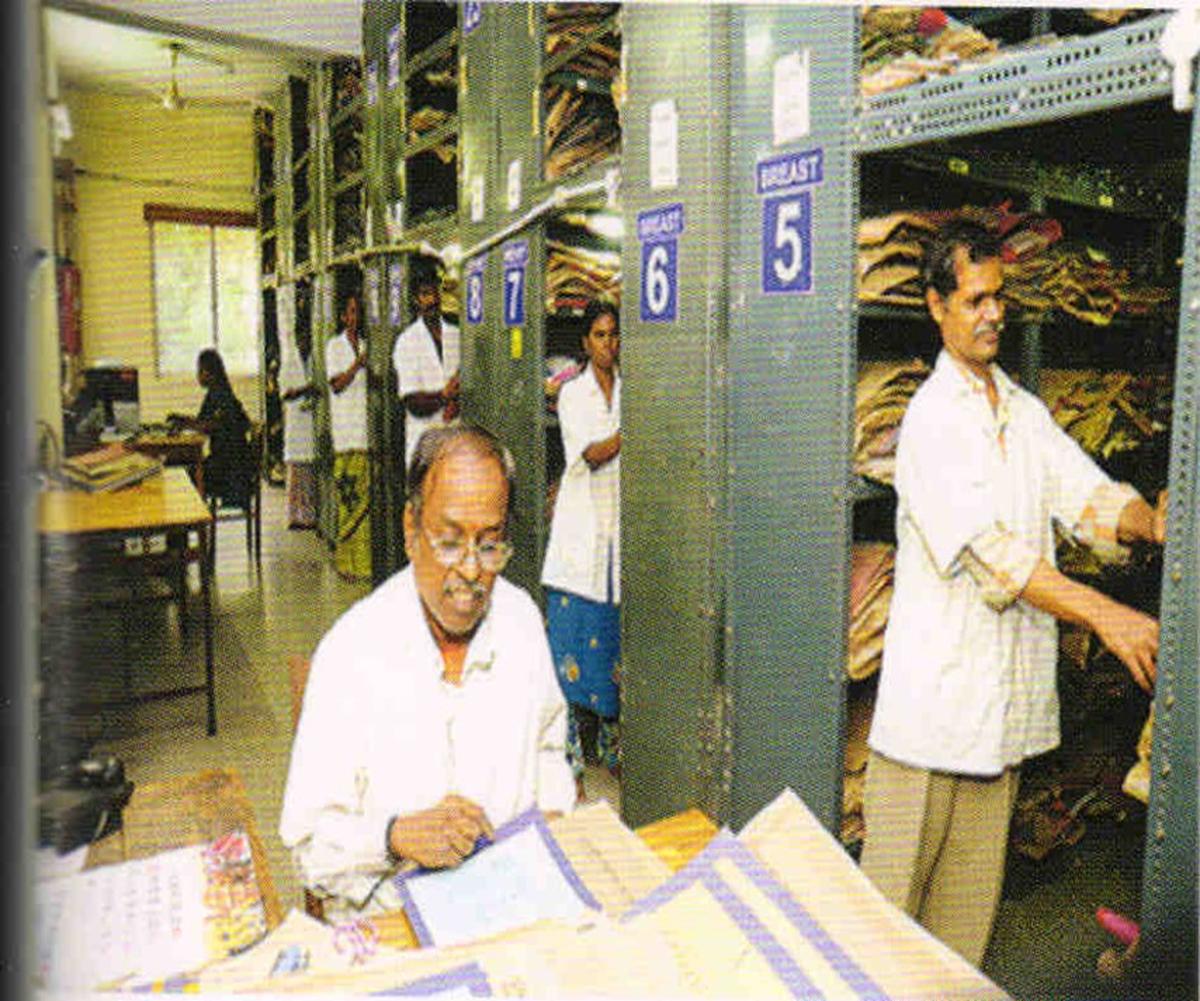
A view of the registry at the Cancer Institute, Adyar in its initial days
| Photo Credit:
Special Arrangement
The first PBCR in Tamil Nadu state, known as the Madras Metropolitan Tumour Registry (MMTR), was also established at Cancer Institute, Adyar, in 1982, by the Indian Council of Medical Research (ICMR) to count every new cancer case occurring among the resident population within Chennai city limits, in order to calculate the annual cancer burden, for value-added public health services.
Here, the data is obtained using a standard notification form from multiple sources under government and private sectors in and around the registry area, either by data abstraction from medical records by registry staff or from data received electronically: from cancer hospitals, other specialty hospitals, pathology labs, imaging centres, palliative services and death certificates.
It is only after the advent of MMTR that we came to know that stomach cancer was the most common among men, cervical cancer was the highest in Chennai among all urban cities in India, and breast cancer has been emerging as the commonest cancer since 2001. Next, a rural registry covering Dindigul district was established by the institute in 2003: this found that that cancer incidence in rural areas was half of that observed in Chennai city, and with an entirely differential common cancer pattern.

Scope of PBCR
Population-based cancer surveillance through the Tamil Nadu Cancer Registry Programme (TNCRP) now covers an 8 crore population, the largest by a single registry in the world since 2012 (https://tncrp.cancerinstitutewia.in/). The TNCRP is run by Cancer Institute, Adyar in collaboration with the Health and Family Welfare department, Tamil Nadu, and it was the work of this programme that led to cancer being declared as a notifiable disease in the State in 2018.
The new cancer burden is estimated to cross 1 lakh this year, occurring at the rate of one per 1,000 population. There are more women with cancer than men. Cervical cancer has shown a decreasing trend while it was the opposite for breast, oral and most other cancers.

Integrated information
The cancer registry programmes spearheaded by Cancer Institute, Adyar, to date, have given a clarion call for combined action by all stakeholders to generate high-quality information on cancer for Tamil Nadu.
At present, integrated data collection in different settings is ongoing by commissioning 21 HBCRs functioning in government medical college hospitals and private institutions across Tamil Nadu. Pattern of care studies have been mounted to deliver oncological outcome statistics. This will result in enriched data on cancer surveillance statistics, closely reflecting the real-world experience in the State.
The TNCRP has also triggered research among teaching faculty/students in multi-disciplinary studies on several cancers specific to their regions. The institute is also spearheading a special registry on childhood cancer covering the Greater Chennai Corporation population and is now expanding this expanded to undertake Statewide surveillance by soliciting the support of all oncologists in T.N.
“Regularity begets boredom” whereas “rarity fosters appeal” – the former is a myth that we have dispelled by showing that newer information is brought to the fore; the latter is a virtue we have embraced by embarking on newer, high-resolution studies. Cancer registration continues, serving as a means to achieve rational cancer control.
(Dr. R. Swaminathan is professor and head, department of epidemiology, biostatistics and cancer registry and associate director, Cancer Institute (WIA). r.swaminathan@cancerinstitutewia.org)
Published – November 07, 2025 10:38 am IST