


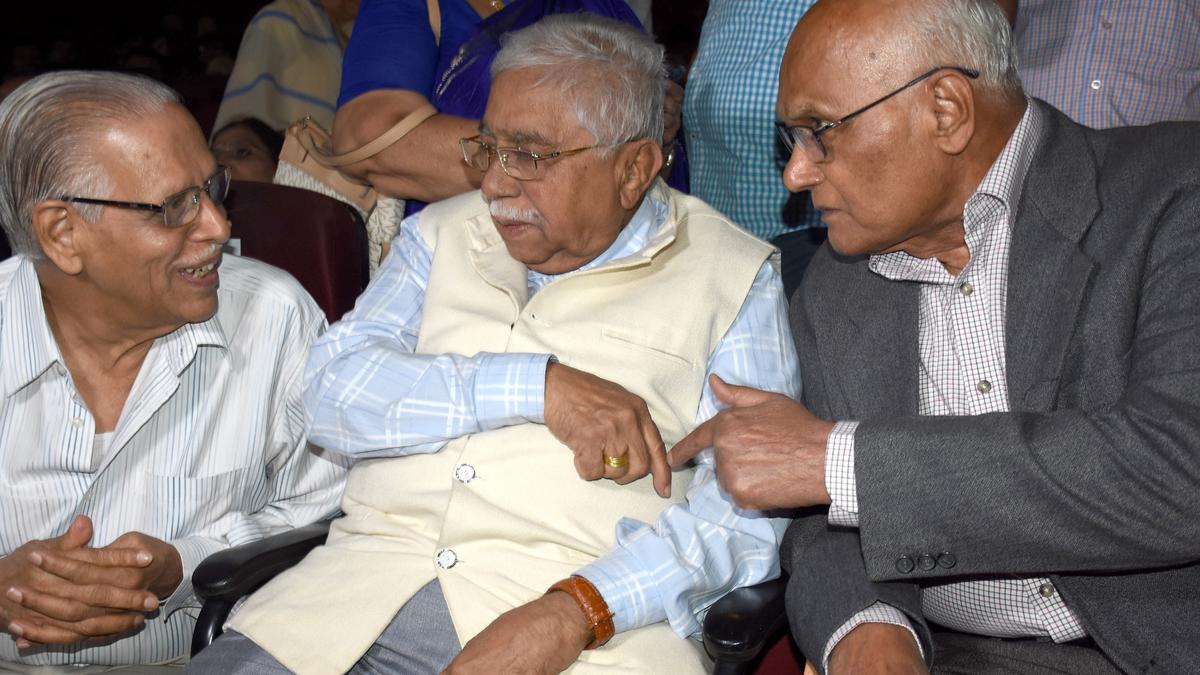
A file photo of S.L.Bhyrappa with Chandrashekar Kambara and Pradhan Gurudutt.
| Photo Credit: SRIRAM MA
What distinguishes S.L. Bhyrappa from his contemporaries was his fidelity to the form of the novel through his life of over six decades as a writer. He was also known for undertaking intense research ahead of writing his novels.
However, many of his works, while being bestsellers, also became controversial for what his critics called “conservative outlook” and the “Hindutva stances” they espoused, triggering intense debate and opposition from progressive sections of society.
Widely read and translated
From his first novel Bheemakaya in 1958 to his 25th and last novel Uttarakanda in 2017, after which he announced his retirement, Bhyrappa remained one of the most popular novelists of Kannada. Each of his novels saw multiple editions and the first novel he wrote when he was 27 is still being reprinted. All his novels came to be translated into multiple Indian languages, apart from English. He had a dedicated readership across the country.
His novels Vamsavriksha, Gruhabhanga, and Parva, a retelling of the Mahabharata, are considered to be classics of Kannada literature. He won the Saraswati Samman award for his novel Mandra in 2010. He was awarded the Padma Bhushan in 2023.
Retelling epics
Bhyrappa retold the two epics, the Mahabharata (Parva) and the Ramayana (Uttarakanda), reconstructing them in the social realism mode using the stream of consciousness narrative.
In an essay he wrote about researching for Parva, Bhyrappa writes about his travels in North India, visiting the places where the events of the Mahabharata are supposed to have taken place, including the Kurukshetra war.
His last novel Uttarakanda, told from the perspective of Sita, was well received even by the progressives and was a sort of a departure from his earlier novels, which faced the criticism that he rarely wrote well-etched women characters. His earlier novel Kavalu (2010) had especially received criticism for being what many termed “anti-feminist.”
Bhyrappa often experimented with subjects not much explored in Kannada. For instance, while Yaana was a science fiction novel, set in space, Anchu is a psychological novel, and Mandra was on the theme of music. Saartha and Avarana were controversial takes on history.
Conservative outlook
While Bhyrappa remained popular, many critics from the progressive school argued that his novels had a conservative outlook, which was often in collision with various Kannada literature movements — Navya, Bandaya and Dalit — which dominated the second half of the 20th century. His fictional works ran parallel to these movements.
Bhyrappa had once characterised his fiction as “Shuddha Sahitya” (pure literature), while alleging that many of his contemporaries who had identified with literary movements “wrote with an agenda.”
This saw intense pushback from other writers, who argued that even Bhyrappa’s novels espoused an agenda — of the Hindutva right — and took conservative stances.
Some of his novels, especially Avarana, triggered a huge controversy, for its portrayal of Muslim rulers and conversion. The novel even had footnotes referring to historical sources based on which he claimed the novel was written. But it was criticised for “selective communal reading” of history.
In his later years, Bhyrappa was an avowed supporter of Prime Minister Narendra Modi. In his condolence message, Mr. Modi described Bhyrappa as a writer “who stirred our conscience and touched the soul of India.”
Published – September 25, 2025 01:08 am IST



