


Khilesh Dewangan, a 40-year-old Congress leader in Chhattisgarh, knows the odds are stacked against him. Yet, there is confidence in his stride as he submits his credentials to be appointed as the party’s Raipur Rural district president.
He believes the Sangathan Srijan Abhiyan (SSA), which translates as organisation re-creation campaign – the Congress’s new experiment in leadership selection – gives workers like him a rare chance to break through entrenched hierarchies. “In the normal course of things, my age and relative stature would have gone against me,” Dewangan admits with a smile.
An appointment process that sits neatly between “the usual nominations” and a full-fledged organisational election, the SSA involves neutral observers from other States shortlisting six potential contenders for the post of District Congress Committee (DCC) president.
The 850 DCC presidents have become the focal point of the party’s revival programme. Under the DCCs, there are three other tiers: block-, mandal-, and booth-level leadership.
The SSA was adopted in April at the Ahmedabad session of the All India Congress Committee (AICC), a central decision-making body that is at the top of the party’s organisational structure. The other tiers include the Congress Working Committee that runs the party’s daily affairs, the Pradesh Congress Committee that consists of heads of States, and the DCCs for which heads are being chosen. The observers for the DCC selection process belong to the AICC.
Once termed “the Congress System” by political scientist Rajni Kothari to describe the party’s dominance in India’s political system, the party’s bulky machinery is beset with both internal and external problems today. Critics argue that its highly centralised leadership and dynastic predilections have stymied the growth of grassroots workers. Externally, the Bharatiya Janata Party (BJP) and its Hindutva platform have changed India’s political narrative, with the Congress struggling to offer an effective counter.
Though it has nearly six crore members, the 139-year-old party’s political footprint has steadily declined over the years. The Congress has not been in power at the Centre since 2014 and is ruling only three States – Karnataka, Telangana, and Himachal Pradesh – of the country’s 28. It is now hoping to create a more agile and accountable structure by combining youth outreach, conducting performance-based reviews, and balancing social representation through the SSA.
“After the Udaipur Declaration [of May 2022], Rahul Gandhi [Leader of the Opposition in the Lok Sabha] and Mallikarjun Kharge [Congress president] started this initiative. Under this, it was decided that 50% of district presidents would be below the age of 50,” says former Rajasthan Chief Minister Ashok Gehlot. He hopes that the endeavour will stay true to the plan and that the AICC will not end up picking candidates of its choice without considering merit.
The DCCs have been empowered to take both political decisions and share financial responsibilities for their regions. They will also be held accountable for their performance, which will be measured in terms of organisation-building right up to the polling booth, election management, ground-level activity, and responsiveness to the demands of party workers. So far, the party has undertaken the exercise in 10 States, beginning with Gujarat.
Grassroots workers find their voice
In the earlier system of appointing DCC presidents, the heads of Pradesh Congress Committees would hand-pick their nominees. Now, people can apply for the job.
“It is not often that someone like me can even be talked about as a contender. Usually, those who orbit around senior leaders automatically make the cut. This time, even standing in the ring matters,” Dewangan says.
One of his rivals is the son of a former Pradesh Congress Committee president, but Dewangan insists that is precisely why the process matters. “It will energise the cadre,” he says, speaking for hundreds of other hopefuls.
In Chhattisgarh’s capital, Raipur, preliminary discussions have begun to narrow down the list of six candidates for the rural and city organisations. There are 41 organisational districts in the State where the party has suffered a hat-trick of defeats, including the Assembly election of December 2023.
At the Raipur district office, where AICC observer Prafulla Vinodrao Gudadhe from Maharashtra is holding marathon meetings with nearly 300 office-bearers, the mood is upbeat. Contenders wait in the corridor clutching their nomination papers and rehearsing their pitches. Discussions are long, sometimes tense, but for many, this is the closest they have come to being heard.
“Even if I make it to the shortlist, it raises my stature. At least now I’ll be seen as being on a par with an MLA,” says an aspirant in his 40s who doesn’t wish to be named.
Leaders map progress
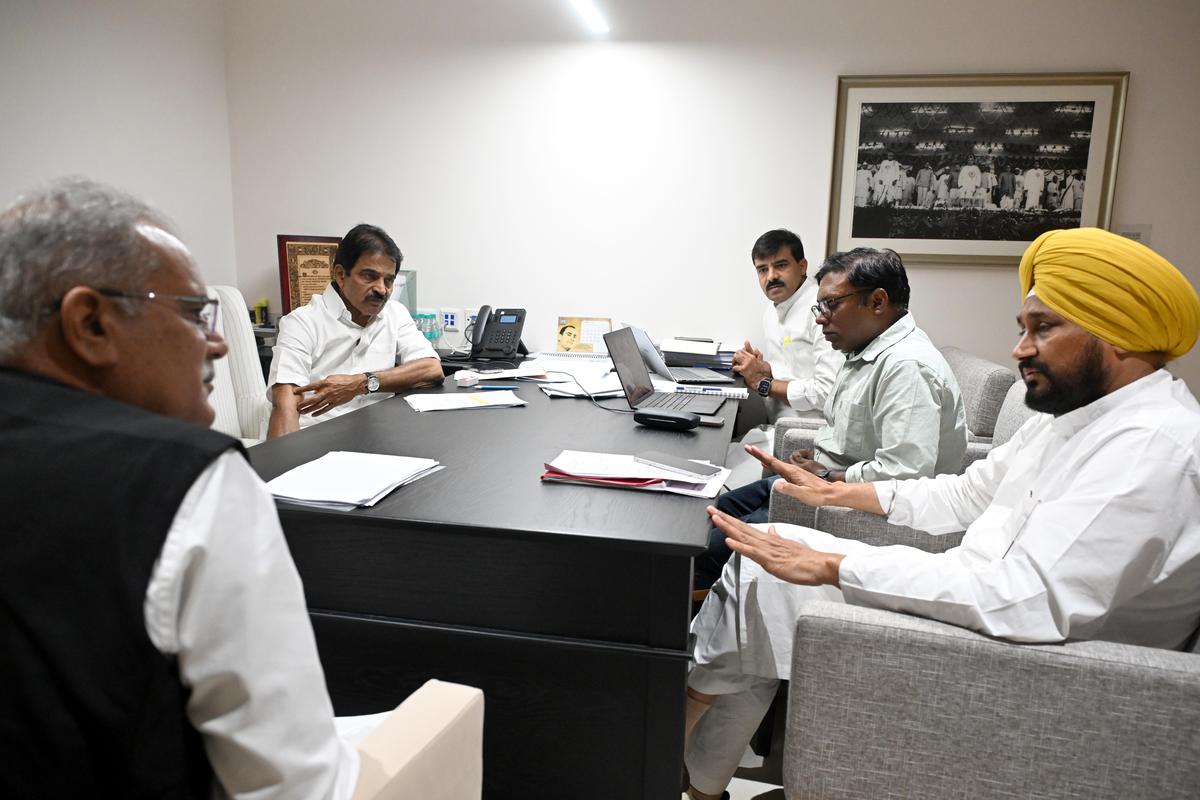
(From left) AICC general secretary Bhupesh Baghel, Congress general secretary (organisation) K.C. Venugopal, Punjab party chief Amrinder Singh Raja Warring, Congress MP from Tamil Nadu Sashikanth Senthil, and former Punjab Chief Minister Charanjit Singh Channi during a meeting at Indira Bhavan, the party headquarters in New Delhi that was inaugurated in January this year.
| Photo Credit:
SHASHI SHEKHAR KASHYAP
Over 1,100 km away, Congress leader K.C. Venugopal, the man who is leading the party’s revival efforts as general secretary (organisation), is busy meeting leaders from Punjab along with the AICC general secretary in charge of the State, Bhupesh Baghel, to review the organisation-building exercise. Bureaucrat-turned-politician Sashikanth Senthil, who represents Tamil Nadu’s Tiruvallur constituency in the Lok Sabha, also joins the discussion as he heads the Congress war room. Former Punjab Chief Minister Charanjit Singh Channi and State Congress chief Amrinder Singh Raja Warring wait for their turn to meet Venugopal.
“Observers, guided by the Congress president and Rahul Gandhiji, spend a week in each district, consulting thousands of local workers and community leaders. This is the most participatory selection process the party has ever undertaken,” Venugopal says between his meetings at Indira Bhavan, the party headquarters in New Delhi that was inaugurated in January this year.
He says the party’s analysis reveals that it is expanding wherever the organisational structure – from block to booth committees – is strong.
“Now, appointments are based on consultation and performance, ensuring community representation and grassroots strength. Not all DCCs perform equally well, but we are monitoring their work daily, assigning clear tasks and verifying results,” he says, warning that those who fail to deliver will be replaced within five to six months. This accountability is part of the party’s new experiment.
Venugopal, with the help of the Congress war room, monitors the progress of tasks given to district units every fortnight or so. From door-to-door campaigns of the party’s national drives against alleged vote theft and the special intensive revision of electoral rolls to defending the constitutional rights of people, the organisational revamp also seeks to keep party workers engaged. “The goal is to take the Congress’s ideology to the ground, rebuild booth-level committees, and bring influential local figures into the organisation. The biggest advantage now is data. For the first time, we have detailed information on every district,” the senior Congress leader adds as the party maps its presence down to the polling booth level.
He says the party has also begun large-scale 10-day training camps in which Gandhi will participate. “The Congress’s core message is simple: stand by the Constitution, protect the marginalised, and empower local leaders to rebuild the party from the bottom up,” he says.
Odisha finds hope
The Congress last came to power in Odisha in 1995 under the late J.B. Patnaik, with Giridhar Gamango and the late Hemanand Biswal subsequently leading short-lived stints.
The 1999 Super Cyclone marked a watershed moment not only in the State’s history of disasters but also in its politics as the State government’s faltering response and allegations of corruption severely dented its credibility. With the emergence of Naveen Patnaik of the Biju Janata Dal (BJD), who reshaped Odisha’s political landscape, the Congress’s electoral presence in the State steadily eroded. Between 1995 and 2024, its vote share declined from 39.1% to 13.4%.
The reasons are both structural and political: a weakened cadre network, recurrent factionalism, and the inability to counter either the BJD’s organisational dominance or the BJP’s rapid expansion in the State.
Under the SSA, 35 new DCC chiefs – a mix of senior functionaries and younger entrants, many in their 30s – were announced on September 26 in Odisha. “As per the SSA framework, district- and State-level war rooms will monitor activities through a live digital dashboard. Every booth committee must be fully functional ahead of polls,” says OPCC chief Bhakta Charan Das.
The first test of the renewed leadership will come in the Nuapada Assembly bypoll, where the party hopes for a morale-boosting performance. Later in November, Gandhi is expected to hold an orientation session for new DCC chiefs as the party seeks to rebuild the organisation in the State.
Not everyone’s happy
Yet, the excitement has its shadows. Despite talk of inclusivity and the Udaipur Declaration promising wider representation, few women are visible in the race. Some say DCC chiefs are still being appointed on the recommendation of AICC observers. A party insider claimed that in Madhya Pradesh a DCC chief was appointed despite the candidate not even making it to the shortlist.
Many draw a parallel between the new appointment process and Gandhi’s “failed experiment” to appoint Youth Congress chiefs through U.S.-style primaries.
Gehlot feels no Congress leader should recommend names to the AICC observers, so that the selection process remains fair and transparent. “After the selection, all leaders should welcome and support the newly appointed district presidents. The Congress will only become stronger when we all work together with unity and loyalty to the organisation,” he says.
Gehlot had to intervene when party workers in Rajasthan went on strike demanding that the party high command follow the previous pattern of appointments. “We have seen such opposition in Haryana too, but we don’t approve of this type of conduct,” Venugopal says, outlining that one of the objectives of the revamp is to reflect a wider social composition of the leadership.
In Haryana, the party’s narrow defeat in the October 2024 Assembly election – by less than 1% of the votes – spurred introspection and urgency. Despite high expectations of a win, the Congress’s organisational weakness at the district level was glaring, especially compared with the BJP’s extensive ‘panna pramukh’ network to get its supporters to the booth.
The SSA spurred the party out of an 11-year paralysis. All 32 DCC presidents were appointed, balancing communities and factions within the party. Ten of the new district presidents come from groups belonging to the Backward Classes. The party aims to reach communities comprising nearly 40% of Haryana’s electorate.
The lone woman DCC president in the State, Santosh Beniwal, says it may take another month for the full organisational structure to be in place as the process to set up executive committees at district and block levels is under way. “The district presidents have sent the list for the executive committees, each comprising 31 members, for the district and booth levels. It will be followed by appointments at mandal levels,” she says.
In neighbouring Punjab, where the party witnessed intense factionalism earlier, Leader of the Opposition Partap Singh Bajwa says the exercise has helped reinvigorate grassroots workers. “The Sanghatan Srijan Abhiyan is not a routine membership or outreach drive – it is a bottom-up organisational rebuilding exercise. Unlike other campaigns that focused mainly on mobilisation during elections, this initiative is about institutional renewal and strengthening of the Congress at every level – booth, block, and district.”
Bajwa adds that the party is using data-driven feedback mechanisms to evaluate performance and participation, and to connect with the real issues of people – especially farmers, youth, and small entrepreneurs. “It is about rebuilding the Congress organisation, not just reactivating it.”
(Shubhomoy Sikdar in Raipur, Satyasundar Barik in Bhubaneswar, and Ashok Kumar in Gurugram; with inputs from Vikas Vasudeva in Chandigarh.)
Edited by Sunalini Mathew



