A little before 8 a.m. on a weekday, Dinakar Kumar Rao stays perched on his two-wheeler at the edge of Uppal junction, watching traffic crawl in slow motion. The skywalk above him may tower impressively, but the chaos below feels like a road network stuck mid-thought — cars edging forward, stopping, shuffling sideways, building pressure that bursts into honks.
Rao, 47, has lived in Boduppal for over a decade and has learnt to mark time by these rhythms. What he once assumed was temporary inconvenience on his long commute to Gachibowli has now settled into a daily test of patience. “What should have become easier has somehow become more complicated,” he says. “It is not just being stuck in traffic; it is the sense that movement itself has stopped making sense.”
Uppal junction embodies that confusion. One approach road is closed, forcing thousands of commuters into a long U-turn loop before they can rejoin the main road. The diversion adds only a few minutes, yet the irritation accumulates far beyond the number. “You take a loop, lose five minutes and end up exactly where you started,” he says.
Across the city, the pattern repeats. At Jubilee Hills, a car trying to beat a U-turn curve smashed into a bus in July, flinging its driver onto the bonnet. In Rasoolpura in September, a man was thrown off his scooter when a speeding vehicle cut through a U-turn near the NTR statue. Such incidents, buried in FIRs and routine police reports, say more about the city’s design anxieties than any traffic dashboard ever does.
The numbers underline the scale. Nearly 800 U-turns dot the tri-commissionerate — 439 in Cyberabad, about 200 in Hyderabad and nearly 150 in Rachakonda. Between 2021 and 2025, the city recorded 366 accidents at U-turn locations, including 25 fatal crashes. In 2024 alone, nearly 4% of all road accidents occurred at U-turn points. Police booked close to 20,000 violations for prohibited or improper turns over five years, with the numbers rising each year.
With roughly 1,500 new vehicles added daily and average speeds hovering at just 22-23 kmph, Hyderabad’s roads are inching close to saturation.
A city of revolving fixes
Authorities insist that U-turns exist for good reason. Each one, they say, goes through a proposal stage, GHMC approval and a trial run before opening. But over time, a pattern has emerged: U-turns open with fanfare, close under pressure, reopen with tweaks and quietly shut again. Tarnaka is the clearest example: reopened experimentally in April 2025 and shut within weeks after massive jams. Tolichowki has gone through similar flip-flop interventions. Even the TRANSCO U-turn near IKEA in Cyberabad was briefly redesigned as a junction before spiralling queues forced authorities to revert to the earlier layout.
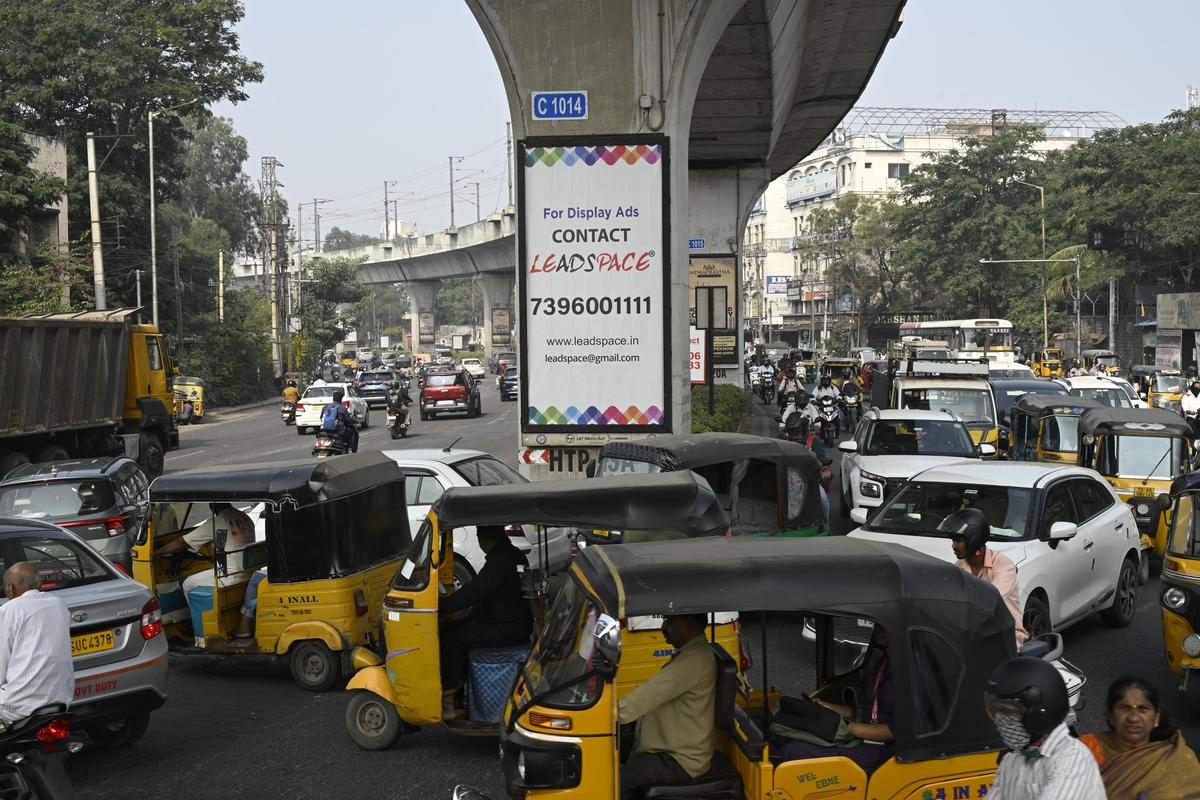
Commuters navigate a U-turn near Sudarshan Reddy Sweet House in Habsiguda, Hyderabad.
| Photo Credit:
Ramakrishna G.
Hyderabad Joint Commissioner of Police (Traffic) D. Joel Davis acknowledges the growing concern. “Each U-turn is introduced only after a trial to assess whether it solves congestion or adds to it. Now, teams are being formed to revisit all U-turns across the city to determine which should stay open and which must be closed,” he says.
For commuters, however, the city is not a policy blueprint but a daily negotiation, and those negotiations are wearing thin. Karkhana is a good place to see how.
Suresh Kumar, 54, has commuted on this stretch for over 30 years and remembers when late-night cricket matches in the bylanes were the biggest disturbances. “In the last two years alone, the U-turns on this two-kilometre stretch have opened and closed so many times that even regular drivers have stopped keeping count,” he says. “First it was near Mahankali temple, then shifted towards Grill 9 restaurant, then pushed further down, and now it sits half a kilometre before Vikrampuri signal.”
For residents, this has created its own arithmetic. A short trip to the corner store now means looping past a busy signal, adding minutes and irritation. “Anyone coming into Karkhana from Trimulgherry or Dairy Farm Road must go all the way to Vikrampuri just to double back home. From the outside it looks orderly, but the discomfort belongs to us,” says Kumar.
Those new to the city find the maze even harder to navigate. When Anita Verghese moved to Hyderabad a few months ago, she expected the city to be simpler than the metros she had lived in. Within days, she found herself circling through one U-turn after another across the western corridor. “It is confusing, exhausting and, frankly, unnecessary,” she says. “As a pedestrian, you feel like a non-entity because there is no signal to help you cross. It feels as though signals were removed, U-turns put in their place to create an illusion of movement and everyone just went along with it.”
That illusion matters. While U-turns theoretically reduce delays by eliminating signal stops, the extra distance and merging time often exceed what a red light would have required. In peak hours, reaching a U-turn 300-400 metres ahead can take over a minute, followed by another half-minute to merge. Analysis shows many commuters spend more than 90 seconds on a U-turn manoeuvre, longer than the average 70-second delay at a properly timed signal.
The Hyderabad traffic police estimate that major U-turns cause delays of 30-60 seconds while regular ones average 10-25 seconds. But poorly designed or poorly placed U-turns often become collision traps. Median openings on divided roads carry critical conflict volumes, with turning vehicles clashing with through traffic. Even small shifts in geometry or location can alter safety outcomes. When a U-turn replaces a junction signal without a proper merging zone, pedestrian space or safe crossing points, the risk of pedestrian conflicts and wrong-side manoeuvres spikes immediately.
Madhapur Traffic DCP T. Sai Manohar says the attempt to save time often backfires. “Many motorists try to avoid the longer loops by cutting the wrong side, especially near U-turns. It creates dangerous situations and contributes to accidents,” he says.
Urban planners argue that Hyderabad’s reliance on U-turns reflects a deeper issue. A traffic and mobility researcher, requesting anonymity, says U-turns have served as “relief valves” in a system designed for a different era. “Traffic is expanding rapidly but road width is not. The carrying capacity of many corridors is no longer enough,” he says. In stretches where widening is impossible, due to properties, heritage structures or terrain, U-turns became the quick fix to keep traffic crawling rather than coming to a full stop.
Jubilee Hills, he says, is the sharpest example of this mismatch. “These were interior residential roads built decades ago. They now serve as one of the main links between Hyderabad and Cyberabad. They were never designed for these volumes,” he adds. Placing U-turns directly at junctions, he warns, creates “zones of collapse” by introducing conflict at already vulnerable points.
Between signals and shortcuts
Compounding the problem is the unpredictability of traffic flows. Movement has shifted dramatically from a north-south axis to an east-west one, which is precisely where public transport is weakest, according to Anant Mariganti of Hyderabad Urban Lab, an interdisciplinary research and action initiative. “These roads have fewer buses, more private vehicles and more commercial intensity. The system is trying to swallow growth at a rate it was never prepared for,” he explains.
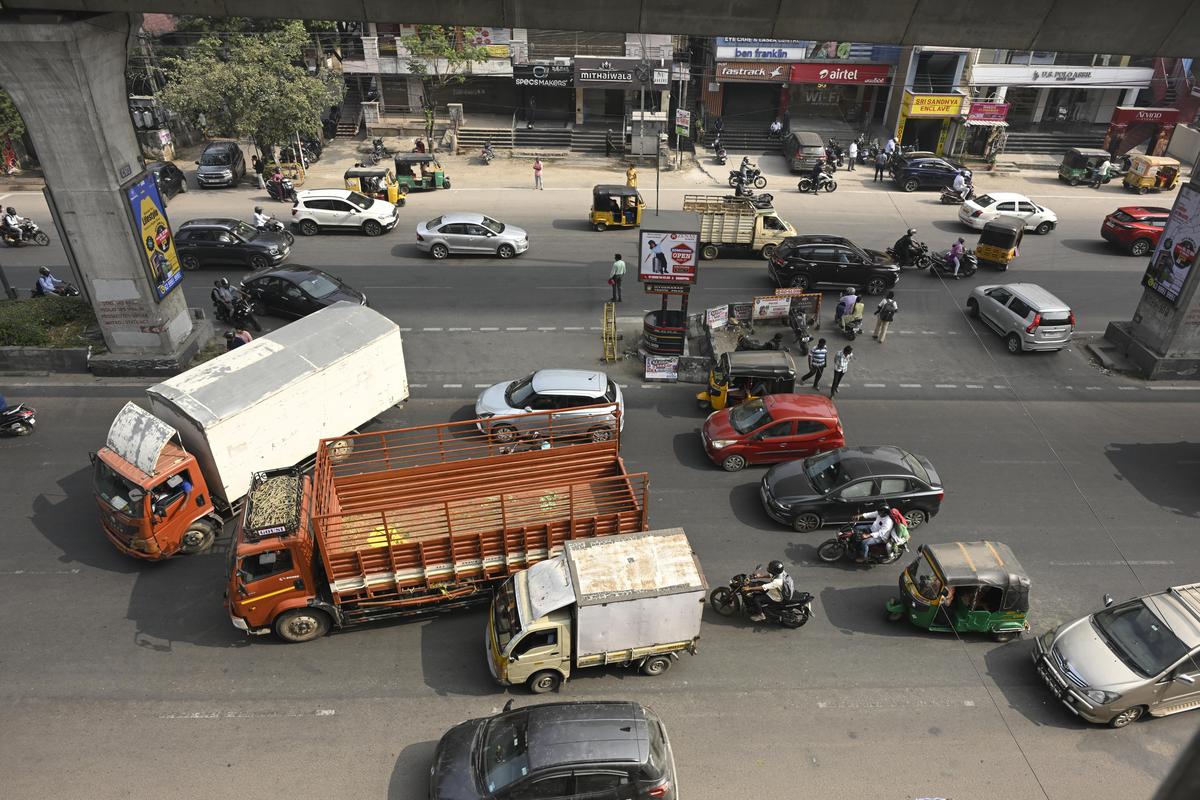
Poorly designed diversion points are leading to delays, violations and accidents across the city.
| Photo Credit:
RAMAKRISHNA G.
To him, the U-turn versus signal debate misses the point. “The solution is not in choosing U-turns or signals. We need a broader systemic response, and no one is thinking in that direction,” he says, pointing to a governance vacuum that cuts across departments.
He argues traffic authorities are forced into constant experimentation because the city lacks a stable mobility model. “The problem is too dynamic to be modelled. Land use is changing, vehicles are multiplying, commute patterns are shifting. With no coherent citywide model, the police are doing what they can with limited tools.”
He says the mandate itself is part of the issue: “Their job is to keep vehicles moving. Movement and mobility are not the same. When signals create the perception of stagnation, U-turns are introduced to create the perception of flow. It is an illusion but the system rewards the illusion.”
He says the real map of the city lies not in official data but in the unreported non-fatal accidents, near misses and daily strain on commuters. “These are the hidden costs. They do not show up in charts, but they shape lived experience,” he says.
Engineering experts add another layer to the debate. Hyderabad’s core issue is the blanket application of U-turns without context-specific analysis, says Srinivas Ganji, director at Arcadis, a global design, engineering and consultancy firm. “The idea became that if vehicles are moving, the problem is solved. But what matters to commuters is not movement, it is time,” he says. Authorities, he notes, often depend on digital map indicators to judge performance. “A green stretch on a map can be misleading. Vehicles may be ‘moving’ but at very low speeds.”
He argues that decision-making must shift to simulation-backed planning. “We need to understand through movement, right-turn and left-turn volumes and merging speeds. U-turns only work when right-turn volumes are low. If high volumes converge at a median opening, all you are doing is shifting the bottleneck.” Heavy vehicles, especially buses, slow the system even further. “On wide high-speed corridors, a large vehicle taking a U-turn can cut the flow instantly.”
According to him, the most damaging delays are the ones commuters don’t immediately perceive. “You might feel you are constantly moving but when you analyse the time lost in detours, merging conflicts and speed drops, the delay is often worse than at a signalised junction,” he says. Vehicle-actuated signals, which adjust timings based on real-time demand, are often far more efficient.
Geometry, design and the road ahead
Where planners, commuters and police converge is in the geometry problem. U-turns depend on alignment, sight distance, median width, turning radius and pedestrian conflict points. And Hyderabad struggles with almost all of them. Many U-turns are located where roads narrow or bend; others lie too close to bus stops or lay-bys. Multiple streams of traffic merge within short stretches, and with weak lane discipline, conflict points multiply.
The TRANSCO U-turn near IKEA illustrated this well. Its initial design forced vehicles to cut across several lanes in a tight arc. When it was briefly redesigned as a junction, the system collapsed within a day. Officials reverted to the U-turn simply because neither layout could handle the underlying pressure.
Even so, planners caution that U-turns are not inherently flawed. Ganji says they work only when certain conditions line up: high turning volumes, moderate through speeds, safe geometry, managed pedestrian/cyclist conflict and adequate merging distance. “In Hyderabad, many of these conditions are not met. When a U-turn adds distance or slows vehicles, the idea collapses. It becomes a detour disguised as a shortcut,” he says.
During peak hours, he notes, reaching the U-turn often takes longer than waiting at a signal.
For now, commuters adapt in their own small ways. Rao adjusts his departure time by 10 minutes every year while Kumar avoids Karkhana’s U-turn maze by slipping through narrow parallel lanes.
What their stories reveal is not just frustration but fatigue. U-turns were meant to ease stagnation; instead, they have become the visible seams of a system stretched beyond capacity.
Those studying the issue say a way forward exists but requires a shift in mindset. Bengaluru’s ASTraM (Actionable Intelligence for Sustainable Traffic Management) platform shows how data-driven modelling can cut congestion, emissions and travel time. If Hyderabad invests in similar predictive tools, it can move beyond reactive fixes.
They also call for transparent, junction-by-junction evaluation of every U-turn. If each tweak were publicly logged with before-and-after impact, decisions could move from perception to measurable outcomes. Cross-functional teams involving traffic police, municipal engineers, transport planners and behavioural specialists could bring consistency to design instead of patchwork improvisation.
Until then, the city will keep depending on workarounds. The skywalk at Uppal will rise above stalled traffic. U-turns will open and close like valves in an overworked machine. Google Maps will keep painting its reassuring green lines. And commuters like Rao will inch across the city each day, caught between movement and the illusion of it.