


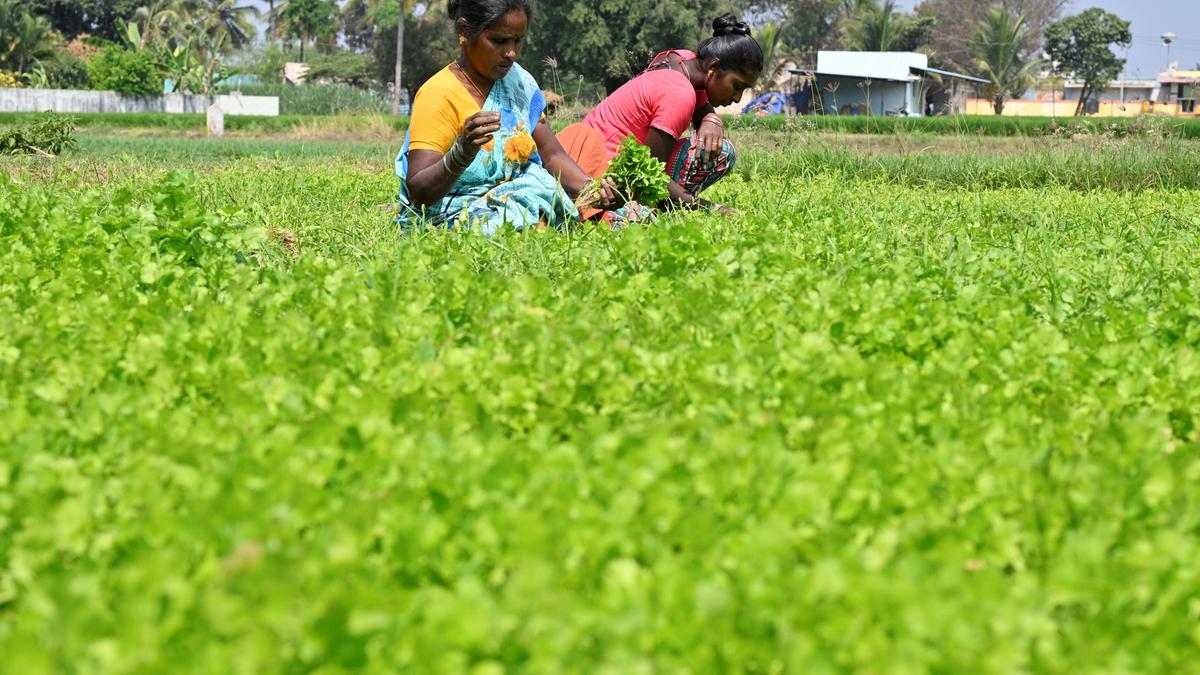
Image used for representational purposes only
| Photo Credit: C. Venkatachalapathy
Several key areas in Tamil Nadu’s agricultural sector require immediate attention to ensure sustainable growth and resilience. This was categorically stated by the State Planning Commission (SPC) in the State’s Economic Survey 2025-26, which was released on Monday (February 16, 2026).
Stating that since 2001-02, Tamil Nadu lost approximately two lakh hectares of net sown area and witnessed a rise in fallow land, the SPC pointed to underutilised cultivable land, while emphasing the need for policies to reclaim and optimise fallow lands. Referring to the decline in surface irrigation sources, such as canals and tanks, accompanied by stagnancy in net irrigated area, the panel called for promoting efficient groundwater management in view of wells, invariably used through electrified pumpsets, dominating the net irrigated area.
“Heavy dependence on local markets for inputs and outputs underscore the necessity for enhanced sustainable input systems and market infrastructure development. Stagnation in yields of key crops like paddy, pulses, and important fruits need [s] to be addressed to improve livelihoods of agricultural households, ” the Commission observed.
Lauding the livestock sector for showing “remarkable growth,” the SPC said this had emerged as a “key driver amid the declining fortunes” of the crop sub-sector. Its contribution to gross value added from agriculture, forestry, and fishing rose from 30% in 2011-12 to 53% in 2024-25. “This sector needs attention through cold storage infrastructure development State-wide to curb wastage in marketing perishable products like eggs, meat, milk, and fish, alongside strengthened support for sustainable practices and market linkages.”

Though paddy had retained its status as the dominant cereal crop of the State, maize cultivation went up significantly. Between 2001-02 and 2023-24, it grew a compound annual rate of 7.5% with the area under maize going up by 3.6 lakh hectares from less than one lakh hectare in 2001-02. This was “primarily because of its demand as poultry feed.” At the same time, all other cereal crops such as “cumbu ragi, kora, varagu, and samai have seen an absolute decline in area under cultivation over the period.”
Speaking of the awareness of farmers about the Minimum Support Price (MSP) for various crops, the Commission recorded the awareness level remained limited. “[The] Survey evidence from 2018-19 suggests that around 68% of agricultural households were unaware of the MSP for paddy and nearly 90% unaware of the MSP for maize, highlighting the need for improved information dissemination and assured procurement to mitigate market risk.” About 80% of households relied on local markets for both input procurement and output sales, underlining the centrality of these market spaces and the urgency of investments in storage, transport, grading, and trading infrastructure to enhance efficiency and farmer welfare.

Favouring the adoption of bio-inputs and less dependence on chemical inputs, the SPC stated despite the presence of a number of extension institutions, there were constraints in their outreach. This had only underscored the need for strengthening extension systems to ensure timely access to reliable technical knowledge. In addition, only a small proportion of households possess soil health cards, even though “soil-specific nutrient management is central to both productivity and sustainability. Expanding soil testing capacity and strengthening soil health laboratory networks are therefore essential for promoting efficient input use and safeguarding the long-term ecological viability of agriculture in Tamil Nadu,” the Commission recommended.
Published – February 16, 2026 04:44 pm IST



