

By using this site, you agree to the Privacy Policy and Terms of Use.
Accept
India Times NowIndia Times NowIndia Times Now
Notification Show More
Font ResizerAa
  • India News
    India News
    Politics is the art of looking for trouble, finding it everywhere, diagnosing it incorrectly and applying the wrong remedies.
    Show More
    Top News
    The States Braces for Protests Over New COVID Rules
    August 29, 2021
    A.P. Chambers draws GST Council’s attention to issues that need redressal
    October 21, 2025
    Yunus keen to improve ties with India, says adviser
    December 24, 2025
    Latest News
    Giraffe dies at Bannerghatta Biological Park
    May 7, 2026
    SC panel orders removal of encroachments on Dalit lands, graveyards
    May 7, 2026
    Telangana accounts for 20% of human trafficking cases in India
    May 7, 2026
    GEMS Hospital earns Royal College of Surgeons of England accreditation
    May 7, 2026
  • Technology
    TechnologyShow More
    Strengthening the Team: Thryve PR Onboards Pranjal Patil as PR Executive & Project Manager
    October 1, 2025
    How to Take the Perfect Instagram Selfie: Dos & Don’ts
    October 1, 2021
    Apple iMac M1 Review: the All-In-One for Almost Everyone
    Hands-On With the iPhone 13, Pro, Max, and Mini
    September 4, 2021
    Apple VS Samsung– Can a Good Smartwatch Save Your Life?
    August 30, 2021
  • Posts
    • Post Layouts
      • Standard 1
      • Standard 2
      • Standard 3
      • Standard 4
      • Standard 5
      • Standard 6
      • Standard 7
      • Standard 8
      • No Featured
    • Gallery Layouts
      • Layout 1
      • Layout 2
      • layout 3
    • Video Layouts
      • Layout 1
      • Layout 2
      • Layout 3
      • Layout 4
    • Audio Layouts
      • Layout 1
      • Layout 2
      • Layout 3
      • Layout 4
    • Post Sidebar
      • Right Sidebar
      • Left Sidebar
      • No Sidebar
    • Review
      • Stars
      • Scores
      • User Rating
    • Content Features
      • Inline Mailchimp
      • Highlight Shares
      • Print Post
      • Inline Related
      • Source/Via Tag
      • Reading Indicator
      • Content Size Resizer
    • Break Page Selection
    • Table of Contents
      • Full Width
      • Left Side
    • Reaction Post
  • Pages
    • Blog Index
    • Contact US
    • Search Page
    • 404 Page
    • Customize Interests
    • My Bookmarks
  • Join Us
Reading: Swamp soil yields evolution of Kaziranga’s vegetation
Share
India Times NowIndia Times Now
Font ResizerAa
  • Finance ₹
  • India News
  • The Escapist
  • Entertainment
  • Science
  • Technology
  • Insider
Search
  • Home
    • India Times Now
    • Home 2
    • Home 3
    • Home 4
    • Home 5
  • Categories
    • Technology
    • Entertainment
    • The Escapist
    • Insider
    • Finance ₹
    • India News
    • Science
    • Health
  • Bookmarks
    • Customize Interests
    • My Bookmarks
  • More Foxiz
    • Blog Index
    • Sitemap
Have an existing account? Sign In
Follow US

Home » Swamp soil yields evolution of Kaziranga’s vegetation

India News

Swamp soil yields evolution of Kaziranga’s vegetation

Times Desk
Last updated: December 31, 2025 10:32 pm
Times Desk
Published: December 31, 2025
Share
SHARE


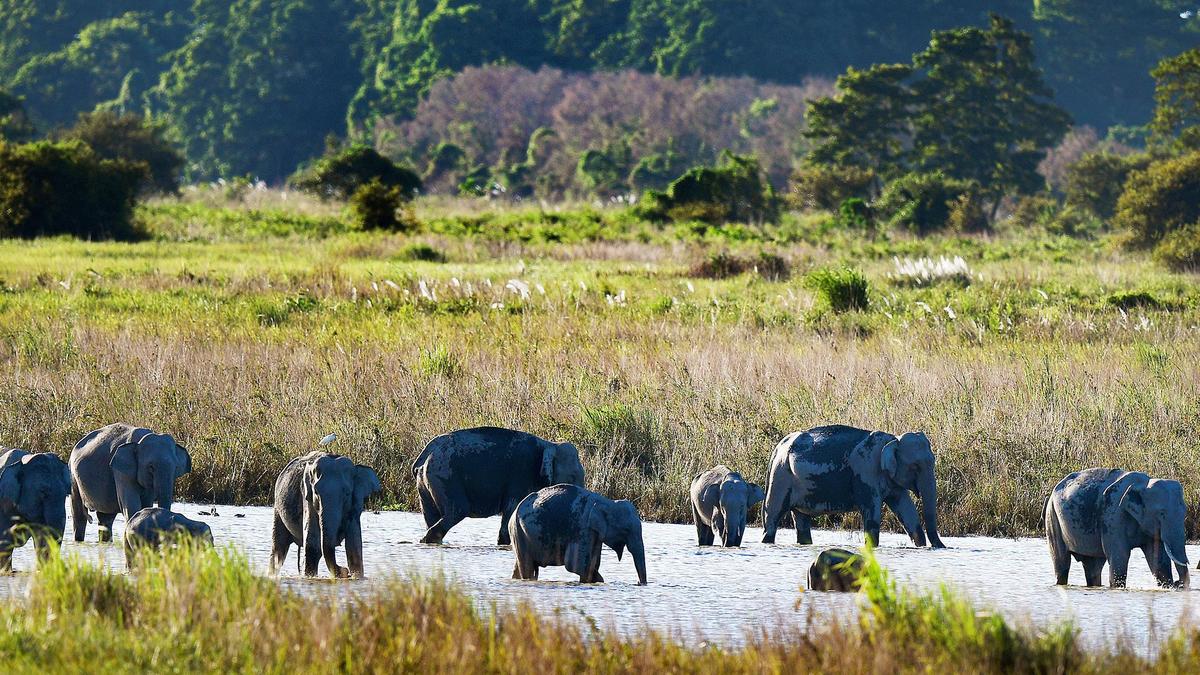
From 640 years BC to the present, Kaziranga became more open, with widespread grasslands and fewer dense forests. File.

From 640 years BC to the present, Kaziranga became more open, with widespread grasslands and fewer dense forests. File.
| Photo Credit: RITU RAJ KONWAR

A new scientific study of swamp soil has uncovered how the vegetation of Assam’s Kaziranga National Park has evolved over 3,000 years to make it the prime habitat of the Indian one-horned rhinoceros.

Published in the Netherlands-based Catena, an interdisciplinary journal of soil science and geomorphology, the study also highlights the movement of the large herbivores from the northern and western parts of the Indian subcontinent to the northeastern region. 

The authors of the study in the 430 sq. km Kaziranga National Park are Sadhan K. Basumatary, Siddhant Vaish, and Swati Tripathi of Lucknow’s Birbal Sahni Institute of Palaeosciences; Eline N. Van Asperen of Newcastle University; H. Gregory McDonald of Denver Museum of Nature and Science, USA; Rajib Gogoi of Botanical Survey of India’s Himalayan Regional Centre in Gangtok, and Ajay Kumar Arya of University of Lucknow. 

The scientists collected a 110-centimetre-deep sedimentary soil from the northwestern side of Kaziranga’s Sohola swamp at intervals of 5 cm for palynological analysis and radiocarbon dating. The layer, containing pollen grains from plants and microscopic fungal spores linked to animal dung, acts like a natural history book. 

By studying these tiny remains and dating them, scientists reconstructed how vegetation, climate, and the movement of large animals changed over time. 
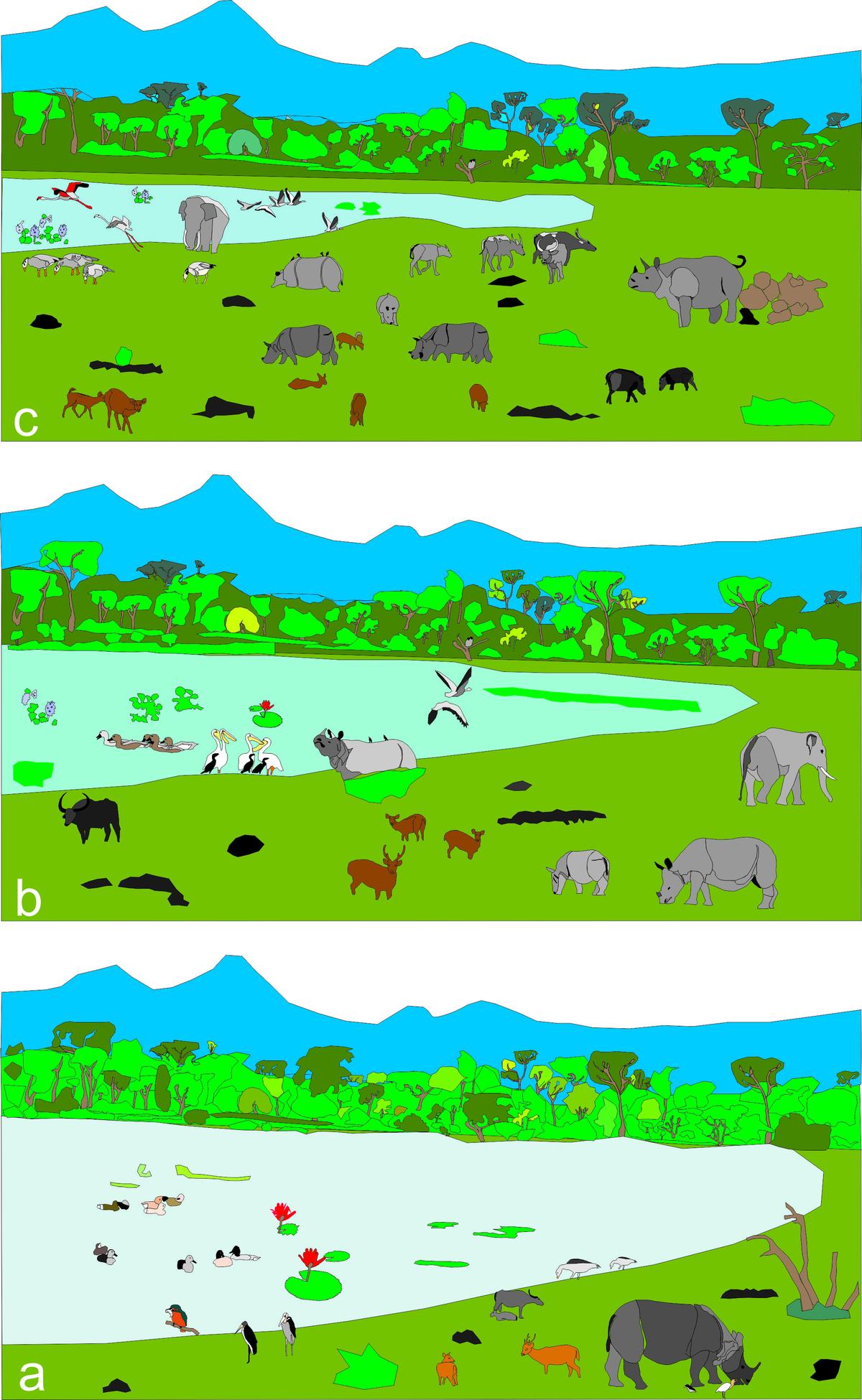
Pictorial evolution showing a. Dense forest with wider and swamp conditions with low wildlife activities (3290 years -1700 years), b. Relatively less dense and less deep water with increased wildlife activities (1700 years-640 years), c. Comparatively less dense forest and a less deep swamp with increased wildlife activities within KNP (640 years-present). Photo: Special Arrangement

Pictorial evolution showing a. Dense forest with wider and swamp conditions with low wildlife activities (3290 years -1700 years), b. Relatively less dense and less deep water with increased wildlife activities (1700 years-640 years), c. Comparatively less dense forest and a less deep swamp with increased wildlife activities within KNP (640 years-present). Photo: Special Arrangement

“Kaziranga looked very different 3,290-1,700 years before present (BP). The park during that phase of warm and humid climatic conditions had a tropical dense mixed forest dominated by Bombax, Cinnamomum, Duabanga, and Lagerstroemia trees, with less grasslands,” Dr Basumatary told The Hindu. BP is a time scale where ‘present’ is fixed at the year 1950. Fungal spores were found in small amounts, indicating fewer grazing animals during this phase.

Expanding grassland

The soil study further showed that the vegetative cover began to change between 1,700 and 640 years BP. The evergreen forests slowly declined, and deciduous trees and grasses began taking up the space. 

“This shift suggested slightly drier conditions and more open landscapes. Around this time, dung-related fungal spores increased, showing that large plant-eating animals were becoming more common,” Dr Basumatary said.

This period also marked the first appearance of Mimosa, an invasive plant species. Its arrival hinted at early ecological disturbance, possibly linked to climate stress or increasing human activity in nearby regions. “The invasion of Mimosa needs proper management,” Dr. Gogoi said. 

From 640 years BC to the present, Kaziranga became more open, with widespread grasslands and fewer dense forests. Dr Tripathi said that there was a strong impact of the Little Ice Age in the northern region of India, which eventually affected the wildlife habitat. 

“We found a sharp rise in fungal spores during this period, suggesting an increase in the numbers of megaherbivores such as rhinos, elephants, buffaloes and deer,” she said.

While Kaziranga’s sedimentary profile revealed the absence of agricultural activities, the scientists hypothesised that the rhinos migrated to the park from the western and northern parts of the Indian subcontinent due to climate changes and growing human pressure. 

The hypothesis was based on a comparative analysis of vegetation dynamics and climatic variables, with earlier recorded rhinoceros bone fossils and historical records. 

Kaziranga is home to more than 70% of the world’s total population of some 3,700 greater one-horned rhinoceros, making it the most critical habitat for the species.

Published – January 01, 2026 04:02 am IST


Source link

Census 2027 to be first fully-digital exercise; House Listing Operations from May 11: Telangana says CS
Crucial meeting scheduled in Delhi to shortlist DGP candidates for Tamil Nadu deferred
LPG crisis updates LIVE: Oil prices climb as Iranian boats hit two fuel oil tankers
Four TMC, one BJP candidate file nominations for Rajya Sabha elections in West Bengal
With Congress’s Rajya Sabha picks from Telangana, Revanth Reddy strengthen’s his grip
TAGGED:KazirangaKaziranga swamp soilKaziranga vegetation
Share This Article
Facebook Email Print
Leave a Comment

Leave a Reply Cancel reply

Your email address will not be published. Required fields are marked *

Follow US

Find US on Social Medias
FacebookLike
XFollow
YoutubeSubscribe
TelegramFollow

Weekly Newsletter

Subscribe to our newsletter to get our newest articles instantly!
[mc4wp_form]
Popular News

Sajjanar takes bus ride on last day as TGSRTC MD

Times Desk
Times Desk
September 29, 2025
Linking women’s reservation with delimitation is unconstitutional, contends G. Ramakrishnan
Tiger that killed Adivasi woman in Nilgiris captured
Stocks making the biggest moves after hours: INTC, CLX, COF
Economic Survey calls for tackling rising digital addiction as it hits academic performance, productivity
- Advertisement -
Ad imageAd image
Global Coronavirus Cases

Confirmed

0

Death

0

More Information:Covid-19 Statistics
© INDIA TIMES NOW 2026 . All Rights Reserved.
Welcome Back!

Sign in to your account

Username or Email Address
Password

Lost your password?

