


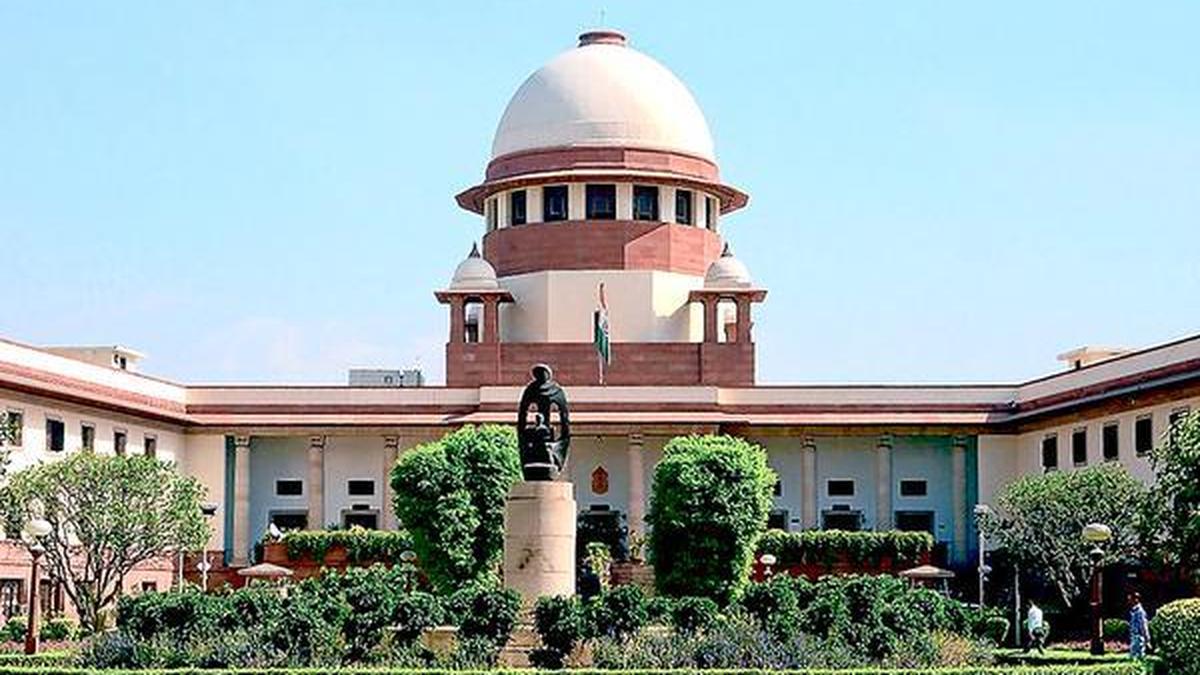
Image used for representational purposes only.
| Photo Credit: S. Subramanium
The Supreme Court on Tuesday (May 26, 2026) agreed to examine a challenge to the constitutional validity of the definition of ‘wetlands’ in the Wetlands (Conservation and Management) Rules, 2017, for arbitrarily excluding most human-made, artificial, and historically developed wetlands from environmental protection and diluting accountability through decentralised oversight.
A Bench headed by Chief Justice of India Surya Kant issued a formal notice to the Union Government on a petition filed jointly by a group of environmental activists and professionals led by Ravindra Sinha that the definition of ‘wetlands’ in Rule 2(g) of the 2017 law was inconsistent with India’s binding international obligations under the Ramsar Convention, 1971.

The Convention expressly included both natural and artificial wetlands, whether permanent or temporary, without distinction, senior advocate Gopal Sankaranarayanan and advocate Anindita Mitra submitted for the petitioners.
Important waterbodies
“The definition under the 2017 Rules will have the disastrous impact of 39 human-made wetlands, out of a total of 94 Ramsar Convention wetlands located in India, losing their status as protected wetlands. By carving out exclusions for waterbodies constructed for drinking water, irrigation, aquaculture, salt production, recreation, and allied purposes, the Rule has the effect of removing a substantial majority of India’s wetlands from the protective framework of environmental law,” the petitioners submitted.
The petition submitted that the 2010 Rules, which the 2017 one replaced, had included human-made wetlands, including all forms of tanks.
Rule 2(g) of the 2010 Rules had protected waterbodies/tanks specifically constructed for drinking water purposes and structures exclusively used for aquaculture, salt production, recreation and irrigation purposes.

The dilution witnessed in the 2017 Rules violated the principle of non-regression, which prohibits governments from weakening an existing legal protection.
“While the 2010 Rules adopted the Ramsar definition in full, created Central and State Wetland Authorities, and imposed explicit prohibitions on reclamation and permanent construction, the 2017 framework dilutes these safeguards by removing the Central authority, deleting the schedule of prohibited activities, and contracting the definitional scope of wetlands,” Mr. Sankaranarayanan submitted.
The petition highlighted that the Supreme Court’s own judgment in M.K. Balakrishnan v. Union of India (reported in 2017) has been violated.
“This court had directed that all 2,01,503 wetlands identified in the National Wetland Atlas be protected… Instead of implementing these directions, the Union government has superseded the 2010 Rules and introduced a narrower definition that defeats the very mandate of this court,” the petitioners submitted.
Manner of identifying wetlands
The 2017 Rules has also departed from the proven manner of identification and recording of wetlands in national wetland inventories based on their functional characteristics, including hydrology, soil saturation, biodiversity support, flood moderation, and groundwater recharge rather than their origin, that is, human-made or natural.
India’s own National Wetland Atlas, 2011, and the National Wetland Inventory and Assessment prepared by the Indian Space Research Organisation (ISRO) classify natural and artificial wetlands together as part of a unified ecological continuum, the petition said.
Published – May 26, 2026 09:47 pm IST



