


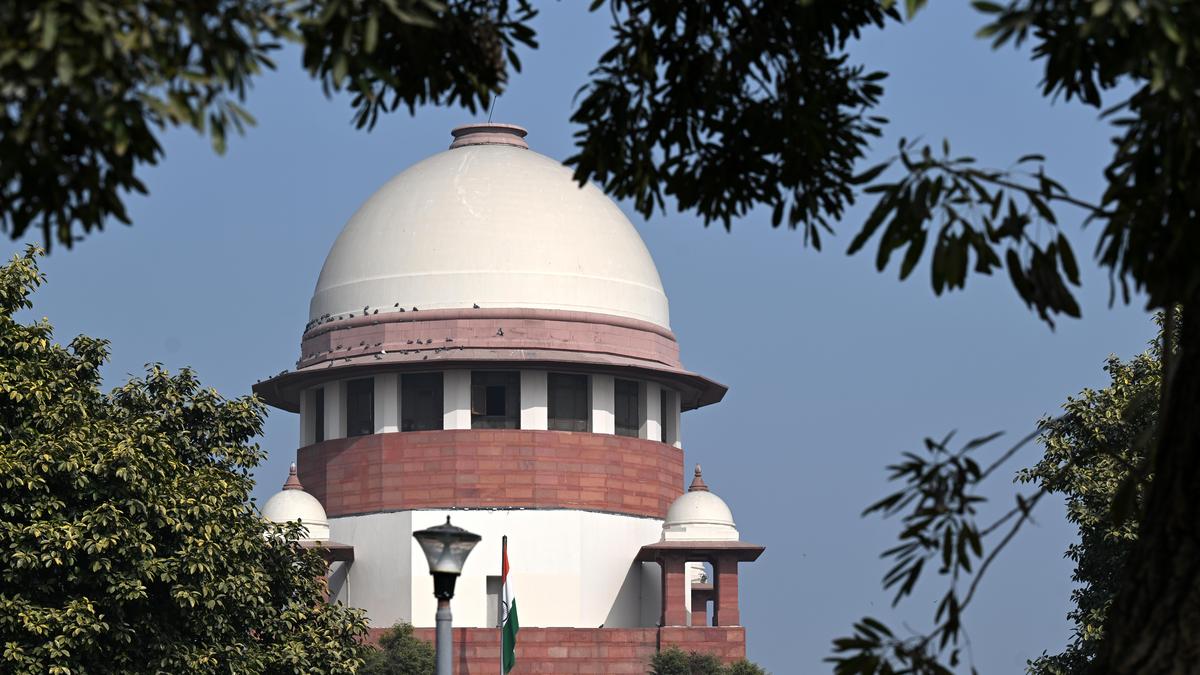
A general view of the Supreme Court. File
| Photo Credit: Shashi Shekhar Kashyap
The Supreme Court has directed State governments to evolve a policy for police-media briefing modelled on a manual prepared by the court’s amicus curiae, senior advocate Gopal Sankaranarayanan, establishing a “principled, rights-compatible and investigation-safe framework”.

The order was passed by a Bench headed by Justice M.M. Sundresh in a batch of petitions led by NGO People’s Union for Civil Liberties, which had in 2014 led to a significant judgment in which 16 mandatory guidelines were laid down as law to be complied with in the aftermath of a police encounter or a suspected extra-judicial killing.
The court had initially charged the Home Ministry with the responsibility to prepare the manual for best practices to be followed in police media briefings. However, the task eventually fell on the amicus.
In its order, the Supreme Court took on record the document prepared by Mr. Sankaranarayanan titled, ‘Police Manual for Media Briefing’, which was prepared after considering the views of the Union government and the practices prevalent at the international level.
The order noted the lack of adequate interest shown throughout by the States despite repeated orders granting them time to participate.
“We do not want to keep these matters pending any longer. We deem it appropriate to direct the States to evolve an appropriate policy for media briefing by taking into consideration the ‘Police Manual for Media Briefing’ furnished by the amicus curiae. The needful will have to be done within a period of three months from the date of receipt of a copy of this order,” the Supreme Court directed in its order on January 15, published on Wednesday (January 21, 2026).
The Bench ordered the Supreme Court Registry to upload Mr. Sankaranarayanan’s work on the Supreme Court website within a period of two weeks.
In his manual, Mr. Sankaranarayanan wrote that his work was in line with the “public’s legitimate interest in timely, accurate information” while safeguarding the need to safeguard the dignity, privacy, and fair-trial rights of victims, witnesses and suspects.
The manual’s recommendations upheld the integrity of police operations and criminal investigations, noting that the police “communicate to prevent harm, correct rumours, enlist public cooperation and maintain law and order”.
It is also extremely vital in the current social media age that the police communicate only correct, verified and necessary information to the public to prevent the spread of incorrect information, which has the propensity to disrupt law and order, the manual said.
Published – January 21, 2026 10:23 pm IST



