

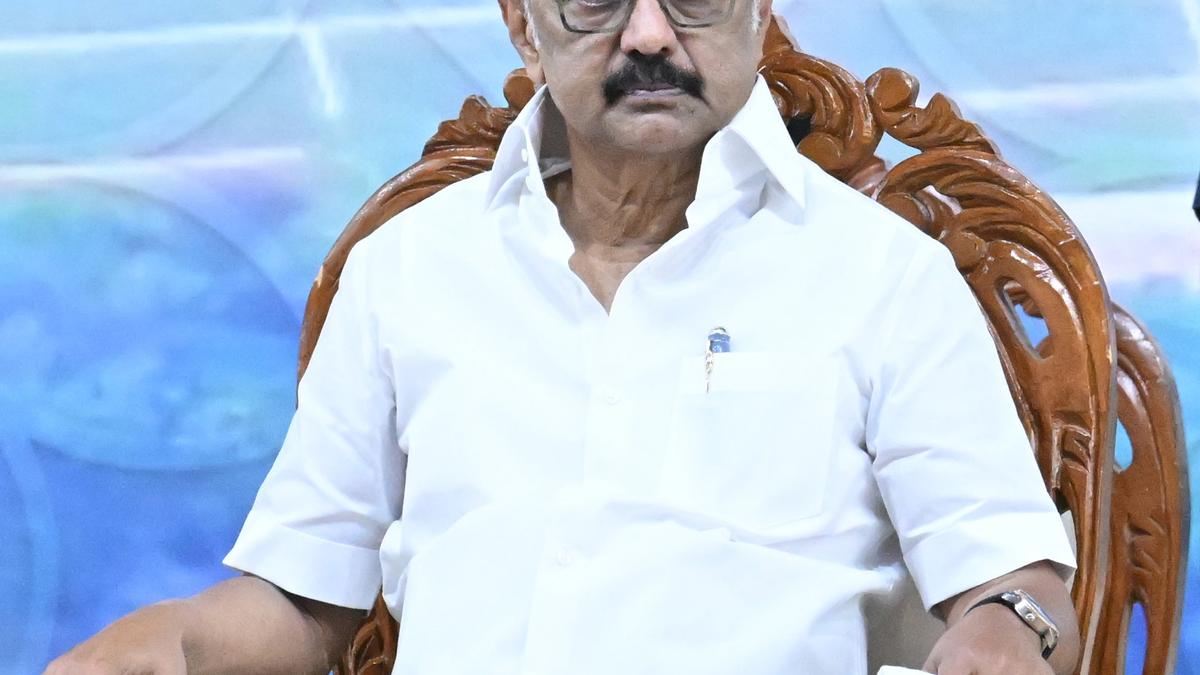


Tamil Nadu Chief Minister M.K. Stalin has urged Prime Minister Narendra Modi to withdraw the office memorandum issued by the Union Ministry of Environment, Forest and Climate Change.
| Photo Credit: FILE PHOTO
Tamil Nadu Chief Minister M.K. Stalin on Friday opposed the exemption of atomic mineral mining from public consultation and urged Prime Minister Narendra Modi to withdraw the office memorandum issued by the Union Ministry of Environment, Forest and Climate Change.
Tamil Nadu’s coastal districts are endowed with deposits of Rare Earth Elements embedded in beach sand systems, and these coasts are ecologically fragile and highly vulnerable, he said.
“Policy changes of such significance must be deliberated transparently in Parliament and State Legislatures, with due consultation of the States and members of the public. Proceeding otherwise would run counter to the spirit of cooperative federalism and the democratic ethos of our country,” Mr. Stalin said in his letter to Mr. Modi.
Nesting grounds
The beaches of the Gulf of Mannar and the Palk Bay are home to the nesting grounds for the endangered turtles, coral reefs, mangroves, and sand-dunes that serve as natural barriers against erosion and cyclonic events, he said.
“These ecosystems sustain biodiversity, stabilise shorelines, sequester carbon, and safeguard coastal communities. Mining in such regions is therefore inherently eco-sensitive and demands rigorous scrutiny with the fullest involvement of local communities,” Mr. Stalin said.
According to the September 8 office memorandum, issued by the Impact Assessment Division of the Union Ministry of Environment, Forest and Climate Change, public consultation is not required for the projects for mining of atomic minerals, notified in Part B, and critical and strategic minerals, notified in Part D, of the First Schedule of the Mines and Minerals (Development and Regulation) Act.
‘A landmark step’
Mr. Stalin recalled that the EIA Notification of 1994, as amended in 1997, introduced mandatory public hearings, a landmark step that had since become integral to participatory environmental governance. “This safeguard was reinforced in the EIA Notification, 2006. Exempting projects from public consultation would deprive local communities of their right to raise legitimate concerns relating to livelihood loss, displacement, and environmental impacts, and would weaken the principles of participatory democracy.”
The office memorandam also raised “serious legal concerns,” Mr. Stalin said, recalling that the National Green Tribunal had in the past struck down office memoranda which sought to dilute statutory safeguards. The Supreme Court, in Alembic Pharmaceuticals Ltd. v. Rohit Prajapati & Ors. (2020), had held that substantive amendments to the EIA framework could not be brought about by way of executive instructions such as office memorandum, and that such instruments could not override statutory notifications, he pointed out.
“The present office memorandum… amounts to an impermissible executive amendment of law and is therefore unsustainable,” Mr. Stalin said. sHe further reiterated Tamil Nadu’s commitment to contributing to the nation’s strategic and defence requirements, as it had always done in the past.
Published – September 12, 2025 05:38 pm IST



