


Chief Minister M.K. Stalin on Saturday inaugurated the Porunai Archaeological Museum, built on 13 acres near Reddiyarpatti hillock on the outskirts of Palayamkottai, to showcase the artefacts excavated at the ancient archaeological sites of Adichanallur, Sivakalai, and Korkai in Thoothukudi district, and Thulukkarpatti in Tirunelveli district.
Built at a cost of ₹56.36 crore, the museum was sanctioned by the Tamil Nadu government following an announcement made by Mr. Stalin in the Assembly on September 9, 2021, wherein he had said Tamil civilisation should be showcased to the world in a fitting manner through the scientifically excavated and proven artefacts of Adichanallur, Sivakalai, and Korkai. The construction commenced after he laid the foundation for the museum on May 18, 2023.
The artefacts excavated at Sivakalai, which demonstrated the Tamils’ expertise in making iron tools and weapons; Adichanallur, the cradle of civilisation on the banks of the Tamirabharani; and Korkai, the port town of the Pandya Kingdom, have been showcased in this aesthetically designed museum featuring Chettinad and local architecture.
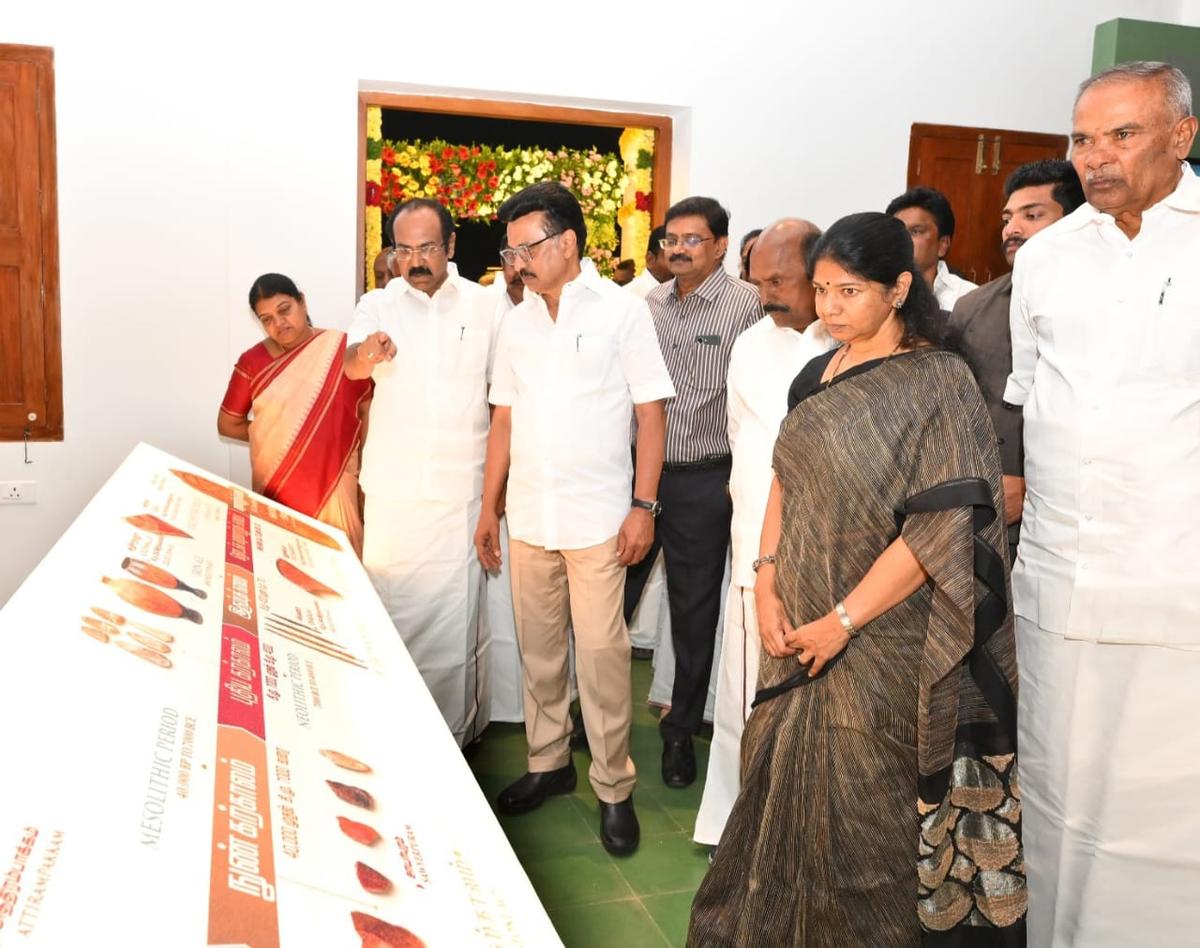
Chief Minister M.K. Stalin at the inauguration of the museum on Saturday, December 20, 2025.
The burial urns, bronze vessels, iron tools and weapons, multi-coloured earthenware, tiles with various signs, and ‘Thamizhi’ letters, all excavated at Sivakalai between 2019 and 2022, have been showcased in the ‘Sivakalai Block’. The Beta Analytics Laboratory in Miami, U.S., while analysing the paddy grains collected from a burial urn excavated at Sivakalai in 2021, determined that the foodgrain dated back to 1,155 BC, proving that Tamils living along the Tamirabharani had cultivated paddy 3,200 years ago.
The ‘Adichanallur Block’ showcases burial urns, iron tools, offering pots, earthenware, and pottery tiles with Thamizhi letters. The 21 baked earthen pipes excavated at Adichanallur show the ancient Tamils’ expertise in using these pipes for diverting water for irrigation.
The high-quality bronze and gold ornaments excavated at Sivakalai and Adichanallur stand testimony to the affluent lifestyle of the ancient Tamils who lived in these two places. The carbon dating done on the iron tools recovered from Adichanallur and Sivakalai has rewritten the hypothesis of the Iron Age. While the iron recovered at Sivakalai belonged to 3,300 BC, the metal artefact excavated at Adichanallur was from 2,613 BC. Hence, this carbon dating has proved that Tamils had used iron even 5,300 years ago.
The excavations done at Thulukkarpatti in Tirunelveli district have yielded silver coins, earthen jewels, glass jewels, polished tiles, a range of iron tools, terracotta figures, and pots with Thamizhi letters. The research done on the artefacts of Thulukkarpatti and Indus Valley civilisations have yielded a lot of similarities between the two civilisations.
The glass beads and bangles, conch bangles, terracotta beads, stone beads, terracotta figures and pipes, copper coins, and Roman and Chinese pottery tiles excavated at Korkai have also been displayed in the museum with an interactive wall.
Light and sound show
Visitors could also enjoy the 15-minute-long light-and-sound show on the ancient Tamil civilisation that took shape in these four places. The touchscreens, virtual reality shows, documentaries, models, etc., on Tamil civilisation, Korkai’s pearl fishery, and deep sea diving skills of ancient Tamils add colour to the museum.
A pond, open theatre for performing arts, outlets to sell local handicrafts, artefact models, battery-operated vehicles for senior citizens and the differently-abled, greeneries, children’s park, and seating arrangements make the museum situated on the Kanniyakumari-Kashmir National Highway vibrant.
In a video released before the inauguration of the museum, Mr. Stalin said that as the ancient Tamil civilisation had left an enviable footprint with its admirable knowledge in science and agriculture, the history of the Indian subcontinent should be written from Tamil land.
Published – December 21, 2025 12:00 am IST



