


In a narrow lane of Hyderabad’s Hafiz Baba Nagar, a modest home hummed with sounds that betrayed nothing unusual — a pressure cooker’s whistle, a child’s laughter, the clatter of steel plates. But above the everyday chaos, a small device tucked quietly on a kitchen shelf blinked in coded rhythm.
It wasn’t a Wi-Fi router, though it looked like one. Inside its sleek, rectangular shell, hundreds of calls were being routed from Cambodia to unsuspecting victims across India. In this unremarkable two-storey house in south Hyderabad, a global cybercrime syndicate had found an unlikely headquarters.

For weeks, the kitchen doubled as a command post. As the family stirred curries and packed lunchboxes below, 28-year-old Hidayatullah climbed up to the shelf on cue from his overseas handler, swapping SIM cards, checking the power connection and resetting the device.
To his neighbours, he seemed like any other young man; often home, moving around in track pants and a loose T-shirt, rarely stepping out except to collect food deliveries. To his family, he was simply between jobs. They had no reason to suspect that their kitchen had turned into a nerve centre of a multi-crore criminal enterprise.
That illusion shattered when the police came knocking on September 11.
Investigators say Hidayatullah had reassured his ageing parents, his brother, sister-in-law and young nephew that he had “finally found work where he could mint loads of money”. He warned them not to question him about his work or the device, even threatening to end his life if they did. For months, the family continued with their routine, unaware that their home was a hub connecting scammers in Cambodia to victims across Telangana and beyond.
Hidayatullah’s path to crime wasn’t deliberate; it was desperate. Once a car dealer, he had watched his life unravel in quick succession: first losing money to addiction, then to a fraudulent investment scheme that wiped out over ₹16 lakh. Cornered and hopeless, he turned to the same friend who had lured him into the investment fraud. This time, the friend introduced him to a woman named Venisa, based in Cambodia, who promised a way to recover his losses.
Her instructions were simple, but sinister: install a SIM box at home, connect it to broadband and feed it with SIM cards. Each call it handled would be part of a sophisticated network that blurred international routes, spoofed caller IDs and allowed fraudsters to pose as government officials. Hidayatullah would be paid for “traffic”, each blink of the device translating into profit.
But keeping the machine alive required hundreds of SIM cards, and that’s where his network came in. Apart from him, police arrested two others, both authorised point-of-sale (POS) agents for Vodafone and BSNL. One of them, just 24, ran a small tea-and-samosa stall from a rented room in the same colony and another counter near the Mahatma Gandhi Bus Station in Imlibun, south Hyderabad. The stall, investigators say, was a cover — a way to appear like an ordinary vendor while secretly supplying SIM cards in bulk to keep the operation running.
By the time police swooped in, they had uncovered over 500 SIM cards, with 80 plugged into the device and another 100 kept in reserve for future use. The criminal operation continued for seven months — from February to September 2025 — until it was finally brought to an end with the full scale still being assessed.
A burgeoning scam
What happened in his kitchen was no anomaly; it was a small node in a vast and rapidly growing web of digital deception. SIM boxes, or compact devices capable of masking international calls as local ones, have quietly become the weapon of choice for cybercrime syndicates behind the booming ‘digital arrest’ scam.
In less than two months, Telangana Police, working with the Department of Telecommunications (DoT), dismantled two such networks. The numbers reveal the scale of the menace. So far in 2025, 898 people across Telangana have fallen prey to these scams, collectively losing ₹55.7 crore, according to data from the Telangana Cyber Security Bureau (TGCSB). During the same period, the State has reported 62,345 financial fraud cases, with losses soaring past ₹1,042.56 crore.
Some 300 kilometres away, in Jannaram of Mancherial district, Telangana, investigators stumbled upon a near-identical set-up — this time inside a cramped, rented room with peeling blue walls and a bare stone floor.
On a thin mat lay five SIM boxes, their tiny lights blinking in mechanical rhythm. A modem and inverter kept the system alive during power cuts, while a whirring air-conditioner prevented the devices from overheating as they pushed through hundreds of calls daily.
At first glance, it looked like nothing more than an improvised workspace. The men behind it — an unemployed diploma holder, a farmer, a labourer and his younger brother — seemed as ordinary as their surroundings. But in just two months, they had routed calls that triggered 14 digital arrest scams across India — 11 in Telangana and one each in Delhi, Uttar Pradesh and Tamil Nadu — siphoning off at least ₹1.6 crore.
Their operation was eerily disciplined. Working between 10 a.m. and 5 p.m., they mirrored government office hours, giving their deception a veneer of legitimacy. Each call they routed impersonated a law enforcement officer, scaring victims into transferring their life savings.
When investigators combed through the space, they found the operation’s real backbone — 230 SIM cards from Jio, Airtel and Vodafone Idea networks, illegally sourced from multiple locations, including Parvathipuram in Andhra Pradesh.
The choice of location was no coincidence. Jannaram’s weak mobile network, with just a handful of 4G towers and no 5G coverage, made precise location tracking extremely challenging.
“The area has only one tower, which hosts multiple telecom networks but no 5G connectivity,” says Inspector Krishna Murthy of Ramagundam Cyber Crime Police Station. “If there was a 5G tower, we could have obtained a Type A location, giving exact coordinates. But with only a 4G tower, we could get just an E-type location: we knew the general area, but not the precise spot. It took us days of field inquiry, CDR [call detail record] analysis of an active call before we could finally pinpoint one of the accused.”
Human cost of the scam
Among the many victims was a 76-year-old retired government doctor from Madhura Nagar. On September 5, she answered a call from some men claiming to be officers of Bengaluru police. Over the next 70 hours, she was repeatedly accused of offences ranging from human trafficking to money-laundering, shown fabricated documents purporting to be from the Supreme Court, Reserve Bank of India and Enforcement Directorate, and coerced into transferring ₹6.6 lakh to a bank account controlled by the fraudsters. Alone at home, and terrified, she complied.
Police said her daughter-in-law was away and returned only after the doctor began complaining of uneasiness. On September 8, she developed severe chest pain and was rushed to a private hospital in Hyderabad, where she died of cardiac arrest. Her sons, who live in West Bengal and Bengaluru, learned the full horror of the scam only after the funeral on September 9.
According to Assistant Commissioner of Police R. G. Siva Maruthi, the fraudsters continued to send messages to her phone even after her death, underlining the cold, mechanical relentlessness of the racket.
Widening the probe, police arrested two men in Maharashtra: Shankar Supur, 38, a water-purifier technician from Kolhapur district whose bank account was used to launder the proceeds, and Vishwas Dattatraya, 35, a businessman from Sangli district, identified as an account supplier.
Cybercrime teams from Hyderabad were also dispatched to north Karnataka to track other suspects. Maruthi says investigation is under way to identify the masterminds and seize the devices used in the scam.
Inside a SIM box
Those devices, unremarkable black or grey boxes, conceal the fraud’s technical engine: a tangle of SIM slots that can hold 32 to 512 SIM cards, each registered under different identities or IMEIs (International Mobile Equipment Identity).
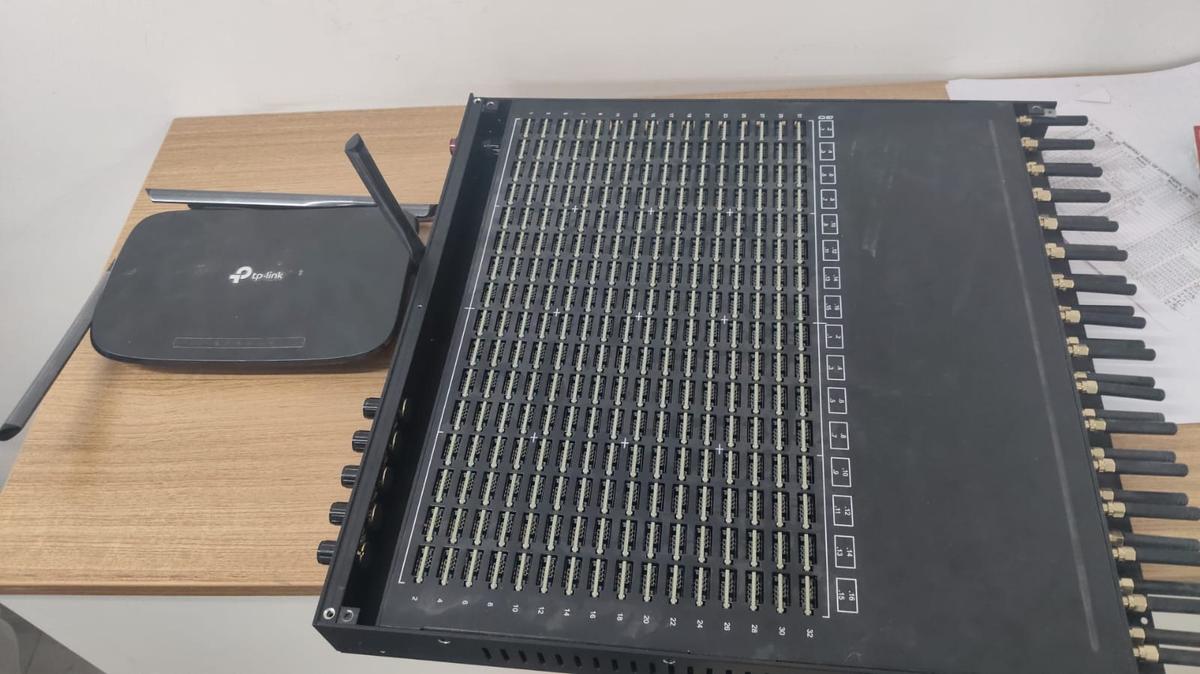
A SIM box seized during a police raid at a home in Hafiz Baba Nagar colony in Hyderabad last month.
| Photo Credit:
ARRANGEMENT
Instead of using licensed international telecom gateways, the perpetrators divert calls over the internet via Voice over Internet Protocol (VoIP). The SIM box converts the VoIP call into a local call and pushes it onto the mobile network through one of its many SIMs. To victims, the incoming number looks domestic, masking the international origin.
The economics of the scam make it efficient and fleeting. Many SIMs are cheap or obtained with forged documents, allowing criminals to pay only local tariffs while international callers are billed at source. For investigators, the combination of spoofed numbers, overseas servers and rapid SIM-swapping, sometimes within 24 hours, turns every lead into a vanishing trail, complicating efforts to map the network and bring its architects to justice.
Tracking the invisible
The hunt for the machines begins at a desk — on the Department of Telecommunications’ Chakshu portal, where digital footprints light up like a trail of breadcrumbs. Unlike regular handsets, the IMEIs of SIM-box slots stand out as unusual. Investigators lean on patterns too: spikes in call volume, clusters of short calls made in quick succession and multiple numbers that stay active from the same location for unnaturally long stretches.
SIM boxes are illegal in India, but their use has surged again after the government banned caller-ID spoofing apps and websites under the Telecommunication Act, 2023. “Since apps that allowed call spoofing are no longer operational in India, fraudsters have returned to SIM boxes,” says K.V.M. Prasad, Deputy Superintendent of Police (cyber crimes), TGCSB. He adds that the devices are not manufactured in India: “They are shipped from Cambodia and installed locally under the guidance of foreign operators.”
To avoid suspicion during shipment, the boxes are disguised as everyday electronics. Small knobs over the SIM slots make them look like volume regulators, says Prasad, adding that those are sent through regular courier services and delivered anonymously. Installation is low-touch and high-efficiency, guided over video calls that show step-by-step how to slot SIMs, connect power and link the box to broadband. Even those with little technical expertise can operate them with a phone and a set of instructions.
But a SIM box is nothing without SIM cards. In the Hafiz Baba Nagar case, the supply chain ran through migrant construction workers from Odisha, Bihar, Jharkhand and other northern States. POS agents lured them with offers of free cards, then quietly registered two or more SIMs under a single identity. The extras were siphoned off to fuel illegal operations.
That tactic added layers of complexity for investigators. “The subscriber details tied to the SIMs belonged to people from far-off States, while the cards themselves powered criminal networks in entirely different locations,” Prasad points out. “Not only does this make tracking the operation extremely challenging, it also puts the workers at risk of being implicated in scams they had no part in.”
In Jannaram, the scale was industrial: fraudsters amassed 200-300 SIM cards linked to a single Aadhaar number, paying lakhs to bypass checks. Each card lived briefly: activated once and used just long enough to route calls before being discarded.
Day after day, hundreds of these disposable SIMs kept the operation churning. When spent, they were shredded, flushed down drains or dumped in lakes and gutters, erasing the trail almost as soon as it was created.
Fault lines in telecom, banking
Investigating SIM box scams in India is fraught with challenges, riddled with loopholes across telecom and banking sectors. “We don’t know who is buying these SIMs or who is using them. Multiple SIM cards are being issued on the same identity,” says Murthy.
In many parts of the city, SIM cards are still openly sold at roadside stalls while POS agents, sub-agents and suppliers form a vast and unregulated network that is nearly impossible to monitor. Weak KYC checks at the point of SIM activation, coupled with the covert nature of international call routing, make detection even tougher.
“Most SIMs we find in these cases belong to BSNL and Vodafone,” says Prasad. “These operators are not keeping proper checks, and because their networks are almost extinct in terms of regular use, fraudsters exploit the gap. For them, it’s easier to buy in bulk and harder for anyone to notice.”
Even when SIMs are seized, tracing their activity is slow and cumbersome. “We have to rely on telecom operators for details like call logs, timings and volumes. If the operators are slow or don’t cooperate, the investigation drags on for weeks,” he explains.
The banking system also presents vulnerabilities. Fraudsters often use mule accounts to quickly move stolen funds, which are then converted into cryptocurrency, effectively disappearing into untraceable channels.
And pinpointing who runs the SIM boxes is another challenge. While the DoT’s Chakshu portal helps flag suspicious devices and their general locations, identifying exact spots requires old-school fieldwork and extensive ground intelligence. Many boxes also operate through international servers, shielding the masterminds behind multiple digital layers.
As investigators chase disappearing trails through servers, SIMs and mule accounts, one truth is undeniable: technology may have made scams borderless, but India’s defences remain fragmented. Until telecom operators, banks and law enforcement agencies tighten coordination, the next SIM box could already be blinking quietly in yet another unsuspecting home.
(Frauds of this nature can be reported to ‘1930’ helpline or at ‘www.cybercrime.gov.in’. In emergencies, one can reach out via WhatsApp on 8172665171)



