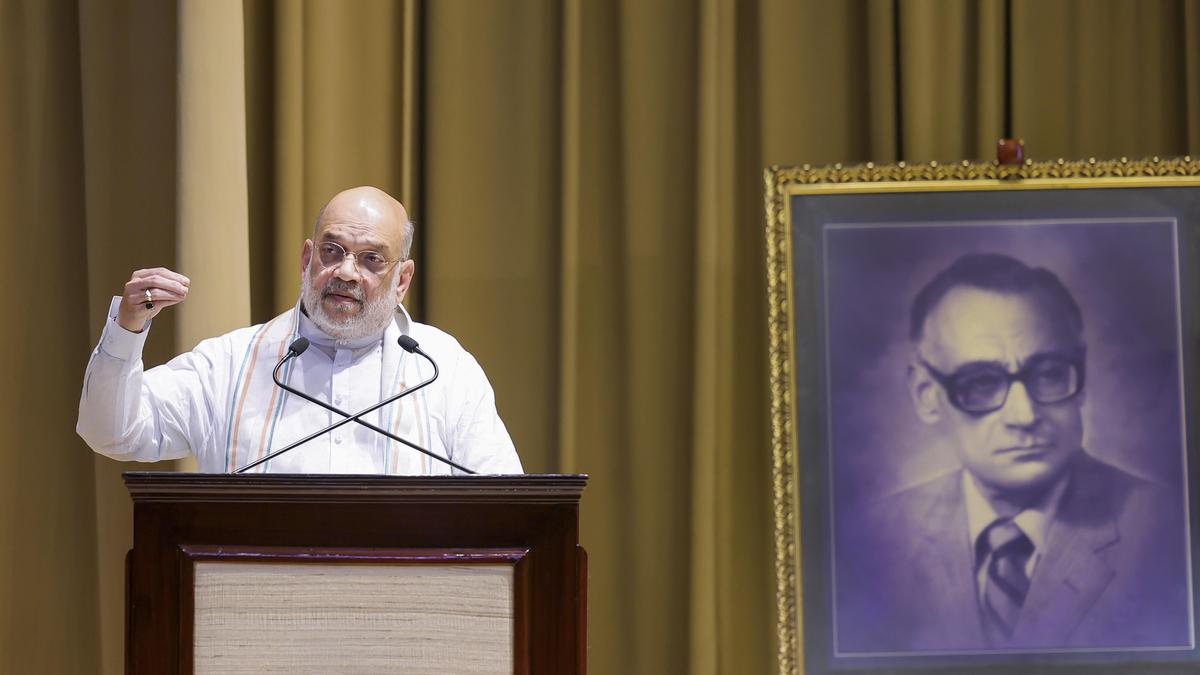
Union Home Minister Amit Shah addresses the R.N. Kao Memorial Lecture-2026 organised by the Research and Analysis Wing (R&AW), in New Delhi.
| Photo Credit: PTI
Union Home Minister Amit Shah on Friday (May 15, 2026) called for a unified global effort in the war against drugs and stressed the need for a unified legal framework to deal with the menace.
He said the battle against drugs must rise above geopolitical differences and individual national interests. The world must fight narco networks and narco-terror states, the Minister said, adding that the world will have to adopt uniform laws for a common definition of prohibited substances, standardised punishments for drug trafficking, extradition of drug kingpins, and intelligence sharing.
Mr. Shah said there was still time for all responsible nations to work together to defeat this threat. He cautioned that if joint efforts were not made now, after 10 years, it would be too late to reverse the harm caused.

He stated that unless there was a high degree of global alignment on what is designated as controlled substances, as well as common standard penalties for drug trafficking, cartels would continue to take advantage of the inconsistencies in policy, thereby weakening the efforts to fight this threat.
Mr. Shah was delivering the R.N. Kao Memorial Lecture in memory of the founder of the Research and Analysis Wing (R&AW). He spoke on ‘Narcotics: A Borderless Threat, A Collective Responsibility’ and called upon Ambassadors and diplomats of different countries to join India’s efforts in the war against drugs, underscoring the need for serious collaborative efforts to achieve a drug-free world to preserve the global social fabric.
The Minister said that India had set a national goal to achieve a ‘Drug-Free India’ by 2047. He highlighted that drug trafficking was not just a law and order subject to be handled by the police or the anti-narcotics agencies, but an issue with a long-lasting impact on society and future generations.
Mr. Shah said that while there was awareness about drug money being funnelled to fund terrorists and criminal networks, and fuel a parallel economy, what largely went unnoticed was the permanent damage drug abuse caused to the human body.
Underlining that the scope for international cooperation on countering narcotics trafficking was crucial, he highlighted the importance of sharing real-time intelligence to interdict narcotics consignments and detain/deport drug kingpins. He informed that in the past two years, India has succeeded in bringing back more than 40 transnational criminals to the country, with the support of friendly nations. However, he added that much more was required to be done.
He stated that there is a need for all responsible countries to reach a consensus on the fact that the war on drugs is critical to national security, protecting public health and preventing narco-states from becoming alternative power centres. To achieve this goal, the Minister called for close international coordination.
Mr. Shah also said that the world, with a population of 8 billion people, 195 nations, and 2,50,000 kilometres of international borders, cannot tackle the problem of drugs through fragmented approaches. In the fight, collective resolve among nations, intelligence sharing, coordinated action, and cross-border operations will prove crucial, he said.
Members of Kao’s family, former Secretaries of R&AW, Ambassadors/High Commissioners and diplomats from more than 40 countries, apart from officials from the Indian security apparatus, attended the event.
Published – May 15, 2026 10:40 pm IST