


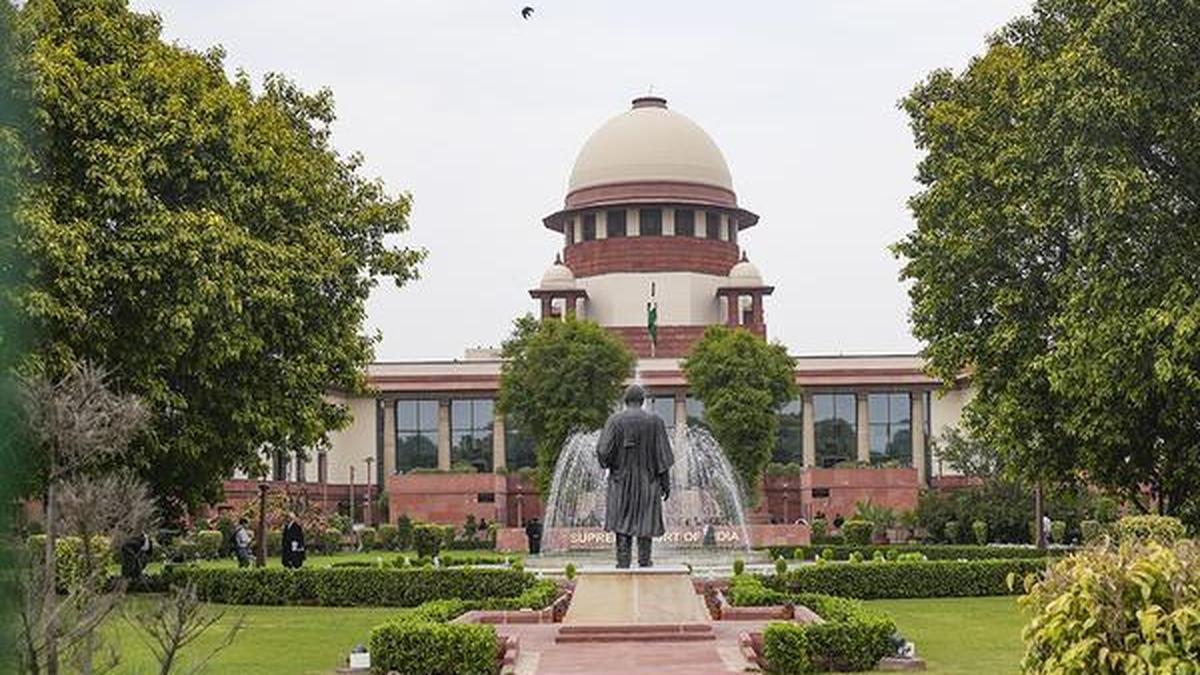
The Supreme Court, on February 20, 2026, refused to entertain the NGO’s petition while granting it liberty to approach the Kerala High Court. File.
| Photo Credit: PTI
Chief Justice of India Surya Kant on Friday (February 20, 2026) deprecated the tendency of filing petitions to use the Supreme Court as a platform to “embarrass” State governments ahead of Assembly elections.
The Chief Justice, heading a three-judge Bench, said petitions filed by private parties and NGOs are designed to put State governments in a tight spot. In the process, the petitioners drag the Supreme Court into the political pell-mell.
Also Read | The judiciary’s ‘between a rock and hard place’ moment
Chief Justice Kant said the petitions raise warning bells in the court, as their timings, usually when the clock is ticking towards an election, are “usually suspect”.
The court was hearing a petition filed by an NGO, Human Rights Foundation, on the installation of PVC flex boards in Kerala, where elections are due this year.

“The problem is people have started fighting political battles in the Supreme Court, whether it is Kerala or ‘A’ State or ‘B’ State. All this is to embarrass the State governments. To create some difficult situations for them,” Chief Justice Kant said.
The Chief Justice said such petitions were meant as an “impediment to election campaigning”.
“The timing of such petitions is suspect. Now see, the Kerala elections are coming, petitions are filed to restrain the State from doing this, restrain State from doing that… How many States do you want us to restrain,” Chief Justice Kant asked.
The court said it was conscious of its role and would not pass orders in such matters unless the need for a judicial intervention was imperative.
The counsel for the NGO said there were continuing violations despite repeated interventions by the Kerala High Court. The High Court had recently directed the Kerala government to ensure that restrictive orders regarding the indiscriminate use of PVC flexes are complied with.
The State government had submitted in the High Court that it had already issued orders and circulars banning 100% PVC flex for advertisement purposes in public places. It had insisted that polyethylene recyclable banners certified by the Pollution Control Board as PVC-free and with a recyclable logo are used. The flex boards will carry the printing unit’s name and certificate number/QR code from the PCB.
The State government had further submitted that the Kerala Municipality (Establishment of Arches and Advertising Boards on Public Streets and Public Places) Rules 1999 provided sufficient restrictive measures in the matter of installing advertisement boards.
The apex court refused to entertain the NGO’s petition while granting it liberty to approach the Kerala High Court.
Published – February 20, 2026 01:54 pm IST



