


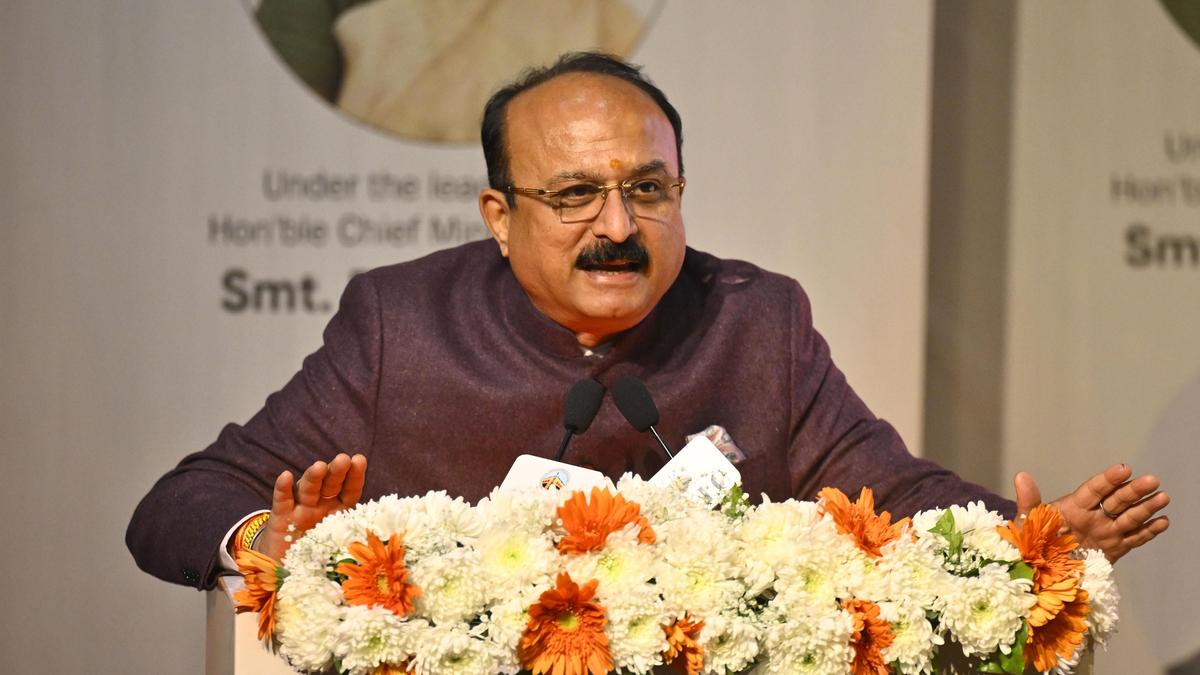
Delhi Education Minister Ashish Sood.
| Photo Credit: SHIV KUMAR PUSHPAKAR
The Supreme Court on Monday (January 19, 2026) questioned the Delhi government over the “hurried” implementation of the Delhi School Education (Transparency in Fixation and Regulation of Fees) Act, 2025, which seeks to regulate the fixation of fees by private schools in the national capital.
A Bench comprising Justices P.S. Narasimha and Alok Aradhe observed that while the legislation was aimed at advancing public welfare, implementing it midway through an ongoing academic session could lead to significant practical and financial difficulties for schools.

“We are completely in favour of the legislation, but its present form of implementation is unviable…You are forcing people overnight to get up and do it. It is an ideal Act enacted for a very good purpose, but it must be implemented in a proper way,” the Bench said, addressing Additional Solicitor General S.V. Raju, appearing for the Delhi government’s Directorate of Education.
The new State law mandates that any increase in fees charged by private schools must be cleared through a two-tier regulatory framework comprising school-level committees and district-level appellate authorities. Under this framework, every private school is required to constitute a School Level Fee Regulation Committee (SLFRC), consisting of representatives of the school management, the principal, three teachers, five parents, and one nominee of the Directorate of Education.
The top court was hearing petitions filed by associations of private unaided schools challenging the validity of the 2025 Act and the rules framed under it. The petitioners contended that the new law runs contrary to the Delhi School Education Act, 1973 and its rules by diluting the authority of school managements and vesting greater control in parents and teachers in the fixation of school fees.
Senior advocate Mukul Rohatgi, appearing for the private schools, argued that even assuming the validity of the legislation, its manner of implementation ran contrary to the scheme of the 2025 Act. He submitted that the Delhi government’s attempt to retrospectively regulate fees for the academic year beginning April 1, 2025 was unlawful, as the Act itself came into force only in December.
Mr. Raju, appearing for the Delhi government, however, contended that the timelines prescribed under the new law had been extended at the behest of the schools. He further informed the Bench that the present exercise was confined to the 2025-2026 academic year, and that the fees currently being charged would be treated as the proposed fees for that year before being placed before the fee regulation committee.
The Bench, however, expressed concern that initiating processes intended to be undertaken later in the academic year could have retrospective consequences, including the recovery of fees already charged.
“If the exercise is innocuous and limited to the constitution of the committee, there is no harm in that. However, we will interfere if the intention is to regulate fees for the 2025-26 academic year,” Justice Narasimha said.
Mr. Rohatgi, however, urged the judges not to accord any form of judicial approval to the SLFRCs, and informed them that a separate challenge to the validity of the law was pending before the Delhi High Court.
The Bench said it was not inclined to interfere with the legislation at this stage, but asked the Delhi government to reconsider the issue of retrospective fee fixation and place its position on record.

The court accordingly directed that the matter be listed again on January 27, 2025.
While hearing petitions challenging the new law, the High Court had earlier declined to stay a notification directing private schools in the national capital to constitute SLFRCs, but had extended the deadline for setting up such panels from January 10 to January 20. It had also extended the deadline for school managements to submit their proposed fees to the committees from January 25 to February 5.
Published – January 19, 2026 11:24 pm IST




