


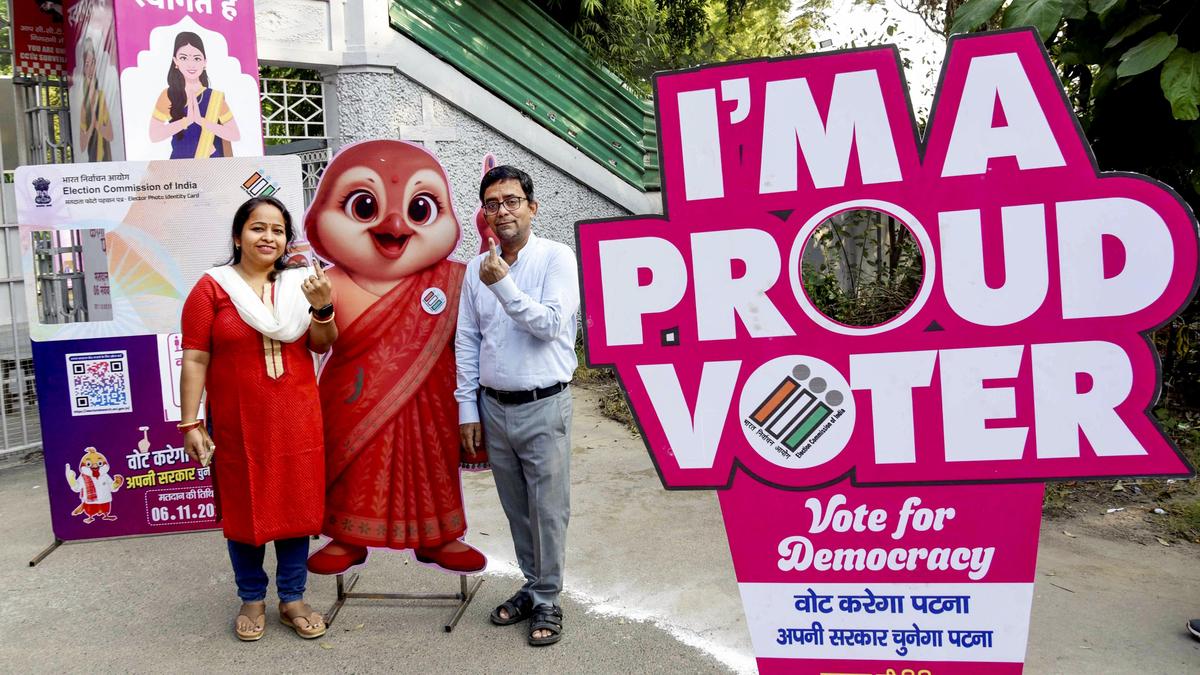
People show their ink marked fingers after casting votes at a polling station during the first phase of Bihar Assembly elections, in Patna on November 6, 2025.
| Photo Credit: PTI
The Supreme Court on Thursday (Noveber 6, 2025) is scheduled to examine the Centre’s argument that the ‘right to vote’ in an election is different from the ‘freedom of voting’, and while one is a mere statutory right the second is a part of the fundamental right to freedom of speech and expression.
The Centre was responding to a petition seeking to declare Section 53(2) of the Representation of the People Act, 1951 and Rule 11 read with Forms 21 and 21B of the Conduct of Elections Rules, 1961, which apply to ‘uncontested elections’, ultra vires the Constitution for violating freedom of speech and expression under Article 19(1)(a).
Section 53(2) kicks in when the number of candidates equals the number of seats to be filled in an Assembly or Lok Sabha election. In such cases, the provision instructs a Returning Officer to declare all such candidates as duly elected by filling in Form 21 ( in case of a general election) or Form 21B (in case of an election to fill a casual vacancy).
Prevents voters’ right to exercise NOTA
The petitioners, Vidhi Centre for Legal Policy, represented by advocate Harsh Parashar, and the Association for Democratic Reforms, through advocates Prashant Bhushan and Neha Rathi, submitted that the RO’s declaration without conducting a poll prevented citizens from expressing their right to vote the ‘None Of The Above’ or the NOTA option and voice their dissatisfaction about the contesting candidate.
A Bench headed by Justice Surya Kant is scheduled to hear on November 6, as polling is on in Bihar. Both the government and the Election Commission of India responded on whether declaration of a sole candidate without taking any poll was a violation of the electors’ right to express their unhappiness by voting NOTA.
Centre’s affidavit
The Centre’s affidavit in court began with a fundamental lesson on the difference between ‘right to vote’ and the ‘freedom of voting’. It said the ‘right to vote’ was only a statutory right conferred by Section 62 of the Representation of the People Act of 1951, and subject to the limitations given in the statute.
Freedom of voting, on the other hand, was a “species of the right to expression under Article 19(1)(a) of the Constitution”.
Illustrating the gulf, the Centre quoted from a 2003 Supreme Court judgment in Civil Liberties (PUCL) versus Union 2003 that “the initial right (right to vote) cannot be placed on the pedestal of a fundamental right, but at the stage when the voter goes to the polling booth and casts his vote, his freedom to express arises. The casting of vote in favour of one or the other candidate is tantamount to expression of his opinion and preference and that final stage in the exercise of voting right marks the accomplishment of freedom of expression of the voter”.
But, the Centre pointed out, the freedom of voting (the freedom to choose a candidate through positive vote or a negative vote through NOTA) was dependent on whether or not there was a poll taken.
“Freedom of voting is an incidence of a poll,” the Union government submitted.
The election would be put to vote only if the number of candidates were more than the number of seats to be filled, as provided under Section 53(1) of the 1951 Act. Again, there would be no poll if the number of candidates were fewer than the seats in an election, as mandated under Section 53(3) of the Act.
‘NOTA not a candidate’
The Centre argued that NOTA did not fit within the definition of a ‘candidate’ under Section 79(b) of the RP Act, 1951.
“NOTA cannot be given an artificial personality. It is merely an option or an expression. It cannot be termed as a candidate so as to take a poll in terms of Section 53(1) of the RP Act,” the government submitted. Besides, it said, elections cannot be left inconclusive by not declaring a winner. Indecisive elections render the electoral process an exercise in futility.
‘Only nine instances of uncontested elections so far’
In a separate affidavit, the EC agreed with the Centre that to treat NOTA as a “contesting candidate” in an election would require legislative amendments in the 1951 Act and the 1961 Rules.
The top poll body said there were only nine instances of uncontested elections out of a total 20 General Elections from 1951 till 2024. In 54 years from 1971, there were only six uncontested elections, and only one uncontested election in 34 years since 1991.
“This shows that with the evolution of democracy, more political parties are contesting and the number of candidates increases automatically. Uncontested elections are a rarity,” the EC reasoned.
Published – November 06, 2025 10:13 am IST



