


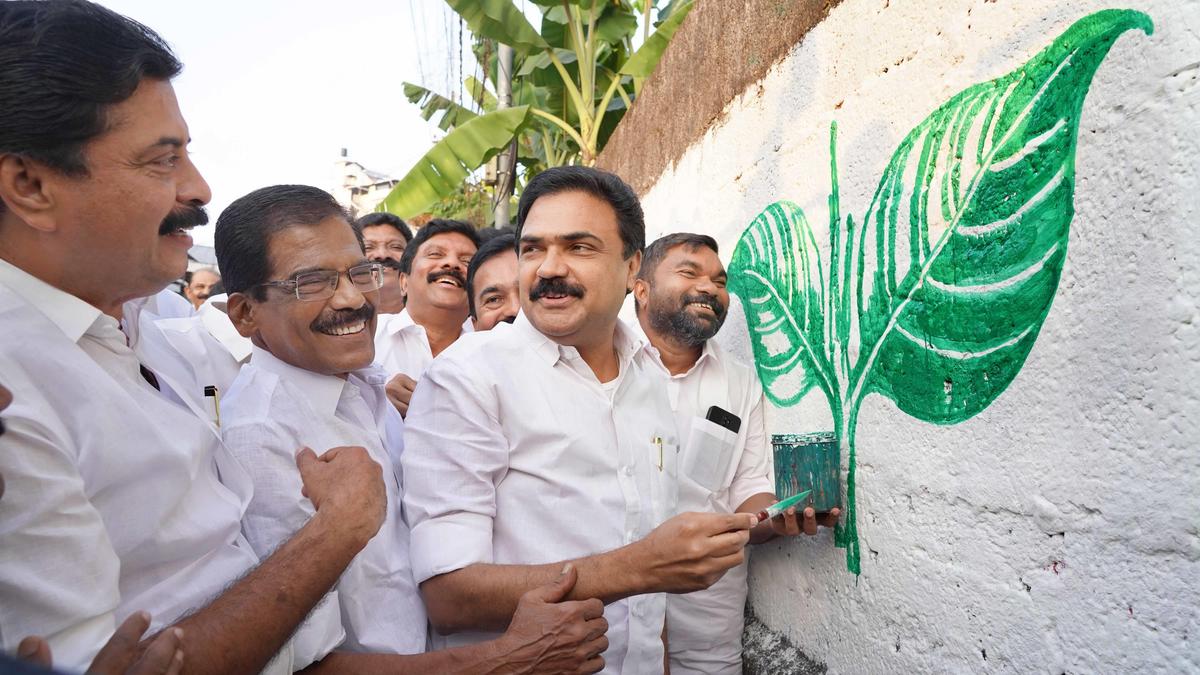
Kerala Congress (M) chairman Jose K. Mani draws his party’s election symbol on a wall in Kottayam district.
| Photo Credit: VISHNU PRATHAP
Few political threads in Central Travancore have been tugged at as often as the question of whether the Kerala Congress (M) will ever return to the Congress-led United Democratic Front (UDF).
It is a familiar episode now. Every time Kerala braces for an election, to Parliament or even a byelection, the whispers begin. A speculative news report appears, a section of UDF leaders roll out an open invitation, and soon the political chatter gathers steam. For a few days, Kerala’s political circles hum with talk of a homecoming by the regional party founded by K.M. Mani.
Then, right on cue, the present party chairman Jose K. Mani steps in to douse the excitement, firmly denying any such move. This recurring drama, replayed several times over the past five years, reveals much about the leverage the regional party commands in Kerala’s power equations.
Now, as the State stands once again on the threshold of another election, all eyes have turned to the vote bank held by the Kerala Congress (M). Estimates show that the party secured around 6.84 lakh votes, translating to 3.28% of the total vote share in the 2021 Assembly elections. Contesting in 12 seats, KC(M) won five, and beyond those constituencies, it claims a support base spread across 23 others, concentrated primarily in the Catholic heartland of Central Travancore.
While thse figured might have been partly fuelled by the strong pro-Left wave that swept Kerala, the party’s core strength is estimated to stand at around 5 lakh votes. Unsurprisingly, the CPI(M)-led Left Democratic Front (LDF) now considers the KC(M) a vital cog in its expansion strategy into Central Travancore’s traditionally anti-Left pockets.
Govt. gesture
The support extended to the KC(M) by the CPI(M) leadership has been unmistakable. The Pinarayi Vijayan government recently rolled out a series of legislative and policy moves that have breathed a new life into the pro-farmer politics espoused by the KC(M). While the major boost came through the Kerala Land Assignment (Amendment) Act and the draft Wildlife Protection (Kerala Amendment) Bill, the hike in the support price for natural rubber came as the icing on the cake.
But in its bid to expand under the CPI(M)’s wings, the KC(M) has faced resistance not only from outside. The friction has come from within the Left fold as well. The CPI, the second-largest ally in the LDF, has bristled at every attempt by the regional party to project itself as the coalition’s second-in-command .
Yet, these rumblings have done little to slow down the KC(M), which has carried this new-found momentum within the LDF straight into the upcoming local body elections.
Reading the signs of voter fatigue and sensing a faint anti-incumbency wave, the party this time has crafted a strategy of fielding candidates with community roots and strong family ties in its core pockets.
While seat-sharing talks are still underway, the KC(M) has already secured a fairly generous share of seats in the districts of Kottayam, Pathanamthitta, and Idukki.
“The KC(M) has been assured at least nine seats to contest in the Kottayam district panchayat, which has 23 divisions. Discussions are still on about whether the 10th seat should go to a party nominee or a party-backed Independent,” explained a senior party leader.
Similarly, in Pathanamthitta, a consensus has reportedly been reached to allot 23 additional seats at the block panchayat level.
Yet, the party’s influence has not been uniform across Kerala. Another KC(M) leader admitted that the party’s presence in the high-range belts of Malabar remains weak.
“We do have a decent base among settler-farmer communities in Malappuram, Kozhikode, and Kannur. But the LDF does not seem too eager to acknowledge that strength. So far, seat-sharing talks in these regions have been far from satisfactory,” he said.
Published – November 14, 2025 09:37 am IST




