

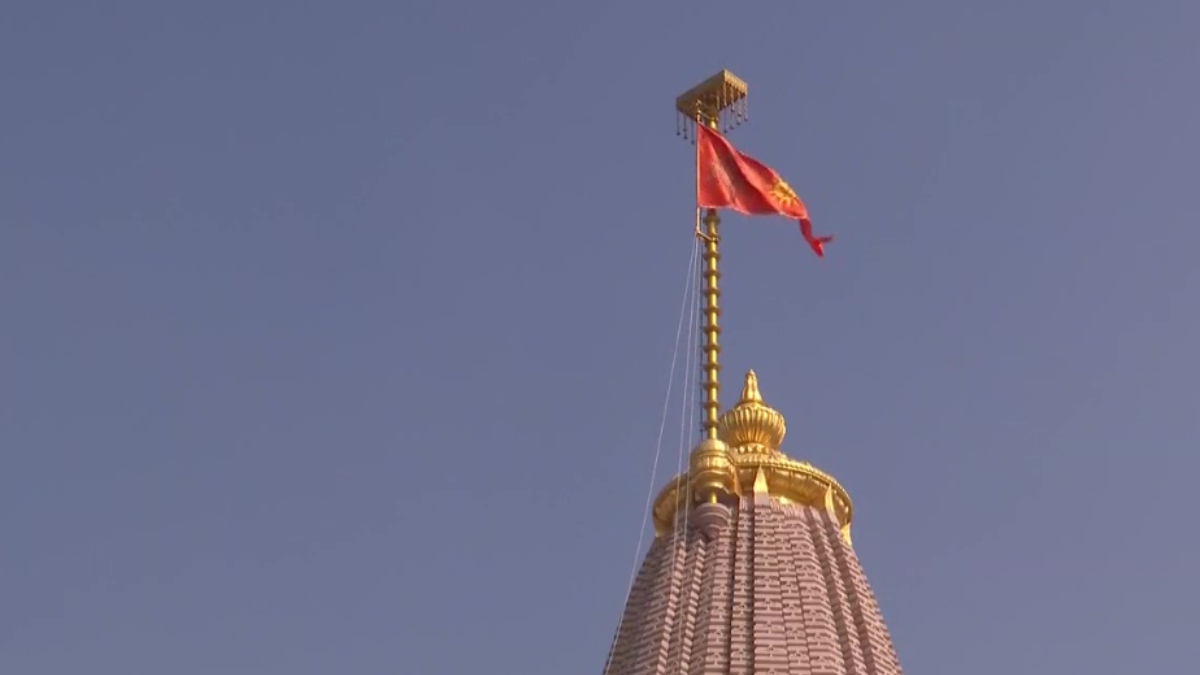

- The sacred triangular Dhwaja (flag) is now atop the Ram Mandir spire in Ayodhya! Learn the profound meaning of the Saffron field, the Sun, the eternal Om, and the epic Kovidara tree. This historic hoisting coincides with the auspicious Vivah Panchami and Abhijit Muhurat.
- Architectural Harmony: North and South
- A Very Auspicious Day
- A Message of Unity and Legacy
- Who Will Be There
- A Journey Completed and a Beginning
The sacred triangular Dhwaja (flag) is now atop the Ram Mandir spire in Ayodhya! Learn the profound meaning of the Saffron field, the Sun, the eternal Om, and the epic Kovidara tree. This historic hoisting coincides with the auspicious Vivah Panchami and Abhijit Muhurat.
This is not just any banner. The sacred flag, around ten feet tall and twenty feet long, is triangular in shape, made of fabric that reflects both simplicity and solemnity.
Emblazoned on its saffron field is a radiant sun, symbolising Lord Rama’s brilliance and valour. An ‘Om’ is inscribed, evoking the timeless spiritual vibration of the universe. And there’s also the image of the Kovidara tree, a touch rooted deeply in epic tradition.
The symbolism runs deep: in Hindu ritual tradition, the act of raising a “dhwaja” (flag) signifies the victory of dharma (righteousness) over adharma (unrighteousness), a reminder that this is more than architecture, it’s a spiritual declaration.
Architectural Harmony: North and South
The flag has been raised on the temple’s main spire, built in the Nagara style, a classic North-Indian temple architecture.
But the surroundings reflect a broader architectural vision: the temple complex’s parkota (outer enclosure) spans 800 meters and is designed in a South-Indian tradition.
The blending of styles speaks to a unity in diversity, much like the flag itself aims to represent.
A Very Auspicious Day
The timing of the hoisting ceremony is deeply meaningful. It coincides with Vivah Panchami, the day celebrated as the divine wedding of Lord Rama and Sita.
According to the Prime Minister’s Office, the moment also aligns with Abhijit Muhurat, a propitious time in Hindu astrology.
Adding to the spiritual significance, November 25 also marks the martyrdom day of Guru Tegh Bahadur, the ninth Sikh Guru, who, according to historical accounts, meditated in Ayodhya for 48 hours in the 17th century.
For many, this layering of traditions and histories weaves Ayodhya’s moment into a larger spiritual tapestry of India.
A Message of Unity and Legacy
According to PM Modi’s office, the flag “will convey a message of dignity, unity, and cultural continuity, embodying the ideals of Ram Rajya.”
This isn’t just a political or civic event — it’s a deeply symbolic act meant to resonate across communities, generations, and belief systems.
Who Will Be There
The ceremony isn’t a solitary act. It will be witnessed by dignitaries, including Uttar Pradesh Governor Anandiben Patel, Chief Minister Yogi Adityanath, and RSS Chief Mohan Bhagwat.
Their presence underscores the magnitude of the day, not just for Ayodhya, but for the entire nation.
A Journey Completed and a Beginning
PM Modi’s role today links two major moments in the temple’s recent history. He laid the foundation stone in August 2020, and later presided over the consecration of the Ram Lalla idol in January 2024.
Now, by hoisting this flag, he symbolically completes the temple’s journey and, in many hearts, heralds a new chapter of spiritual unity.
ALSO READ: What makes Abhijit Muhurta ideal for Ram Mandir flag hoisting and pujas?



