


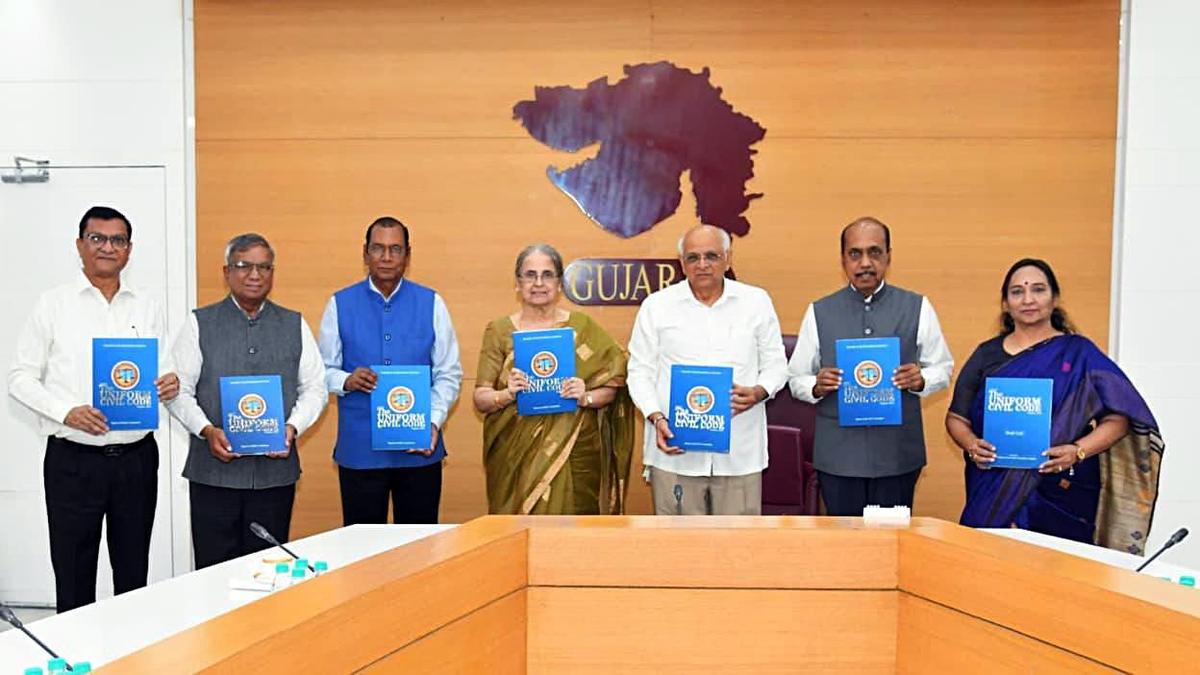
Chairman of the High-Level Committee formed for the implementation of the Uniform Civil Code (UCC) in Gujarat Justice Ranjanaben Desai meets Gujarat Chief Minister Bhupendra Patel, in Gandhinagar on March 17, 2026. Photo: X/@CMOGuj X/ANI
A five-member committee constituted by the Gujarat government to draft the Uniform Civil Code (UCC) for the state submitted its detailed and final report to Chief Minister Bhupendra Patel on Tuesday (March 17, 2026).
The State government is likely to table a draft bill on the UCC in the legislature Assembly during the ongoing Budget session.
The committee, chaired by retired Supreme Court judge Justice Ranjana Prakash Desai, made a presentation while submitting its report to the Chief Minister.
The government had formed the panel in February last year to explore various aspects related to the implementation of the UCC in the state and prepare a draft bill for the same.
During the presentation, the panel’s chairperson said it has suggested a common legal framework for all religions and communities on issues like marriage, divorce, inheritance and adoption in the report, a government release stated.
In particular, equal rights and protection of women have been given priority, it said.
Retired senior IAS officer C.L. Meena, senior advocate R.C. Kodekar, former Vice Chancellor of Veer Narmad South Gujarat University Dr Dakshesh Thakar, and social worker Gita Shroff are other members of the committee.
Sources said the State government may bring the draft bill on the UCC in the legislative assembly on March 25, the last day of the ongoing Budget session.
At the time of the formation of the committee, the CM had said the state government was committed to fulfill Prime Minister Narendra Modi’s resolve of implementing UCC across the country.
Mr. Patel had also said the five-member committee would examine various aspects related to UCC and take into account views of people from different walks of life to prepare its report.
Initially, the panel was expected to submit its report in 45 days after examining various aspects. Later, the committee was given extensions.
In August last year, the state government had said the panel held meetings with 38 Muslim organisations to understand their point of view on this proposed legislation.
The committee members travelled to all the districts of Gujarat and collected feedback from political and religious leaders, the State government had said.
People also expressed their opinions regarding UCC on a website created specifically for this reason and nearly 19 lakh suggestions were received by the panel, according to the government.
Despite the government’s assurance, people from the Muslim community had registered their protest against the proposed UCC by forming human chains in Ahmedabad and Vadodara city of Gujarat in April 2025.
In December last year, the Gujarat High Court had rejected a plea challenging the constitution of a committee by the State government to assess the need for a UCC in the state.
While rejecting the appeal filed by Surat-based petitioner Abdul Vahab Sopariwala, the HC had held that the court cannot interfere into the executive functions as laid down under Article 162 of the Constitution.
“Under Article 162 of the Constitution, the government holds such power. So, the separation of power principle has to apply. We do not have any power of judicial review in such functions which are purely in the domain of the state,” the bench said.
Published – March 17, 2026 05:07 pm IST



