


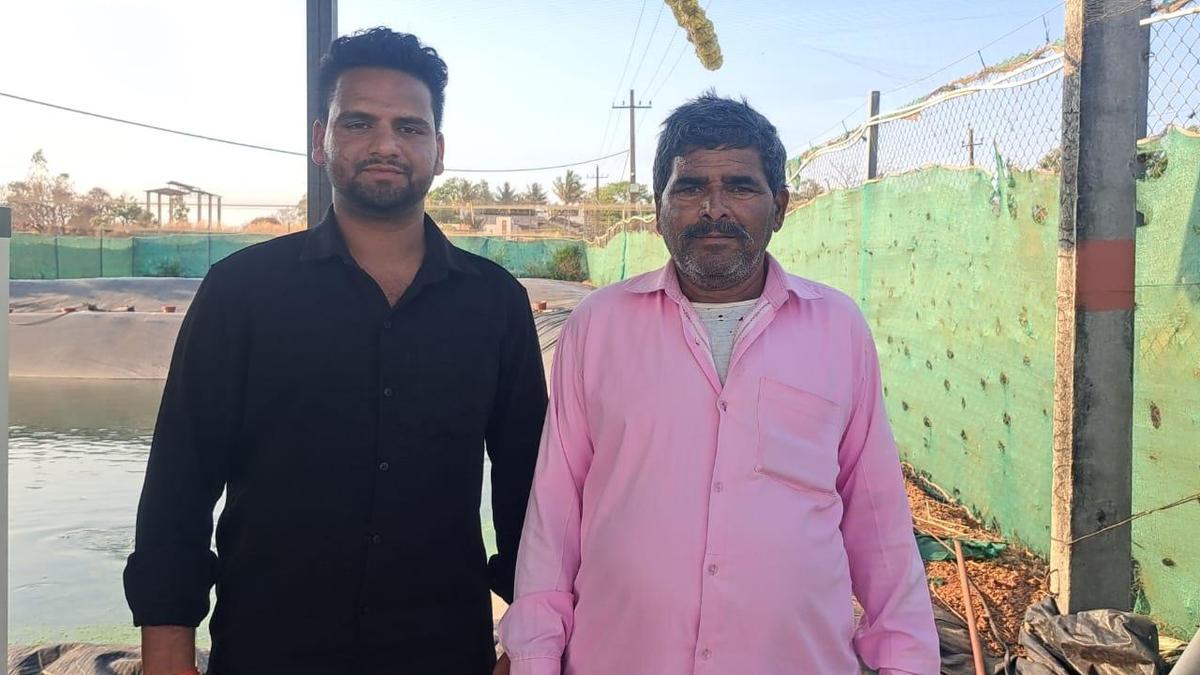
Fish farmers Raju Shivalingappa Huddar and Shivalingappa Satappa Huddar of Bodkyanatti village in Belagavi district whose success story was mentioned by Prime Minister Narendra Modi in Mann Ki Baat on Sunday.
| Photo Credit: P.K. BADIGER
Prime Minister Narendra Modi made a reference to Bengaluru-based Prayoga Institute of Education Research and a Belagavi-based fish farmer during his Mann Ki Baat address on Sunday.
Mr. Modi spoke about Prayoga’s efforts in popularising science education at the school level and its education research project Anveshana.
“I have come to know about an unique initiative related to education in Bengaluru. A team here is running Prayoga Institute of Education Research. This team has a special focus on research projects. This team is engaged in popularising science education at the school level. They have launched an experiment called Anveshana, which provides students from classes 9 to 12 the opportunity to innovate in areas like chemistry, earth science, and wellness,” Mr Modi said.
He added that this initiative provides students with a very good research experience and a platform to publish their projects.
“Friends, during our Pareeksha Pe Charcha, some students told me that they wanted to study science but were also intimidated by it. The efforts of the Prayoga team in this direction are commendable. This initiative gives students the opportunity to engage with science and demonstrate practical experience. When we try something firsthand, curiosity and interest are generated. Who knows, perhaps one of these young friends of mine might be a great scientist of the future,” he added.
Prayoga’s founder and chief mentor H.S. Nagaraja said: “At Prayoga, our focus extends to over 12,000 government school students, enabling them to learn science through hands-on, experiential methods. These are opportunities that were once inaccessible at the school level, and we have made them available. Importantly, all of this is provided free of cost, ensuring that access to quality learning and research is not limited by background.”
The institute said recently, four young students from rural Karnataka have emerged as a powerful reflection of the programme’s grassroots impact. As part of Anveshana, they undertook a research project in green chemistry focused on the synthesis of copper oxide nanoparticles using plant-based extracts.
Fish farmer
Young Raju Shivalingappa Huddar and his father Shivalingappa Satappa Huddar of Bodkyanatti village in Belagavi district have achieved significant success in inland farming. Residents of Bodkyanatti village were very happy to listen to Mr. Modi mention the success story of Mr. Raju Huddar during Mann Ki Baat.
They are growing snakehead murrel or mudfish using biofloc high density aquaculture. Mr. Raju and his father have been farming fish from 2024. They have built four farm ponds on one acre. They brought fingerlings from Vijayawada in Andhra Pradesh and have spent around ₹30 lakh as initial investment. They are earning around ₹20 lakh every 10 months. The fertility of their soil has gone up as they use the waste water from the farm pond to irrigate their four acre farm.
Published – March 30, 2026 12:29 am IST



