


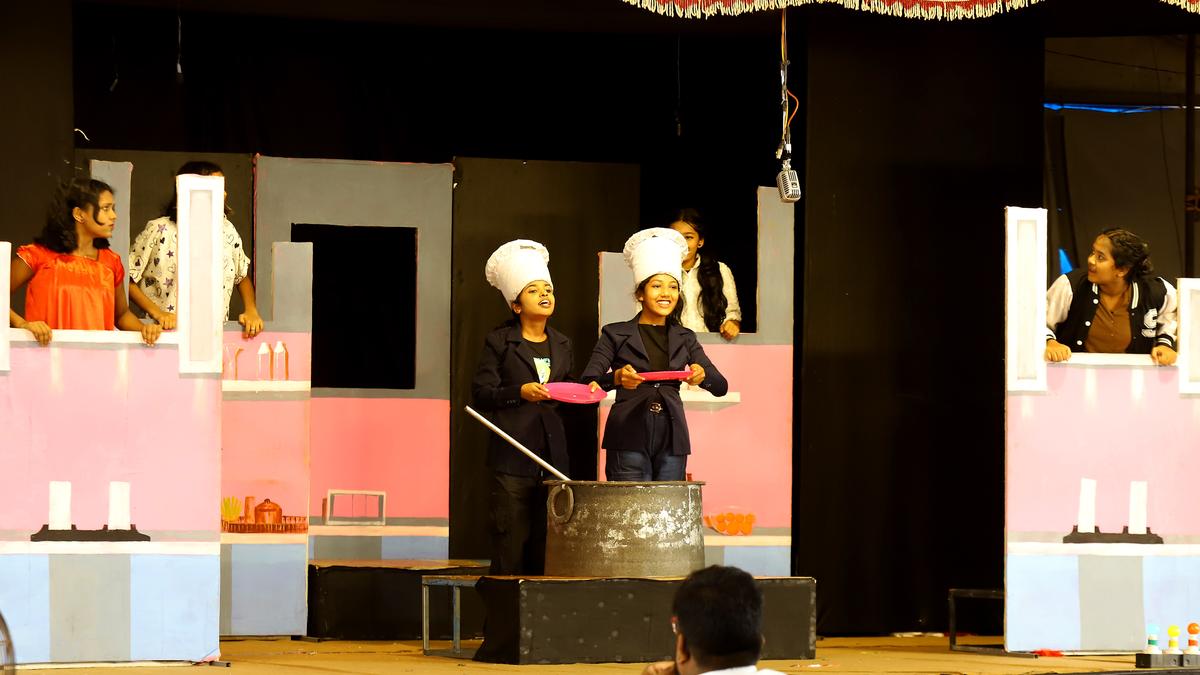
Students of Nellimoodu GHSS, Thiruvananthapuram, at the HS drama competition at the State School Arts Festival on January 15, 2026.
| Photo Credit: K.K. Najeeb
Young performers delivered big truths at the High School drama competition at the 64th State School Art Festival on Thursday (January 15, 2026). The full house at the Chaldean Syrian HSS Ground was enthralled by fine performances as well as themes drawn from both global crises and local realities. Students proved that powerful theatre did not need age or excess, but only honesty and courage.
One of the arresting productions of the day, ‘Bhasha’ by students of Memunda Higher Secondary School (Kozhikode), spoke of a language older and stronger than words: the language of love and humanity. The play captured the terror and loneliness of displacement, reminding the audience that the mind of a refugee is among the most frightened and isolated in the world.

The narrative recalls the haunting image of Aylan Kurdi — the Syrian child found dead on a seashore in a red T-shirt and blue trousers during the perilous journey to Europe. As visuals of the hunted and uprooted refugees cut through the performance, the theme froze the present moment, making the pain uncomfortably real.
Yet Bhasha found hope in simplicity. Children on a shore befriend a speechless refugee boy, protect him and build bonds without sharing a common language. In that quiet act of solidarity, the play laid bare its politics — compassion as resistance.
“Violence against children is one of the greatest challenges of our time,” said P.M. Fidel Gautham, who played a key role. “In Gaza and elsewhere, it is children who are the victims. It is their little dreams that burn first. To understand the language of love, you don’t need great linguistic scholarship. All you need is a good heart. That is what we are trying to say through this play.”

Siyara Babu added: “Children across the world are living in extreme insecurity today. War can break out anywhere, at any moment. Education, basic facilities and affection are rights every child deserves. We tried to tell the world this message in the simplest possible way.”
Director Jino Joseph underlined the central idea of the play:
“Wherever in the world, the language of love and pain is the same. It is beyond language. When children show that a smile and a little more love can bring all living beings together, the play reminds us that the world needs the language spoken by the heart.”
Balancing global conflict with local conscience was Arana, a play rooted in social prejudice and blind belief. Drawing from the Malayalam proverb ‘Arana kadichal udane maranam’, the production examined how myths turn into verdicts — and how innocence is crushed by collective fear.

In the play Arana is blamed for a death, sentenced to capital punishment and abandoned even by friends, only for society to later realise that the supposed cause of death was nothing more than superstition. The play struck hard at misinformation, mob mentality and the cost of silence.
Handled with energy, clarity and emotional precision, just about every production demanded attention. They ventured into the exploitation of marginalised groups, the hollow promises of those in power, and deep-rooted social prejudices. The plays were not just performances. They were questions, too.
Published – January 15, 2026 09:13 pm IST



