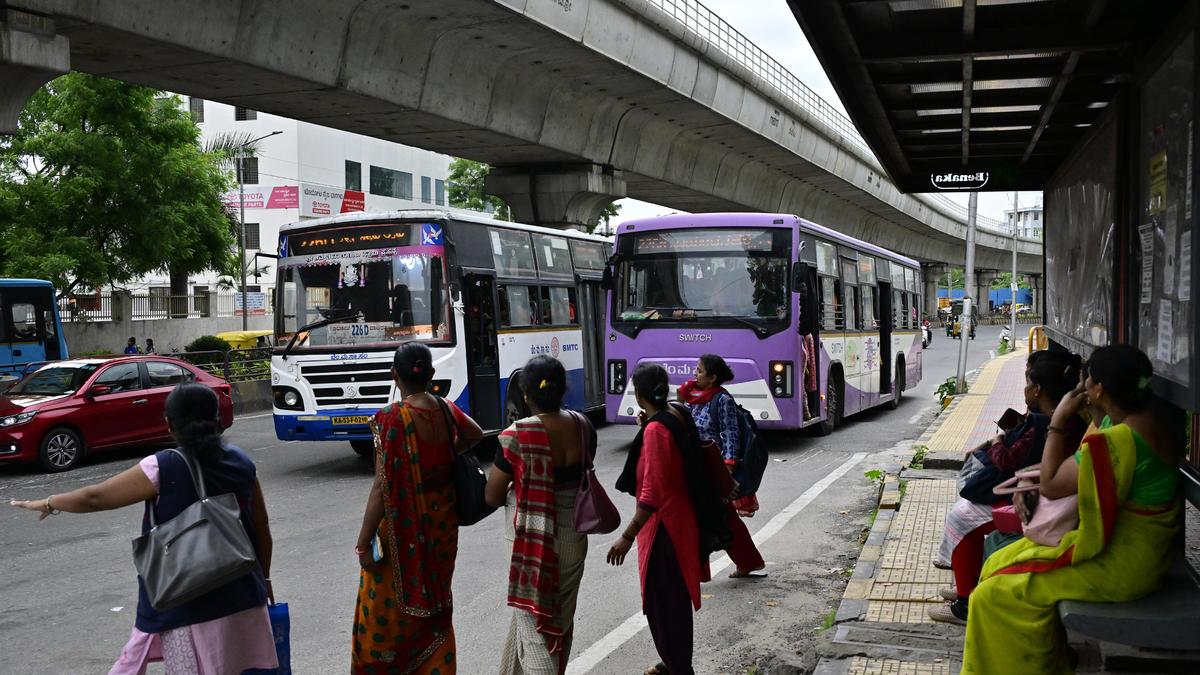
Chief Minister Siddaramaiah has asserted that spending on the guarantee schemes has been a driving force behind women’s financial autonomy and gender equality.
| Photo Credit: K. MURALI KUMAR
As the Congress government in Karnataka gears up to present the 2026–27 Budget on Friday, it faces a tightrope walk between containing revenue deficit and funding its guarantee schemes, amid speculation over a possible change of Chief Minister after the Budget Session.
Chief Minister Siddaramaiah, who also holds the Finance portfolio, presents his 17th Budget on Friday.
Women’s empowerment
Mr. Siddaramaiah, who recently became the longest-serving Chief Minister of Karnataka by surpassing the record held by D. Devaraj Urs, has asserted that spending on the guarantee schemes has been a driving force behind women’s financial autonomy and gender equality — one of the United Nations’ Sustainable Development Goals.
A whopping ₹1.2 lakh crore has been spent on these guarantees since their inception up to the end of January, 2026.
The Bharatiya Janata Party and the Janata Dal (Secular) have accused the government of using welfare schemes to divert attention from its alleged failure to develop infrastructure and irrigation projects, thereby causing a financial strain.
They have also alleged that taxes and prices of essential commodities and services have been raised multiple times to fund these guarantees and safeguard Mr. Siddaramaiah’s position. The Supreme Court recently chastised State governments for distributing “freebies” indiscriminately without distinguishing between the haves and the have-nots.
Appeal to well-off?
With annual spending exceeding ₹50,000 crore on guarantees casting a shadow over long-term fiscal sustainability, Mr. Siddaramaiah may appeal to relatively well-off families to voluntarily give up certain benefits. The government is also likely to rationalise the number of beneficiaries under the guarantee schemes to reduce non-development expenditure.
The current financial year (2025–26) is expected to witness a revenue deficit of at least ₹18,000 crore, owing to the rationalisation of the GST and a decline in property-related revenues caused by disruptions in the issuance of e-Khatas in Bengaluru.
Shortfall in revenues
The State’s tax revenue stood at ₹1,55,405.57 crore as of January, 2026, as against the target of ₹2,08,100 crore for 2025–26. Collecting the remaining ₹52,000 crore in February and March would be a daunting task, likely resulting in the downward revision of the Budget size from ₹4,09,549 crore in 2025–26 to around ₹3.9 lakh crore.
The State’s estimated total liabilities are projected to cross ₹8.14 lakh crore by March, 2026, amounting to 26.5% of the Gross State Domestic Product (GSDP) – breaching the permissible limit of 25% mandated by the Karnataka Fiscal Responsibility Act (KFRA), 2002. Only in 2022–23 and 2019–20 did the liabilities remain within the statutory limit.
More taxes likely
To mobilise additional revenue, Mr. Siddaramaiah is expected to increase taxes on fuel, liquor, and property registration.
Published – March 04, 2026 08:33 pm IST