


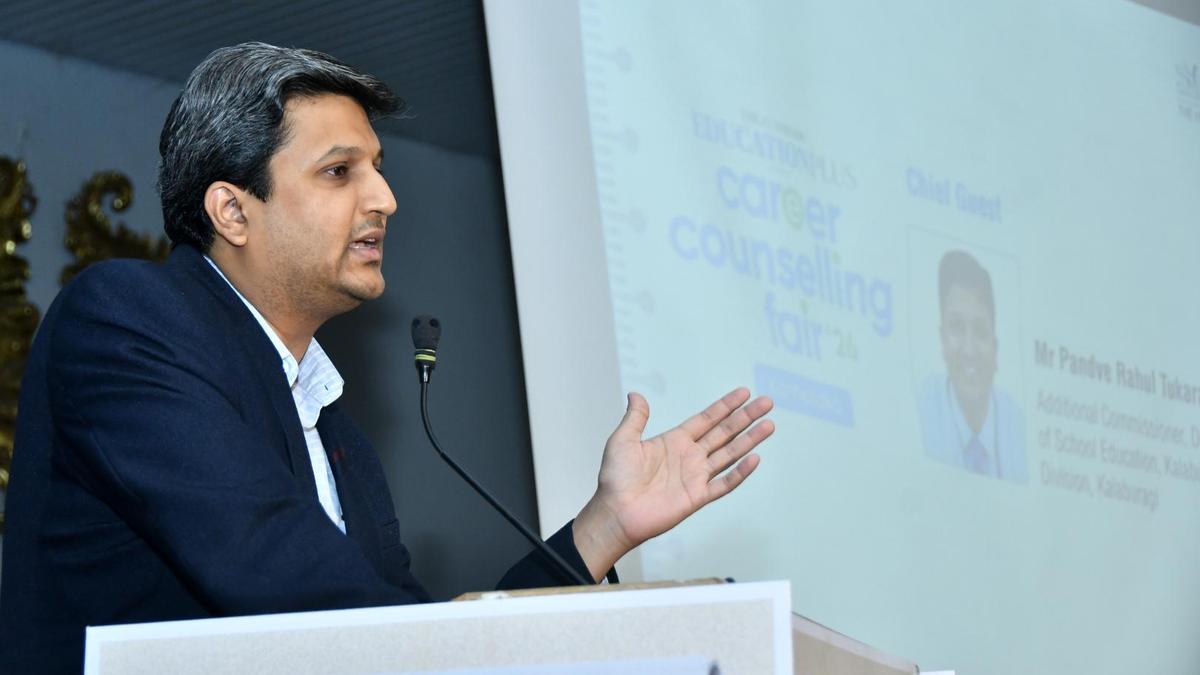
Rahul Pandve, Additional Commissioner, Department of School Education, Kalaburagi Division, addressing students during The Hindu EducationPlus Career Counselling 2026, held in Kalaburagi on Saturday (May 16).
| Photo Credit: ARUN KULKARNI
Students should choose careers based on their interests and passions rather than social pressure or parental expectations, said Rahul Pandve, Additional Commissioner, Department of School Education, Kalaburagi Division, on Saturday (May 16).
He was speaking after inaugurating The Hindu EducationPlus Career Counselling 2026 for PU students at Doddappa Appa Sabha Mantapa on the campus of Sharnbasva University in Kalaburagi.
Mr. Pandve said a person’s career eventually becomes his or her identity and influences financial condition and social responsibility throughout life. However, discussions on career choices often take a back seat in Indian society, he observed.
He said many students in India begin thinking seriously about their careers only after the age of 23 because of prolonged dependence on parents and family support systems. Unlike in Western countries where children become independent at an earlier age, Indian students often delay career planning due to a sense of security provided by their families, he added.
Mr. Pandve advised students not to become obsessed with civil services examinations at a young age. “The desire to crack UPSC and become an IAS or IPS officer should not kill your passion for something else,” he said.
He urged students to first pursue higher education in the field of their interest and excel in it before considering civil services or other career options. Students were not expected to sacrifice their passions and interests merely for the sake of UPSC examinations, he added.
Recalling trends in civil services examinations, Mr. Pandve said Arts students performed exceptionally well in the UPSC examinations during the 1990s, while in later years students from specialised fields such as engineering and medicine, particularly IIT graduates, achieved significant success.
“What this shows is that you must first build expertise in your chosen field and then think about UPSC. That will place you in a better position to choose your career,” he said.
Highlighting the impact of Artificial Intelligence on employment opportunities, Mr. Pandve said the job market is undergoing major disruption and will continue to change rapidly in the coming years.
“The era in which one could survive with a basic skill set for 30 or 40 years is gone. Today it is an era of ‘hire and fire’. If you remain relevant and updated, you will retain your job. If you become outdated, you may lose it,” he said, advising students to continuously update their knowledge and skills in order to remain relevant in a competitive economy.
Mr. Pandve also emphasised on the importance of having an alternative career plan. Sharing his personal experience, he said his parents wanted him to become a doctor, but he could not secure a medical seat after performing poorly in the entrance examination.
“At that time, I thought my career was over. But one of my teachers encouraged me to take up the CAT examination because I was good at mathematics. I did not even know about the examination till then. I was successful in that examination and secured admission to the Indian Institute of Management. I gained confidence after graduating from the premier institution, following which I prepared for the UPSC examination and became an IAS officer,” he said.
Published – May 16, 2026 07:48 pm IST




