


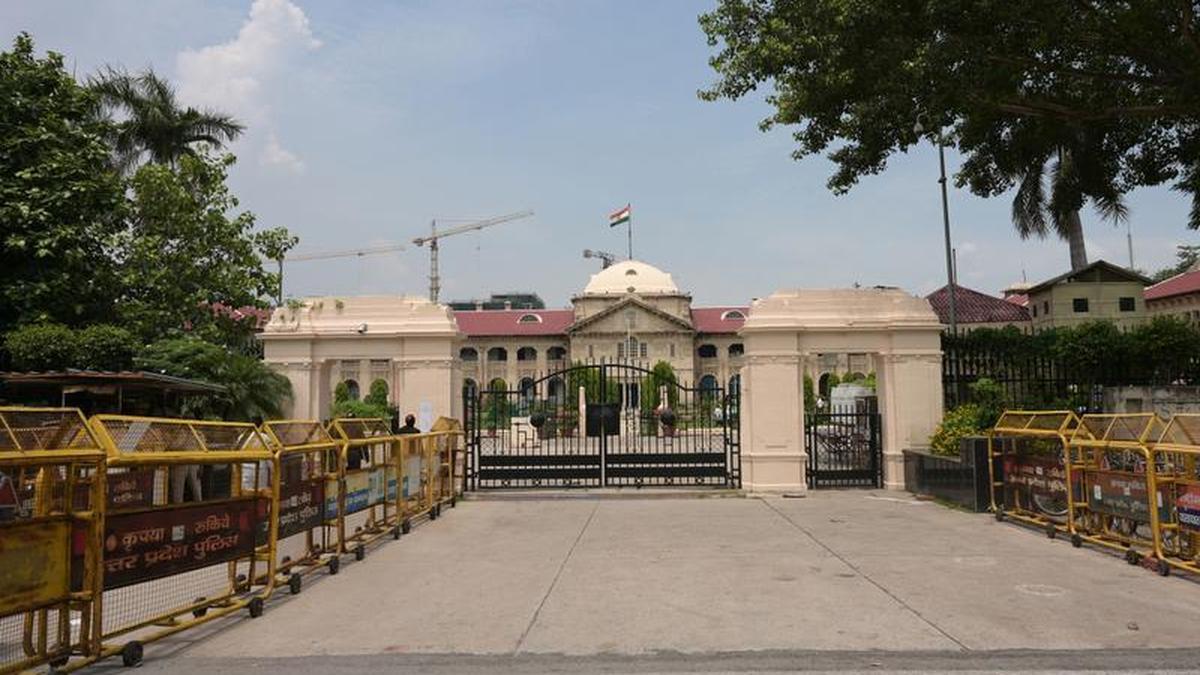
The High Court said it does not view the petitioners through the lens of religion but as adults who have chosen to live together.
| Photo Credit: File Photo
Stating that no one among the 12 interfaith live-in partners have converted from his/her religion and hence don’t attract penalty under the anti-conversion law, the Allahabad High Court on Monday allowed police protection to the couples and asked the state and private respondents to refrain from interfering with their life, liberty and privacy.
A Bench led by Justice Vivek Kumar Singh was hearing a batch of 12 writ petitions involving seven cases where Muslim women were living with Hindu men and five cases where Hindu women were living with Muslim men. The judge observed that the court did not view the petitioners through the lens of religion but as adults who had voluntarily chosen to live together peacefully for a considerable period.
“It is the bounden duty of the state as per the Constitutional obligations cast upon it to protect the life and liberty of every citizen. Right to human life is to be treated on much higher pedestal, regardless of a citizen’s religious belief. The mere fact that the petitioners are living in an interfaith relationship would not deprive them of their fundamental right as envisaged in the Constitution of India, being citizens of India. No discrimination can be made on the basis of caste, creed, sex or religion,” the court said.
The State government, however, argued that the couples had failed to comply with Sections 8 and 9 of the Uttar Pradesh Prohibition of Unlawful Conversion of Religion Act, 2021, as no application for religious conversion had been submitted since the law came into force in November 2020. The State further contended that their relationship was unlawful and therefore not entitled to protection under the Act.
Rejecting this argument, the court observed that the anti-conversion law applies only when there is an actual conversion from one religion to another through misrepresentation, force, coercion, undue influence, allurement, fraud, or through marriage or a relationship in the nature of marriage. The court noted that even interfaith marriages are not prohibited under the Act.
“Even the interfaith marriage, per se, is not prohibited under the 2021 Act. Provision has also been made under the Act, according to which, if a person wishes to change/convert his or her religion, he/she is expected to follow the procedure prescribed under Section 8 & 9. But one cannot be forced to convert his or her religion for the purposes of marriage or for living together in a live-in relationship,” the Bench said.
‘Freedom of choice’
“This court fails to understand that if the law permits two persons even of the same sex to live together peacefully, then neither any individual nor a family nor even the state can have objection to heterosexual relationship of two major individuals who out of their own free will are living together,” the Bench said.
It said to disregard the choice of a person who is of the age of majority would not only be antithetical to the freedom of choice of a grown-up individual but also be a threat to the concept of unity in diversity.
Published – February 23, 2026 11:41 pm IST



