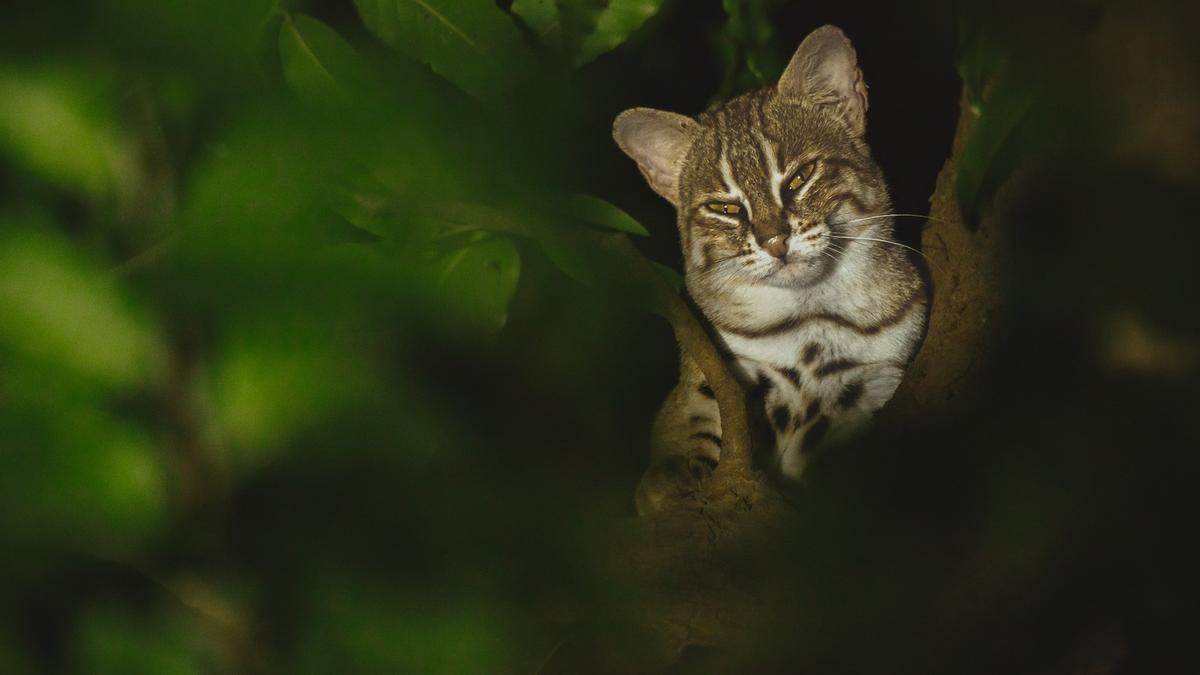
On September 16, 2023, the researchers documented a rusty-spotted cat, Prionailurus rubiginosus, perched on a False Ashoka tree, a common ornamental species found in gardens and along settlements.
| Photo Credit: Special Arrangement
For the first time in Delhi-National Capital Region (NCR) and Haryana, a rusty-spotted cat – the world’s smallest wild cat – has been photographed with its kitten in Faridabad’s Kot village, confirming breeding activity in the region. The adult and its dependent young were spotted during routine field surveys by a team of researchers monitoring mammalian diversity.
The researchers, including wildlife photographer Yatin Verma, have been conducting observations since August 2022. On September 16, 2023, they documented a rusty-spotted cat, Prionailurus rubiginosus, perched on a False Ashoka tree, a common ornamental species found in gardens and along settlements. Before this, only four to five opportunistic sightings had been reported from different parts of Delhi-NCR, with none establishing breeding.
“In July last year, when we spotted the cat with a kitten, we knew it was an important discovery. It was not documented before,” Mr. Verma said.
A research paper by the team, including Amit Kumar, Tejveer Mavi and others, documenting the discovery was recently published in Zoo’s Print, a monthly, peer-reviewed journal focused on wildlife conservation, zoo management, and animal welfare.
The discovery underscores that the Aravalis – one of India’s oldest fold mountain systems spanning Delhi, Haryana, Rajasthan, and Gujarat – are crucial for wildlife, including rusty-spotted cats, Mr. Verma said.
He added that in NCR, all records of the species are from the Aravalis, which also shelter leopards and hyenas. This finding reinforces the urgent need to protect the Aravalis as a key stronghold for threatened species, he said.
The new photographic evidence confirms active reproduction outside protected areas. “This record marks a significant extension of the species’ documented breeding range and highlights the conservation importance of fragmented green spaces within the highly urbanised NCR landscape,” the research paper noted.
Kot village lies in the northern range of the Aravalis. The rusty-spotted cat is found in India, Nepal, and Sri Lanka. In India, its range extends from Tamil Nadu to Jammu and Kashmir, including Madhya Pradesh, Gujarat, and Odisha. Though the cat prefers moist and dry deciduous forests, scrublands, grasslands, and rocky areas, it also breeds near farms and human settlements.
Ecologically elusive and low in density, the species is often under-recorded. The research paper notes that it is listed under Schedule I of the Wildlife Protection Act, 1972, and as ‘Near Threatened’ on the IUCN Red List. Habitat loss, farm expansion, and industrial growth threaten nearly 75% of its range. Recent records show populations persisting outside protected areas, including Kalesar National Park in Haryana and Takhni-Rehmapur Wildlife Sanctuary in Punjab.
The findings point to viable populations surviving beyond reserve boundaries. Researchers said there is a need to formulate management plans that cover both protected and non-protected landscapes to conserve the species.
Published – May 07, 2026 01:09 am IST