


With Kerala sharing striking similarities with Assam, not only in climate and environment but also in wildlife habitat and their conservation methods, it can draw valuable lessons from the measures adopted by the Assam Forest department in the conservation of one-horned rhinoceroses in its protected sanctuaries with the help of rescued wild elephants.
Kerala and Assam face rising man-animal conflict in villages close to wildlife sanctuaries or forest fringe areas. For instance, the Pobitora Wildlife Sanctuary at Mayong, which comes under the Morigaon and Kamrup (metro) districts of Assam and is known for holding the highest density of Greater One-Horned Rhinoceros in the country, is home to 107 rhinos and a kumki elephant force comprising 15 rescued elephants.
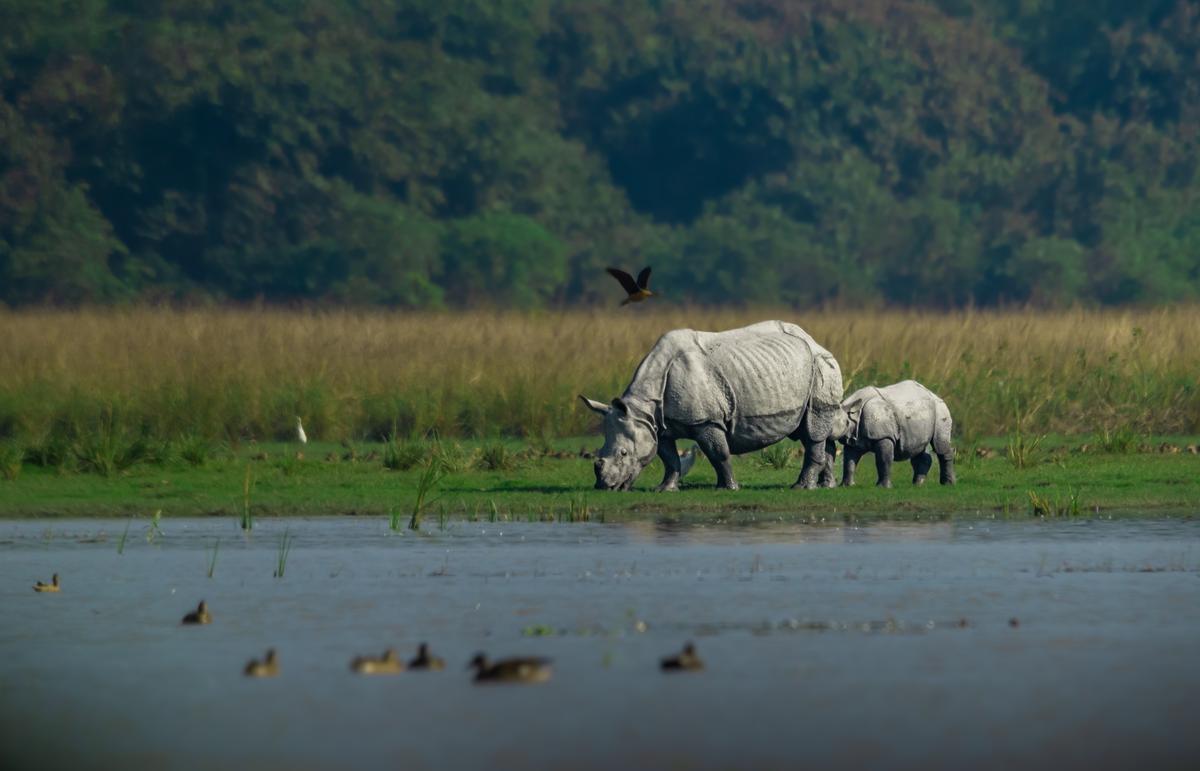
The Pobitora Wildlife Sanctuary at Mayong, which comes under the Morigaon and Kamrup (metro) districts of Assam and is known for holding the highest density of Greater One-Horned Rhinoceros in the country, is home to 107 rhinos and a kumki elephant force comprising 15 rescued elephants
| Photo Credit:
Debajit Nath
Speaking to The Hindu, Pranjal Baruah, ranger of Pobitora Wildlife Sanctuary under Guwahati WL Division, Basistha, said the sanctuary covers around 37 villages, and rhinos stray into 70% of the areas under these villages. Unlike Kerala, marauding rhinos stray into human habitations at least 20 times in a day. However, in 80% of the cases, the rhinos would return to the sanctuary on their own, and only the rest had to be chased back to the sanctuary by the Forest department.
Tough task
As rhinos exhibit comparatively lower intelligence than many other animals, especially wild elephants, which are very social, and solitary males and female rhinos with calves are ferocious in wild conditions, chasing them back is an arduous task for the villagers and forest staff. Here comes the service of trained kumki elephants, whose main role is to chase the aggressive rhinos back to the sanctuary.
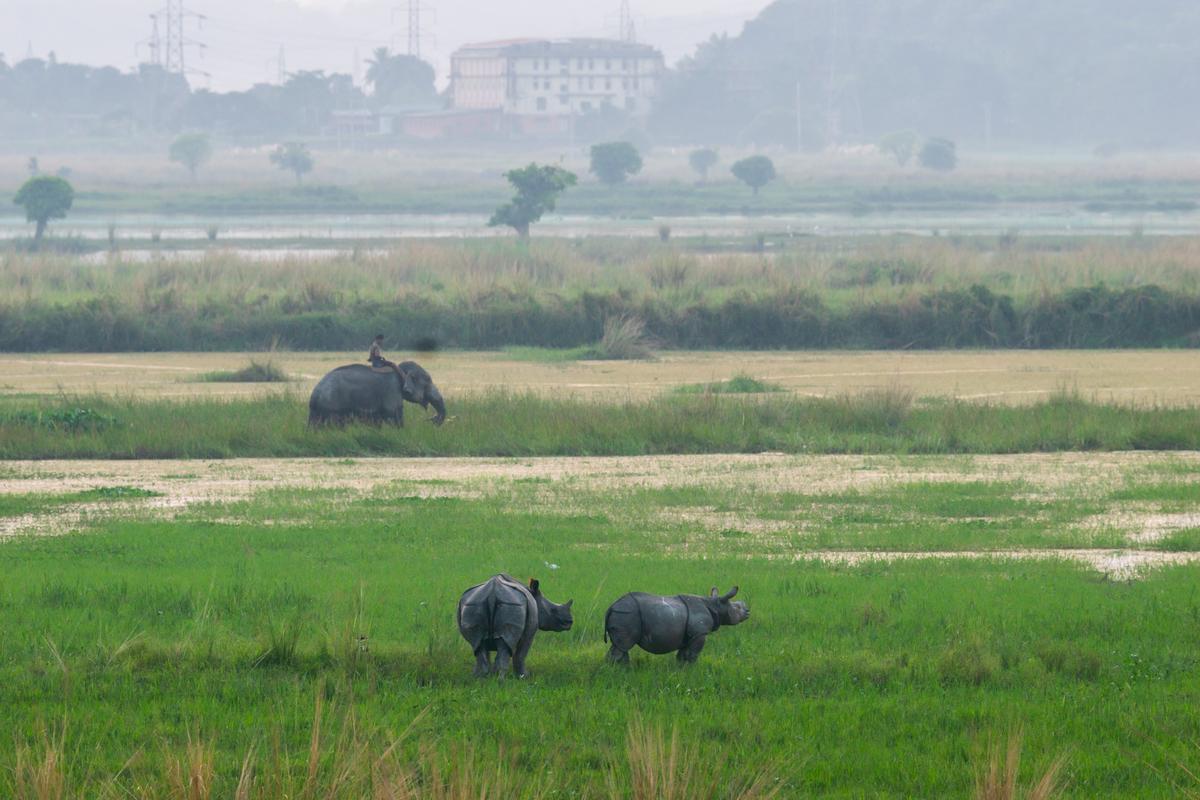
The Pobitora Wildlife Sanctuary at Mayong, which comes under the Morigaon and Kamrup (metro) districts of Assam and is known for holding the highest density of Greater One-Horned Rhinoceros in the country, is home to 107 rhinos and a kumki elephant force comprising 15 rescued elephants
| Photo Credit:
Debajit Nath
According to Prahlad Phukan, a forest guard at the sanctuary, the rhinos that stray into human habitations would destroy crops, especially matured paddy and other crops, apart from posing a threat to human lives. No villager will dare go near a rhino if it appears aggressive. “We wait until the animal comes back to its normal behaviour to safely drive it back to the sanctuary,” said Mr. Phukan.
Since rhinos are quite dangerous in wild conditions and they are territorial animals, which hardly have any herd characteristics, the officials won’t tranquilise an aggressive rhino under normal circumstances. First, they have poor eyesight and rely largely on their sense of smell and hearing to detect objects.
Therefore, tranquilisation is only the last resort when a rhino repeatedly strays into human habitations after losing its way and is unable to be driven back to the sanctuary by forest staff with kumki elephants and other methods. Moreover, the process of tranquilising a rhino has to be followed with strict riders as per the suggestions of veterinary officers. However, the method of chasing the rhinos back to the sanctuary with the help of elephants is a successful method, proven by the department here, said Mr. Baruah.
Moreover, the conservation measures jointly carried out by the Centre and the Assam government have yielded results in the sanctuary, which was declared open in 1987, with the rhino population steadily increasing to 107, as per the 2022 census in the sanctuary. It is also now home to other species, including 22 species of mammals, 375 species of birds, 27 species of reptiles, 9 species of amphibians, and 39 species of pisces (fish).
A total of 10,933 waterbirds across 56 species have been sighted in the Asian Waterbird Census in Pobitora in held in January 2025, consisting of 80% migratory and 20% resident birds, say officials.
The writer was in Assam at the invitation of Press Information Bureau
Published – November 26, 2025 12:26 pm IST



