


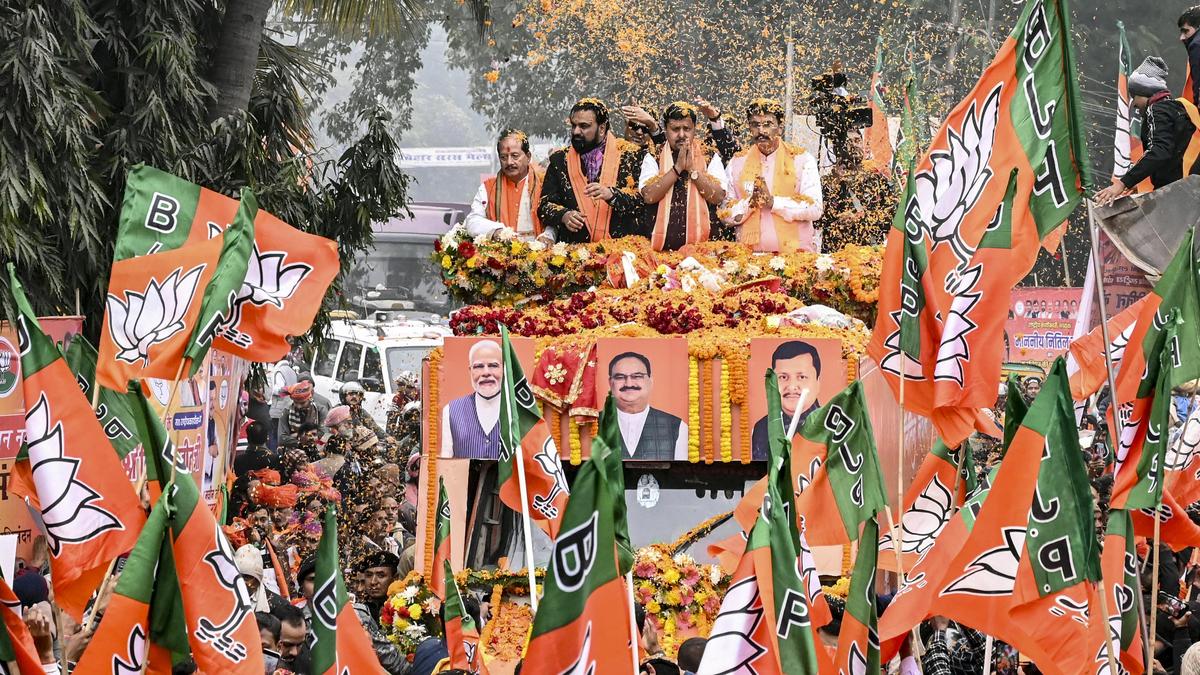
Bihar Deputy Chief Ministers Samrat Choudhary, Vijay Kumar Sinha with BJP National Working President Nitin Nabin during a roadshow, in Patna, on December 23.
| Photo Credit: PTI
The recently concluded Bihar Assembly election highlights an interesting point; that Nitish Kumar, who has taken oath as Chief Minister for the 10th time, has been able to retain the government even after almost two decades of ruling the State. This shows us a contrast between global and Indian State-level patterns of (anti) incumbency. In many major democracies across the world, voters displayed a strong sense of anti-incumbency.
The defeat of the U.S. democrats, the U.K. conservatives, Japan’s Liberal Democratic Party and South Africa’s African National Congress reflect that people in these countries were willing to use their elections as an instrument to address perceived non-performance of the government and demand an alternative in power. Senegal’s election similarly captured youth anger and a generational push against elites.
A pro-incumbency trend
Indian State assembly elections held over the last few years indicate a trend in the opposite direction. Many governments during this period got re-elected, indicating a strong pro-incumbency sentiment. The incumbent Bharatiya Janata Party government got re-elected in Bihar, Haryana, Madhya Pradesh and Maharashtra, despite spirited opposition campaigns. These governments were re-elected, beating anti-incumbency, because the ruling party anchored its election campaign pushing narratives of stability, ‘double engine ki sarkaar’ (the idea that the Centre and the State is ruled by the same party) for faster development, welfare delivery and strong leadership, which triumphed the narrative propagated by opposition parties. In Gujarat, the BJP extended its record to a seventh straight term, while Naveen Patnaik’s Biju Janata Dal (BJD) in Odisha converted personal credibility and targeted schemes into multi-term mandates. West Bengal’s 2021 mandate for Mamata Banerjee’s Trinamool Congress, against a highly contested BJP challenge, highlights pro-incumbency in a polarised contest. These examples may look like isolated cases of States being voted back to power, with the recent Bihar Assembly election being one of them, but Indian elections since 1952 had witnessed periods of pro and anti-incumbency.
India’s history
The first few years (1952-1966) were a period of pro-incumbency. Out of the 39 assembly elections held during this period, almost 85% governments got re-elected. But the periods of 1967-79 and 1980-1988 witnessed both pro and anti-incumbency trends. During 1967-79, out of 82 assembly elections, 54% of governments got re-elected, while 46% of them got voted out. Similarly, during the 1980-88 period, of 53 assembly elections, 51% governments got re-elected while 49% governments got voted out.
However, the periods of 1989-98 and 1999-03 witnessed a very strong trend of anti-incumbency. During 1989-98, of 63 assembly elections, 71% of incumbent governments were voted out. The trend continued during the 1999-03 period, where of the 31 assembly elections, 61% of incumbent governments were voted out.
The trend changed again during the 2004-15 period, which witnessed a mix of anti and pro-incumbency. In this period, nearly 55% incumbent governments got re-elected, while 45% governments were defeated. The 2016-2018 period has seen a strong anti-incumbency trend where nearly 75% of incumbent governments got defeated. This is understandable, for when the BJP-led National Democratic Alliance government came to power at the Centre in 2014, many Congress-ruled States lost in subsequent State elections.
We are again witnessing a strong pro-incumbency trend. Many BJP ruled States have witnessed governments being re-elected. It is true that many of these governments were re-elected riding on the popularity of the welfare schemes, but it also has to do with general infrastructural improvement which the State and its people have started benefitting from. While politics of welfare has helped the ruling party mobilise the votes of the poor and the lower middle classes, infrastructural developments have especially helped in mobilising the votes of the upper middle-class voters.
Examples from around the world indicate how structural pressures, economic strain, social churn, and an anti-elite sentiment are producing different electoral logics. Globally, these stresses have translated into a rotation of ruling parties losing elections, paving the way for a new party to form the government. But in India’s States, governments have got re-elected, often being mediated through strong leader-centric, welfare-driven incumbencies that can absorb discontent and bring in renewed mandates.
Sanjay Kumar is a professor and election analyst. Arindam Kabir is researcher with Lokniti-CSDS. Views are personal. It does not reflect the views of the institution.
Published – December 24, 2025 08:30 am IST



