

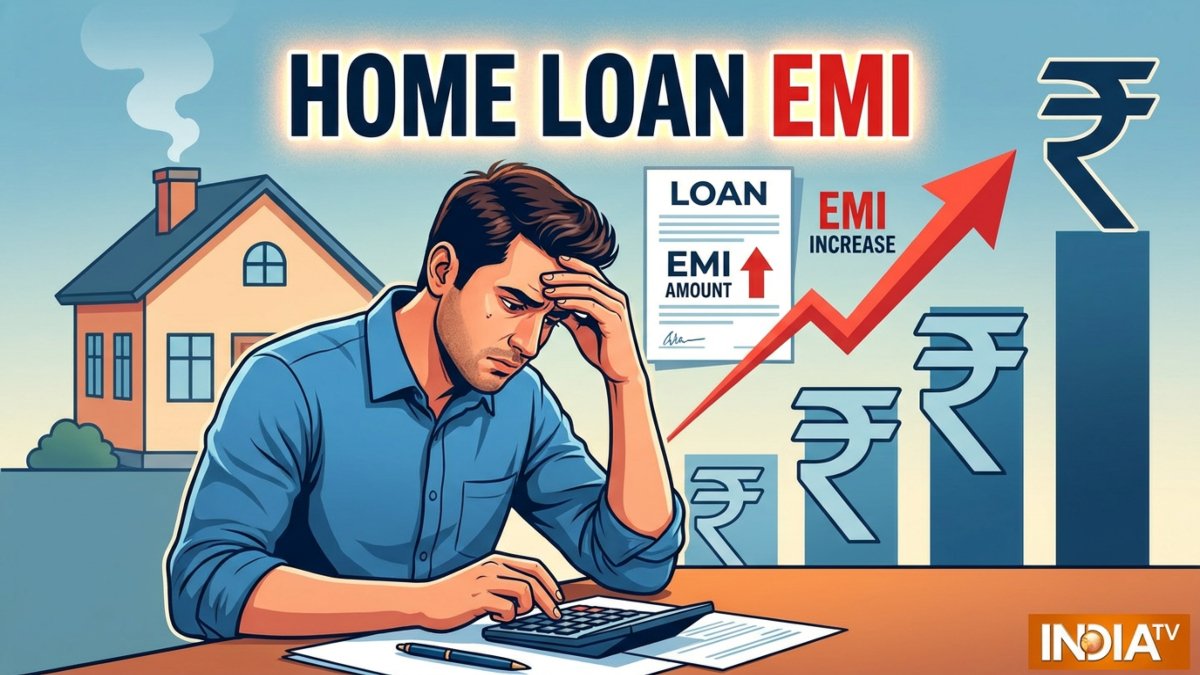

The Reserve Bank of India has raised the key benchmark policy rate by 25 basis points to 5.5 per cent. This is the first repo rate hike in over three years and comes as an effort to tame rising inflation amid the ongoing West Asia crisis. With the rate hike, home loans, vehicle loans and corporate loans will become more expensive, and EMIs for existing borrowers will also go up. The last repo rate hike was in February 2023, when the RBI raised the rate by 0.25 per cent to 6.50 per cent. It kept the rate unchanged through 2023-24 before beginning its rate-cut cycle in 2025.
How much extra you will have to pay on a home loan
To put the impact on borrowers in perspective, on a standard Rs 50 lakh home loan with a 30-year tenure, a 25 bps rate increase lifts the monthly EMI by Rs 852 at a PSU bank, from Rs 34,109 to Rs 34,961, and by RS 867 at a private bank, from Rs 35,821 to RS 36,688.
“Over the full 30-year tenure, this translates into an additional interest outgo of approximately Rs 3.07 lakh for a PSU bank and Rs 3.12 lakh for a private bank, assuming the loan runs for the full tenure,” said Atul Monga, CEO & Co-Founder, BASIC Home Loan.
Home Loan EMI Calculator
| Lender Category | Loan Amount | Loan Tenure | Current Interest Rate | Current EMI | Revised Rate (+25 bps) | Revised EMI (+25 bps) |
| PSU Bank | Rs. 50 Lakh | 30 Yrs | 7.25% | Rs. 34,109 | 7.50% | Rs. 34,961 |
| Private Bank Bank | Rs. 50 Lakh | 30 Yrs | 7.75% | Rs. 35,821 | 8.00% | Rs. 36,688 |
While Monga feels that a moderate increase in the repo rate could have a marginal impact on borrowing costs, he is of the view that it would not materially change the underlying demand for homeownership.
“Housing remains a long-term financial decision, with demand continuing to be supported by urbanisation, rising incomes and strong aspirations among first-time buyers, particularly across Tier II and Tier III markets,” he added.
May impact housing demand going forward
However, Suresh HA, Managing Director, Sanjeevini Group, is of the view that a repo rate hike at this stage, and a signal of further hikes in the future, may impact housing demand going forward and further put pressure on affordability by increasing home-loan costs, particularly for first-time and financing-dependent buyers.
“However, banks could hold on to the current rates with a view to support the festive consumption boost, as a stable interest-rate environment would help sustain buyer confidence and provide greater visibility to both homebuyers and developers,” he said.



