


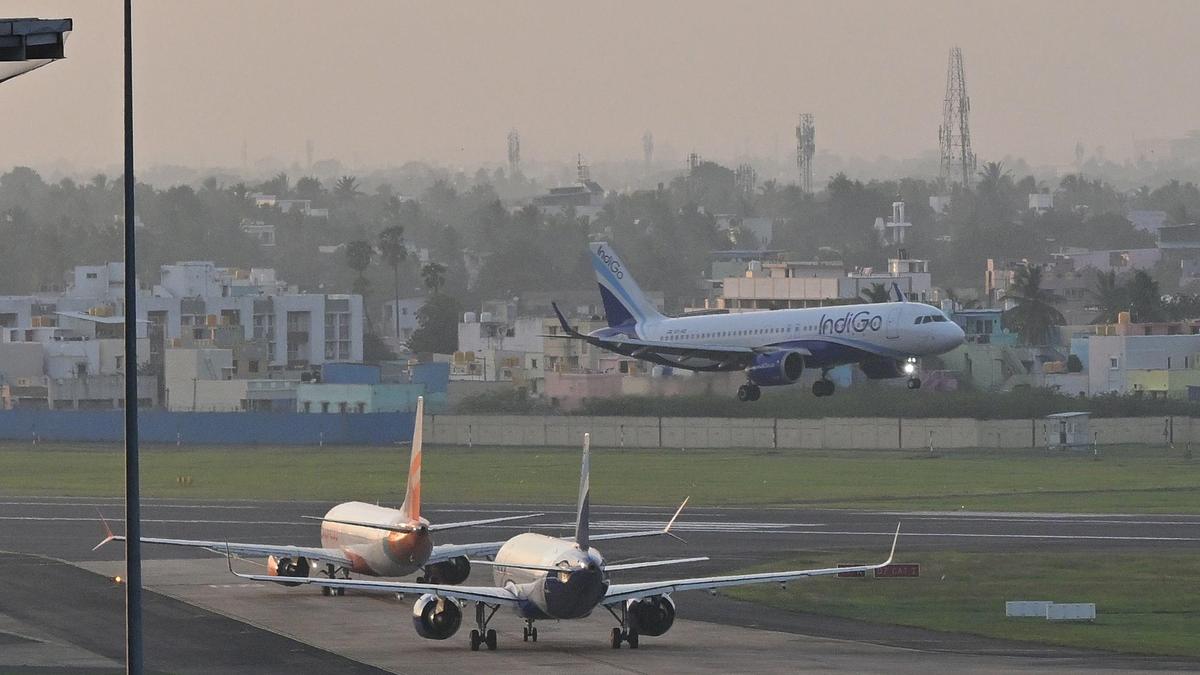
Airline executives warn that there are also other factors pushing up airfares, including rising fuel prices which are now up by 30% resulting in a 10% to 12% impact on airfare. Image for representation purposes only.
| Photo Credit: The Hindu
Air travellers may have to brace for fare hikes of up to ₹20,000 on Gulf routes as insurers slap steep war-risk premiums on airlines, forcing carriers to pay extra for cover against risks such as missile strikes, terrorism, aircraft damage, and passenger casualties amid the escalating Iran-Israel conflict.
Alongside rising crude oil prices that are inflating aviation turbine fuel (ATF) costs, mounting operational expenses could ultimately push up domestic airfares as well, industry executives said.
While insurers had initially barred airlines from operating flights into parts of the conflict-hit Gulf region, they have since eased the restrictions, given the need for repatriation and continued travel demand, according to an insurance broker who spoke to The Hindu on the condition of anonymity.
Airlines are now required to notify insurers before operating each flight into West Asia. But coverage can be withdrawn at short notice if the conflict escalates.

Range of higher premiums
The additional premium being imposed ranges from 0.075% to 0.1% of the aircraft value for every return flight undertaken by an airline, the insurance broker explained.
Airline executives said that at an estimated value of ₹700 crore for a narrow-body aircraft such as an Airbus A320, the additional war-risk premium works out to about ₹70 lakh per return flight. Spread across an aircraft with roughly 180 seats on a round trip, this translates into an additional cost of around ₹20,000 for each passenger.
For wide-body aircraft such as the Boeing 787 Dreamliner operating in the region, the war-risk premium could be more than double, at nearly ₹2 crore per return journey, pushing the per-passenger cost to roughly 1.5 or two times that of a narrow-body aircraft.

Fuel prices rise
Airline executives warn that there are also other factors pushing up airfares, including rising fuel prices which are now up by 30% resulting in a 10% to 12% impact on airfare.
Airlines are also grappling with under-utilisation of aircraft, as they are able to secure only a limited number of slots at airports in the Gulf, further pushing up operating costs. The unpredictability of slot allocations and last-minute flight approvals leave carriers with little time to sell tickets. In addition, flights on the India–Dubai leg are often operating with very few passengers, adding to the cost pressures and contributing to higher airfares.
Published – March 06, 2026 08:10 pm IST



