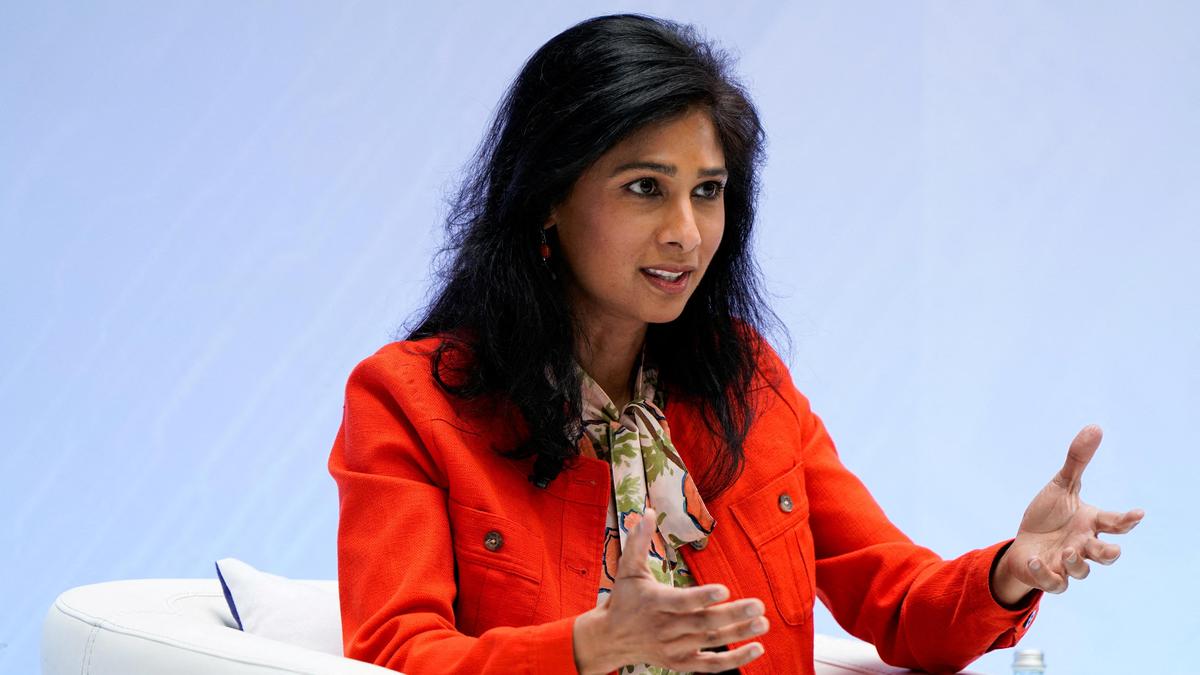
Gita Gopinath was briefing the Parliamentary Joint Committee reviewing the Constitution (One Hundred and Twenty-Ninth Amendment) Bill, 2024, which aims to introduce simultaneous elections. File
| Photo Credit: Reuters
Holding simultaneous elections for legislatures at the State and Union level would be a “positive step” from an ecinomic standpoint, according to Harvard economist Gita Gopinath, a former chief economist and first deputy managing director at the International Monetary Fund (IMF). However, she also cautioned that the implementation of the proposed reform will require careful planning to address logistical complexities, according to sources.
Ms. Gopinath was briefing the Parliamentary Joint Committee reviewing the Constitution (One Hundred and Twenty-Ninth Amendment) Bill, 2024, which aims to introduce simultaneous elections. The panel also met Sanjeev Sanyal, a member of the Economic Advisory Council to the Prime Minister, who backed simultaneous polls as well.
Also Read | Tenure of Joint Parliament Committee examining simultaneous polls extended
‘Could spur investment’
In a written submission to the panel, Ms. Gopinath reportedly said that synchronising the Lok Sabha and Assembly elections could reduce prolonged periods of policy uncertainty and spur economic activity. “International research shows that pre-election uncertainty slows investment. In India, this is compounded by the Model Code of Conduct, which freezes new projects during staggered polls,” she noted. States that hold simultaneous elections have recorded stronger post-election growth, she added.
The economist argued that fewer election cycles could also shift public spending towards long-term infrastructure projects. “Election years often see short-term fiscal measures such as subsidies and freebies, crowding out capital investment. Capital spending in India yields roughly 2.5 times the GDP returns compared to transfer programmes,” she observed. Synchronisation, she said, could help governments prioritise infrastructure, boosting growth prospects.
Uncertain cost impact
But while the synchronised elections could generate efficiency and gains, she also warned that international experience, notably Indonesia’s 2024 election, underscores the risks of fully simultaneous polls. “Indonesia faced record spending, heavy logistical pressures and unusually high staffing needs, prompting its Constitutional Court to partially separate elections from 2029,” she said. While India’s administrative strengths may mitigate some challenges, the net cost impact remains uncertain.
Ms. Gopinath recommended a systematic review of States such as Andhra Pradesh, Odisha, Arunachal Pradesh, and Sikkim, which currently hold simultaneous elections, to assess cost-effectiveness and share best practices.
Arguing on similar lines, Mr. Sanyal said that simultaneous elections would reduce expenditure, adding that is not the primary reason to bring in this reform. The staggered elections impose “significant economic costs due to repeated disruptions in policy continuity”, he pointed out. He also claimed that synchronised polls could enhance governmental stability, thereby strengthening long-term decision-making and policy planning.
Published – December 17, 2025 09:41 pm IST