


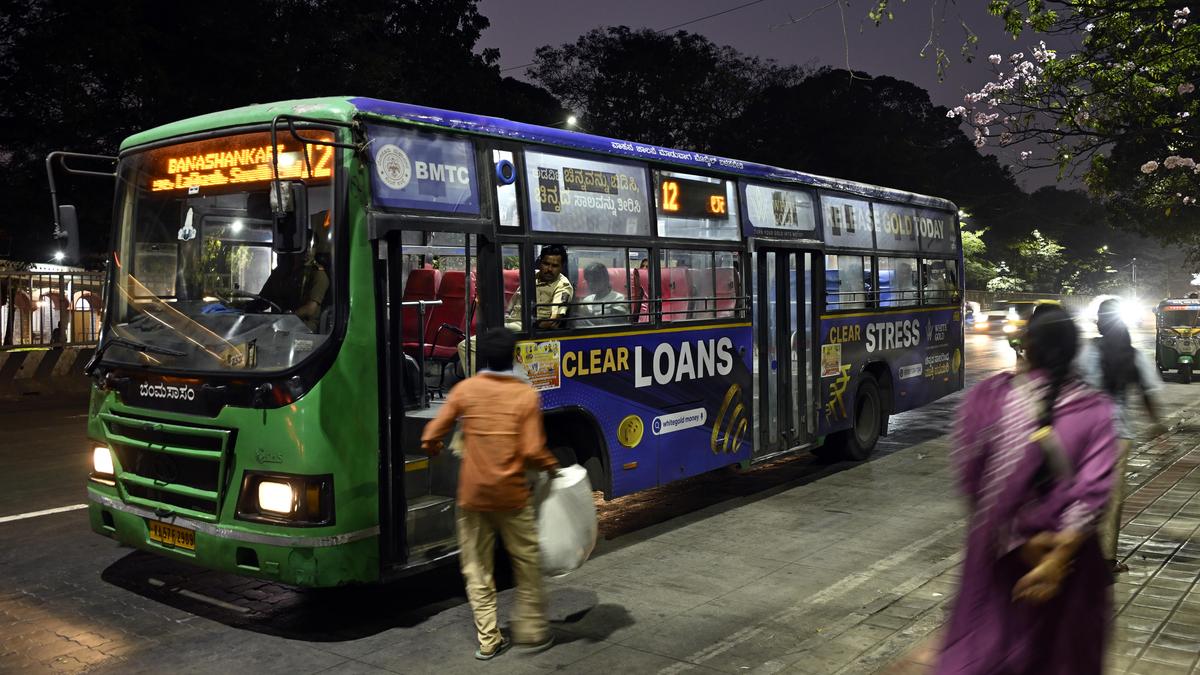
In the 2023–24 financial year, the corporation earned ₹811 crore through non-traffic revenue sources such as leasing land, renting out space at bus stations, commercial stalls, offices and parking facilities, along with advertisements on bus rears
| Photo Credit: SUDHAKARA JAIN
The Bengaluru Metropolitan Transport Corporation (BMTC) has significantly strengthened its non-fare revenue base, with advertisements displayed on its buses now generating ₹4.79 crore every month, with an annual income of ₹57.54 crore.
Officials said that they expect this figure to rise substantially, projecting total advertising revenues of nearly ₹230 crore over the next three to four years.
As part of a renewed push to augment earnings through alternative revenue streams, the BMTC, beginning January this year, introduced full-body advertisement wraps on 3,400 of its buses. This marks a clear shift from the earlier policy that permitted advertisements only on the rear panels of buses. The new initiative allows advertisers to utilise a much larger surface area, thereby increasing the corporation’s earning potential.
A senior BMTC official said that under the arrangement, one advertising firm has been awarded the contract to wrap 3,000 non air-conditioned ordinary buses, while a separate firm has been entrusted with wrapping 400 air-conditioned buses. “Each ordinary bus offers approximately 350 sq. ft of advertising space, covering sections such as the louvre glass panels and the rear portion behind the driver’s cabin. In comparison, the AC buses provide around 430 sq. ft of usable advertising area.”
Fixed monthly licence fee
According to the officials, the BMTC earns a fixed monthly licence fee of ₹12,616 per ordinary bus, while the corresponding fee for each AC bus stands at ₹25,255. The higher tariff for AC buses is attributed to their operation on premium routes, including Bengaluru International Airport services and major IT corridor routes, which attract greater advertiser interest due to higher passenger visibility.
The BMTC has emphasised that essential information on the buses remains clearly visible despite the advertisements. The official said, “The BMTC logo, vehicle registration numbers and depot identification markings have not been obstructed. Addressing environmental and maintenance concerns, we have opted for eco-friendly advertisement materials that do not leave stains or damage the bus surface when removed. In line with government norms, all advertisements mandatorily include Kannada text.”
Non-traffic revenue sources
The officials also noted that lessons had been learnt from past feedback. In 2018, stickers placed on lower glass panels of nearly 4,000 buses were removed following complaints from passengers about restricted visibility. “This time, the BMTC has ensured that transparent materials are used on glass surfaces so that visibility from inside the bus is not compromised,” he added.
At present, the BMTC operates a fleet of 6,158 buses, including 1,027 electric buses. In the 2023–24 financial year, the corporation earned ₹811 crore through non-traffic revenue sources such as leasing land, renting out space at bus stations, commercial stalls, offices and parking facilities, along with advertisements on bus rears.
The BMTC’s move follows similar non-fare revenue initiatives adopted by the Bangalore Metro Rail Corporation Limited, which has also begun wrapping metro train coaches with advertisements to boost its non fare revenue.
Published – December 26, 2025 09:51 pm IST



