


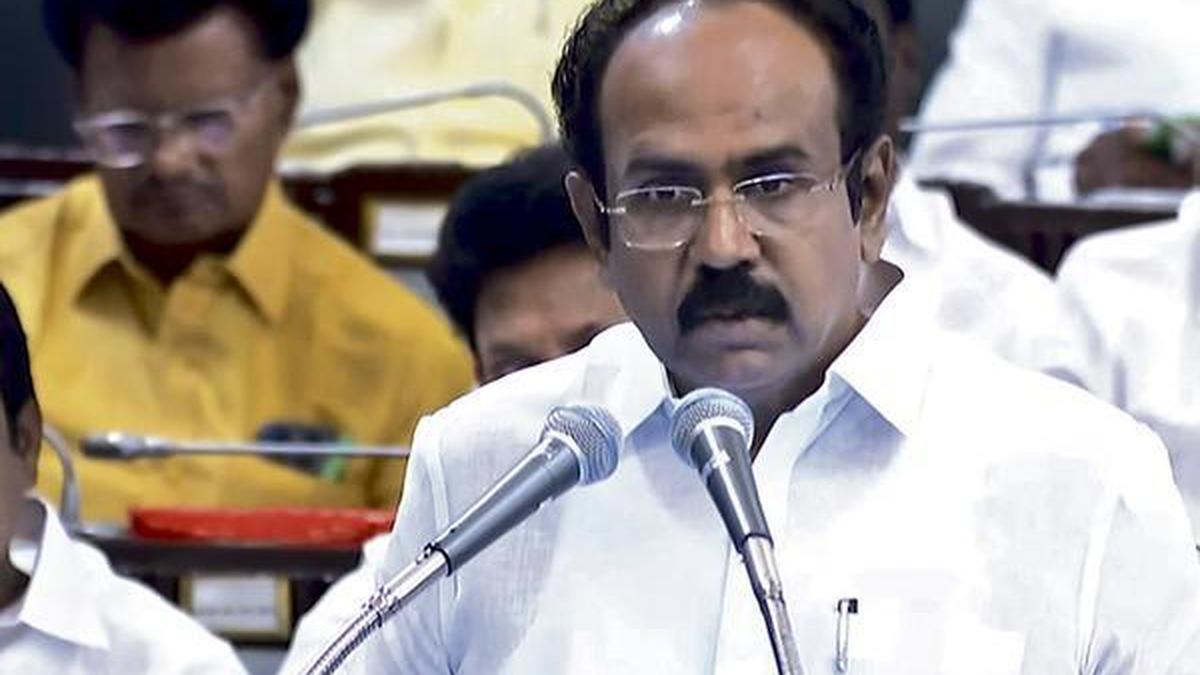
Tamil Nadu Finance Minister Thangam Thennarasu presenting the Interim Budget in the Assembly on February 17, 2026.
| Photo Credit: File photo
Estimates fixed by the Tamil Nadu government with respect to various fiscal indicators for 2026-27 have raised questions over whether they are realistic, despite the State undergoing a “severe fiscal stress” arising out of the Goods and Services Tax (GST) rate rationalisation and the Union government’s actions.
Be it gross fiscal deficit or the ratio of revenue deficit to the Gross State Domestic Product (GSDP) or interest payment to Revenue Receipts, the estimates are all favourable. This has been done even though the State, after 2022-23, has been increasingly under fiscal strain. The improvement witnessed in 2022-23 was primarily attributed to the economic recovery all over the country after being hit by the COVID-19 pandemic for two years from 2020. Since 2023-24, one of the factors that contributed to the rise in revenue expenditure was the implementation of the Kalaignar Magalir Urimai Thittam, wherein nearly 1.31 crore women are now being paid ₹1,000 every month. A few weeks ago, all the beneficiaries received ₹5,000 which included the payment for the next two months coupled with a “special summer assistance” of ₹2,000.
The two principal political parties — the AIADMK and the ruling DMK — have assured people that in the event of victory in the Assembly election, they will increase the monthly assistance to ₹2,000 per beneficiary. The AIADMK’s offer is for all ration card holders, numbering around 2.25 crore.
Though the component of expenditure on account of Kalaignar Magalir Urimai Thittam will be around ₹15,720 crore only for the next year under the existing conditions, the State government has been, even otherwise, incurring huge expenditure with regard to electricity subsidy in the form of free power to over 2.3 crore domestic consumers up to 100 units bimonthly and 23.86 lakh agricultural connections. Also, it is absorbing the entire financial loss incurred by the Tamil Nadu Power Distribution Corporation Limited (TNPDCL).
Budget speech
Finance Minister Thangam Thennarasu, in his Budget speech on February 17, 2026, had said the Union government had mandated that the State government pay an amount of about ₹16,300 crore to the TNPDCL towards loss funding, even though the State government’s calculations revealed that the the actual loss would be only ₹413 crore this year.
The balance has to be paid in the current year. Also, the Centre’s imposition of the condition for maintaining 5% of outstanding guarantees in the Guarantee Redemption Fund (GRF) had led to an unbudgeted expenditure of about ₹3,100 crore. It was no wonder that revenue expenditure for the current year went up to nearly ₹3.79 lakh crore (Revised Estimates) from around ₹3.29 lakh crore during 2024-25.
The State gets one-thirds of its total Revenue Receipts from the Centre in the form of share of Central Taxes and grants in aid. Even in this area, there has been a perceptible fall in the quantum of grants since 2023-24. During 2022-23, the State received about ₹37,730 crore as grants in aid and this shrunk to ₹16,509 crore two years later. The State expects only about ₹24,760 crore even in 2026-27.
Notwithstanding the challenges, the State government officials are hopeful of the government sticking to statutory norms with regard to fiscal management, citing their track record. Referring to the savings of about ₹5,710 crore in non-development expenditure, they are optimistic about achieving the targets, which have, of course, been set in “the absence of new external fiscal challenges”.
Tamil Nadu’s performance in select fiscal indicators in the last five years
| Indicator | 2021-22 | 2022-23 | 2023-24 | 2024-25 | 2025-26 (RE) | 2026-27 (BE) |
| Gross Fiscal Deficit (₹ in crore) | -73,739 | -81,886 | -90,430 | -1,01,344 | -1,24,007 | -1,21,949 |
| Gross Fiscal Deficit to GSDP | -3.38% | -3.46% | -3.32% | -3.24% | -3.48% | -3% |
| Revenue Surplus(+) / Deficit(-) (₹ in crore) | -46,538 | -36,215 | -45,121 | -45,840 | -69,219 | -48,696 |
| Revenue Surplus(+) / Deficit(-) to GSDP | -2.14% | -1.53% | -1.66% | -1.47% | -1.94% | -1.20% |
| Revenue Surplus(+) / Deficit(-) to RR | -22.43% | -14.86% | -17.05% | -16.21% | -22.35% | -14.13% |
| Total Liabilities (including Reserve Fund and Deposits) to GSDP | 27.36% | 28.64% | 27.85% | 27.40% | 27.41% | 27.03% |
| Total Liabilities (including Reserve Fund and Deposits) to SORR | 441.78% | 404.85% | 392.42% | 399.28% | 420.01% | 427.33% |
| SORR (₹ in crore) | 1,34,983 | 1,67,284 | 1,93,182 | 2,13,828 | 2,32,805 | 2,57,283 |
| SORR to RE | 53.14% | 59.75% | 62.37% | 65.06% | 61.44% | 65.42% |
| RR (₹ in crore) | 2,07,492 | 2,43,749 | 2,64,597 | 2,82,829 | 3,09,698 | 3,44,575 |
| Interest Payment to RR | 20.34% | 19.56% | 20.71% | 21.82% | 22.33% | 22.83% |
| Salary Expenditure to RR | 29.22% | 28.14% | 28.36% | 27.71% | 27.45% | 27.39% |
| Pension Expenditure to RR | 11.17% | 11.68% | 12.68% | 12.80% | 12.91% | 13.15% |
RE-Revised Estimate; BE-Budget Estimate; RR-Revenue Receipts; GSDP-Gross State Domestic Product; SORR-State’s Own Revenue Receipts; and RE-Revenue Expenditure
Source: Interim State Budget document for 2026-27 and the Budget Memoranda (Part-I) of the Tamil Nadu government’s Finance Department for the last five years
Published – February 21, 2026 11:18 pm IST



